Job 31
Berean Standard Bible · Tap a verse to see its cross-references.
Job’s Final Appeal
1“I have made a covenant with my eyes.
How then could I gaze with desire at a virgin?
2For what is the allotment of God from above,
or the heritage from the Almighty on high?
3Does not disaster come to the unjust
and calamity to the workers of iniquity?
4Does He not see my ways
and count my every step?
5If I have walked in falsehood
or my foot has rushed to deceit,
6let God weigh me with honest scales,
that He may know my integrity.
7If my steps have turned from the path,
if my heart has followed my eyes,
or if impurity has stuck to my hands,
8then may another eat what I have sown,
and may my crops be uprooted.
9If my heart has been enticed by my neighbor’s wife,
or I have lurked at his door,
10then may my own wife grind grain for another,
and may other men sleep with her.
11For that would be a heinous crime,
an iniquity to be judged.
12For it is a fire that burns down to Abaddon;
it would root out my entire harvest.
13If I have rejected the cause of my manservant or maidservant
when they made a complaint against me,
14what will I do when God rises to judge?
How will I answer when called to account?
15Did not He who made me in the womb also make them?
Did not the same One form us in the womb?
16If I have denied the desires of the poor
or allowed the widow’s eyes to fail,
17if I have eaten my morsel alone,
not sharing it with the fatherless—
18though from my youth I reared him as would a father,
and from my mother’s womb I guided the widow—
19if I have seen one perish for lack of clothing,
or a needy man without a cloak,
20if his heart has not blessed me
for warming him with the fleece of my sheep,
21if I have lifted up my hand against the fatherless
because I saw that I had support in the gate,
22then may my arm fall from my shoulder
and be torn from its socket.
23For calamity from God terrifies me,
and His splendor I cannot overpower.
24If I have put my trust in gold
or called pure gold my security,
25if I have rejoiced in my great wealth
because my hand had gained so much,
26if I have beheld the sun in its radiance
or the moon moving in splendor,
27so that my heart was secretly enticed
and my hand threw a kiss from my mouth,
28this would also be an iniquity to be judged,
for I would have denied God on high.
29If I have rejoiced in my enemy’s ruin,
or exulted when evil befell him—
30I have not allowed my mouth to sin
by asking for his life with a curse—
31if the men of my house have not said,
‘Who is there who has not had his fill?’—
32but no stranger had to lodge on the street,
for my door has been open to the traveler—
33if I have covered my transgressions like Adam
by hiding my guilt in my heart,
34because I greatly feared the crowds
and the contempt of the clans terrified me,
so that I kept silent
and would not go outside—
35(Oh, that I had one to hear me!
Here is my signature.
Let the Almighty answer me;
let my accuser compose an indictment.
36Surely I would carry it on my shoulder
and wear it like a crown.
37I would give account of all my steps;
I would approach Him like a prince.)—
38if my land cries out against me
and its furrows weep together,
39if I have devoured its produce without payment
or broken the spirit of its tenants,
40then let briers grow instead of wheat
and stinkweed instead of barley.”
Thus conclude the words of Job.
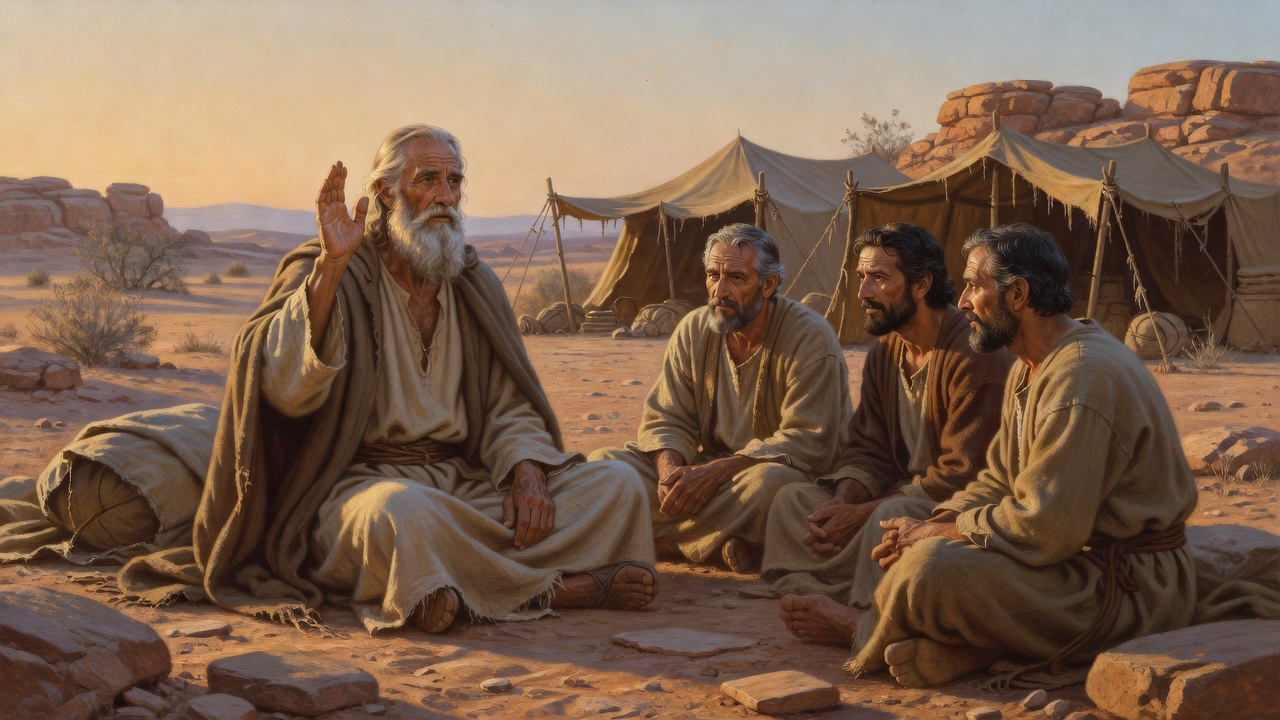
Did you know?
Job's Final Oath of Innocence
- Job frames his defense using a series of conditional self-curses, swearing that if he has committed specific moral or social sins, severe punishments should fall upon him. His ethical code extends beyond external deeds to internal motives, demanding fairness even for his servants because both master and slave were formed by the same God in the womb.Sources: the Bible text itself
- Job disavows the ancient practice of throwing a kiss with his hand toward the radiant sun or the moon in splendor. In the ancient Near East, kissing one's hand toward celestial bodies was a widespread form of astral worship, which Job regards as an offense that denies God on high.Sources: the Bible text itself
- The chapter marks the conclusion of Job's speeches with a formal legal appeal. He presents his written mark or signature, asking the Almighty to answer him and declaring that he would proudly carry any formal indictment on his shoulder like a crown, approaching God with the dignity of a prince.Sources: the Bible text itself · Job
Notes written with AI assistance from open sources (Theographic Bible Metadata, CC BY-SA 4.0; Easton’s Bible Dictionary, public domain) and reviewed before publishing.
Credits and license for this translation
Berean Standard Bible
The Holy Bible in English: Berean Standard Bible
Public Domain
Language: English
Contributor: BSB Publishing, LLC
2026-10-02
Source: http://ebible.org/engbsb/ · eBible.org