John 19
Berean Standard Bible · Tap a verse to see its cross-references.
The Soldiers Mock Jesus
1Then Pilate took Jesus and had Him flogged. 2The soldiers twisted together a crown of thorns, set it on His head, and dressed Him in a purple robe. 3And they went up to Him again and again, saying, “Hail, King of the Jews!” and slapping Him in the face.
4Once again Pilate came out and said to the Jews, “Look, I am bringing Him out to you to let you know that I find no basis for a charge against Him.” 5When Jesus came out wearing the crown of thorns and the purple robe, Pilate said to them, “Here is the man!”
6As soon as the chief priests and officers saw Him, they shouted, “Crucify Him! Crucify Him!”
“You take Him and crucify Him,” Pilate replied, “for I find no basis for a charge against Him.”
7“We have a law,” answered the Jews, “and according to that law He must die, because He declared Himself to be the Son of God.”
8When Pilate heard this statement, he was even more afraid, 9and he went back into the Praetorium. “Where are You from?” he asked.
But Jesus gave no answer.
10So Pilate said to Him, “Do You refuse to speak to me? Do You not know that I have authority to release You and authority to crucify You?”
11Jesus answered, “You would have no authority over Me if it were not given to you from above. Therefore the one who handed Me over to you is guilty of greater sin.”
12From then on, Pilate tried to release Him, but the Jews kept shouting, “If you release this man, you are no friend of Caesar. Anyone who declares himself a king is defying Caesar.”
13When Pilate heard these words, he brought Jesus out and sat on the judgment seat at a place called the Stone Pavement, which in Hebrew is Gabbatha. 14It was the day of Preparation for the Passover, about the sixth hour. And Pilate said to the Jews, “Here is your King!”
15At this, they shouted, “Away with Him! Away with Him! Crucify Him!”
“Shall I crucify your King?” Pilate asked.
“We have no king but Caesar,” replied the chief priests.
The Crucifixion
16Then Pilate handed Jesus over to be crucified, and the soldiers took Him away. 17Carrying His own cross, He went out to The Place of the Skull, which in Hebrew is called Golgotha.
18There they crucified Him, and with Him two others, one on each side, with Jesus in the middle.
19Pilate also had a notice posted on the cross. It read:
JESUS OF NAZARETH,
THE KING OF THE JEWS.
20Many of the Jews read this sign, because the place where Jesus was crucified was near the city, and it was written in Hebrew, Latin, and Greek. 21So the chief priests of the Jews said to Pilate, “Do not write, ‘The King of the Jews,’ but only that He said, ‘I am the King of the Jews.’”
22Pilate answered, “What I have written, I have written.”
23When the soldiers had crucified Jesus, they divided His garments into four parts, one for each soldier, with the tunic remaining. It was seamless, woven in one piece from top to bottom. 24So they said to one another, “Let us not tear it. Instead, let us cast lots to see who will get it.” This was to fulfill the Scripture:
“They divided My garments among them,
and cast lots for My clothing.”
So that is what the soldiers did.
25Near the cross of Jesus stood His mother and her sister, as well as Mary the wife of Clopas and Mary Magdalene. 26When Jesus saw His mother and the disciple whom He loved standing nearby, He said to His mother, “Woman, here is your son.” 27Then He said to the disciple, “Here is your mother.” So from that hour, this disciple took her into his home.
The Death of Jesus
28After this, knowing that everything had now been accomplished, and to fulfill the Scripture, Jesus said, “I am thirsty.” 29A jar of sour wine was sitting there. So they soaked a sponge in the wine, put it on a stalk of hyssop, and lifted it to His mouth. 30When Jesus had received the sour wine, He said, “It is finished.” And bowing His head, He yielded up His spirit.
Jesus’ Side Is Pierced
31It was the day of Preparation, and the next day was a High Sabbath. In order that the bodies would not remain on the cross during the Sabbath, the Jews asked Pilate to have the legs broken and the bodies removed. 32So the soldiers came and broke the legs of the first man who had been crucified with Jesus, and those of the other.
33But when they came to Jesus and saw that He was already dead, they did not break His legs. 34Instead, one of the soldiers pierced His side with a spear, and immediately blood and water flowed out. 35The one who saw it has testified to this, and his testimony is true. He knows that he is telling the truth, so that you also may believe.
36Now these things happened so that the Scripture would be fulfilled: “Not one of His bones will be broken.” 37And, as another Scripture says: “They will look on the One they have pierced.”
The Burial of Jesus
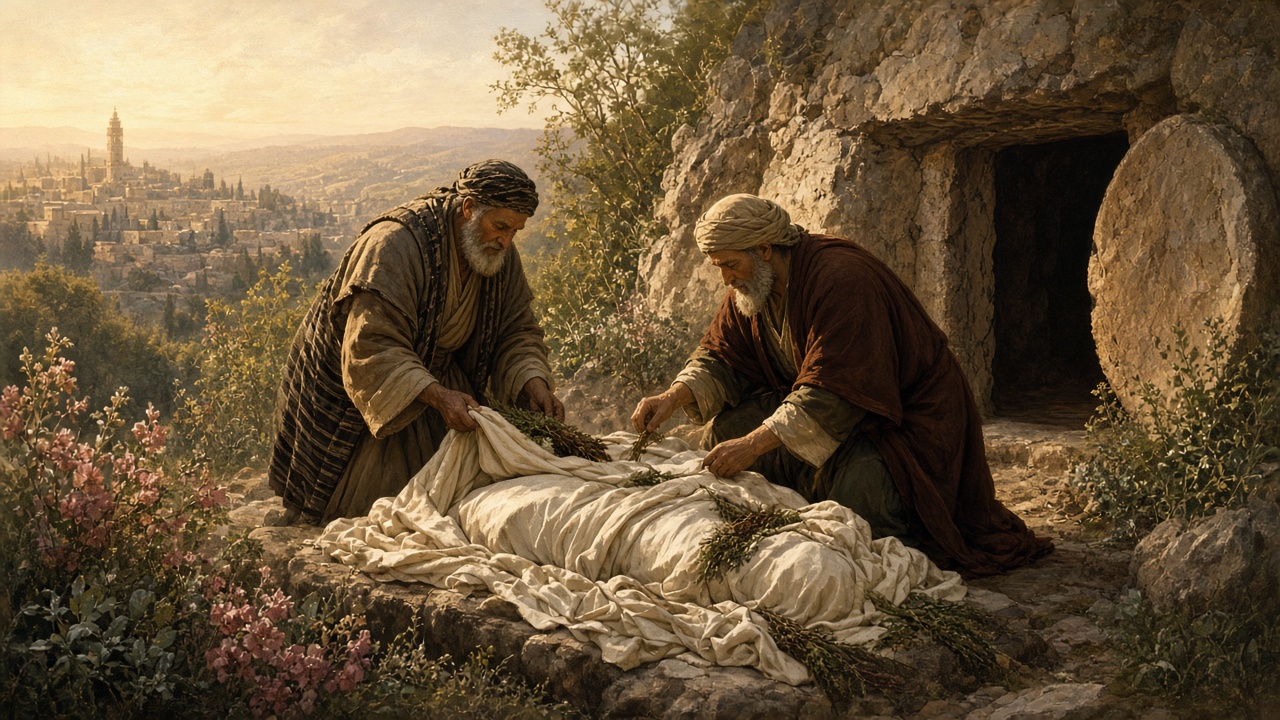
38Afterward, Joseph of Arimathea, who was a disciple of Jesus (but secretly for fear of the Jews), asked Pilate to let him remove the body of Jesus. Pilate gave him permission, so he came and removed His body. 39Nicodemus, who had previously come to Jesus at night, also brought a mixture of myrrh and aloes, about seventy-five pounds. 40So they took the body of Jesus and wrapped it in linen cloths with the spices, according to the Jewish burial custom.
41Now there was a garden in the place where Jesus was crucified, and in the garden a new tomb in which no one had yet been laid. 42And because it was the Jewish day of Preparation and the tomb was nearby, they placed Jesus there.
Did you know?
Judgment, Cross, and Burial
- Pontius Pilate, the sixth Roman procurator of Judea (A.D. 26-36), was based at Caesarea but often went up to Jerusalem. Roman governors customarily set their tribunals in the open; John places Pilate’s judgment seat at the Stone Pavement, called Gabbatha in Hebrew, a mosaic of colored stones outside the praetorium, explained as the paved temple mound where the fortress of Antonia stood.Sources: Pontius Pilate · Pavement · Gabbatha · the Bible text itself
- The evangelists interpret Golgotha as “the place of a skull”: the name transcribes Aramaic Gulgaltha, Hebrew gulgoleth, “a skull,” and is the same place called Calvary, described as a small knoll rounded like a bare skull, outside the gate and near the city. Because it was so near, many Jews could read Pilate’s notice, written in Hebrew, Latin, and Greek, naming Jesus of Nazareth—the town where Joseph and Mary had lived—as King of the Jews.Sources: Golgotha · Nazareth · the Bible text itself
- Joseph of Arimathea, a wealthy member of the Sanhedrin from Arimathea—probably Old Testament Ramah, though others identify it with Ramleh or with Rama in Benjamin—asked Pilate for the body, and Pilate agreed after the centurion confirmed that Jesus was dead. Nicodemus, a Pharisee of that council who had once visited Jesus at night, brought about seventy-five pounds of myrrh and aloes; they wrapped the body in linen with the spices, in the Jewish way, and laid it in a new garden tomb nearby, since it was the day of Preparation and the next day a high Sabbath.Sources: Joseph (of Arimathea) · Nicodemus · Arimathea · the Bible text itself
Notes written with AI assistance from open sources (Theographic Bible Metadata, CC BY-SA 4.0; Easton’s Bible Dictionary, public domain) and reviewed before publishing.
Places in this chapter
Only places identified with high confidence are shown (90% or more according to the scholarly sources compiled by OpenBible). Period map: DARE (Digital Atlas of the Roman Empire), CC BY 4.0; modern map: © OpenStreetMap contributors; places: OpenBible.info (CC BY 4.0).
Credits and license for this translation
Berean Standard Bible
The Holy Bible in English: Berean Standard Bible
Public Domain
Language: English
Contributor: BSB Publishing, LLC
2026-10-02
Source: http://ebible.org/engbsb/ · eBible.org