John 1
Berean Standard Bible · Tap a verse to see its cross-references.
About this book
About John
- Easton's Bible Dictionary (1897) attributes the Gospel of John to the apostle John and says it was probably written at Ephesus about A.D. 90. It notes that after Jerusalem was destroyed in A.D. 70, Ephesus became a center of Christian life and activity in the East, and that from about 1820 many attempts were made to deny that John was the author.Sources: Easton: John, Gospel of
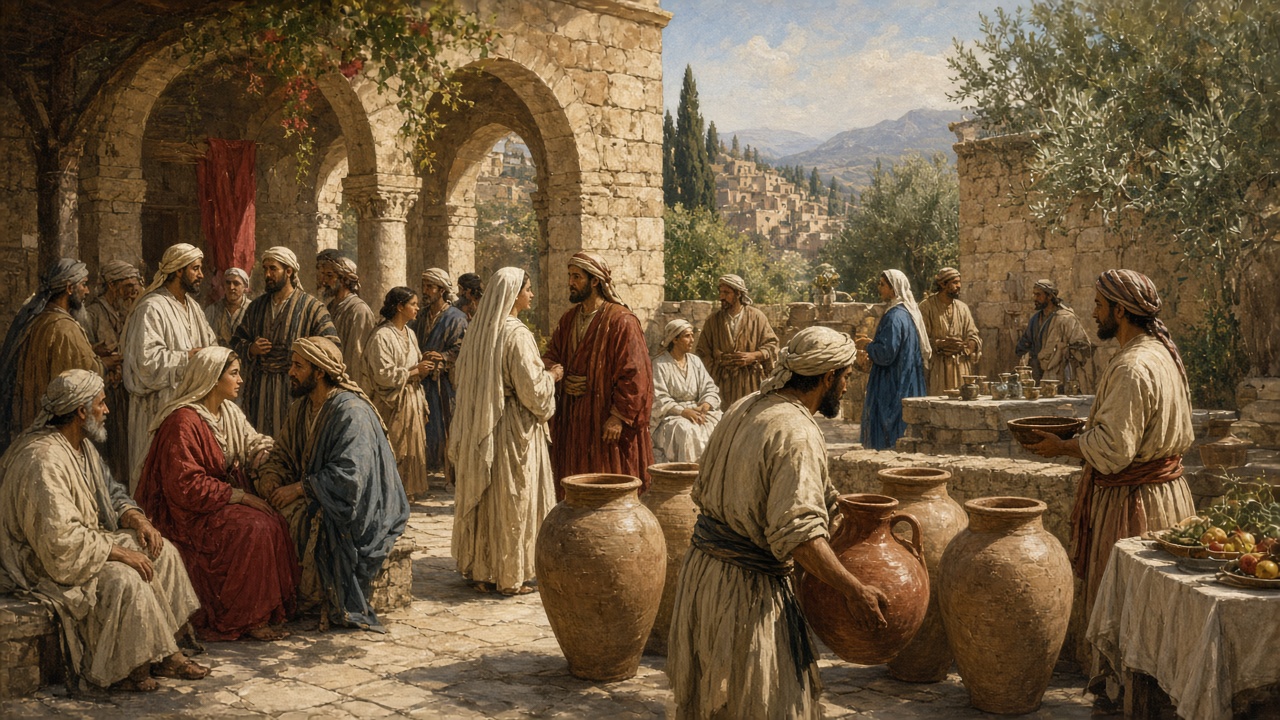
- The narrative is set in the time of Pontius Pilate, the sixth Roman procurator of Judea from A.D. 26 to 36, whose headquarters were at Caesarea and who often went up to Jerusalem. Judea was then the southernmost of Palestine's three divisions, distinguished from Galilee and Samaria, and was part of the Roman province of Syria; the Gospel also places a wedding at Cana, a town of Galilee near Capernaum.Sources: Pontius Pilate · Judea · Cana
- After the prologue (1:1-5), Easton says the historical narrative begins at verse 6 and falls into two parts. The first (1:6 through chapter 12) follows the public ministry from John the Baptist's introduction of Jesus until that ministry closes. The second (chapters 13-21) presents him in private life with his immediate followers (13-17) and then recounts his sufferings and his appearances to the disciples after the resurrection (18-21).Sources: Easton: John, Gospel of
- Easton lists four distinctive features: the relation of the Son to the Father, the relation of Christ to believers, the announcement of the Holy Spirit as the Comforter, and the prominence given to love in Christian character. The dictionary says the Gospel was addressed primarily to Christians.Sources: Easton: John, Gospel of
- Easton notes that it was once supposed John wrote to supply omissions in the first three Gospels, but says there is no evidence for this. Citing Reuss, it describes the book instead as a historical presentation of Christian faith centered on the person of Christ, picturing the world's antagonism to the truth revealed in him and the spiritual blessedness of the few who yield themselves to him as the Light of life.Sources: Easton: John, Gospel of
Notes written with AI assistance from open sources (Theographic Bible Metadata, CC BY-SA 4.0; Easton’s Bible Dictionary, public domain) and reviewed before publishing.
The Beginning
1In the beginning was the Word, and the Word was with God, and the Word was God. 2He was with God in the beginning. 3Through Him all things were made, and without Him nothing was made that has been made. 4In Him was life, and that life was the light of men. 5The Light shines in the darkness, and the darkness has not overcome it.
The Witness of John
6There came a man who was sent from God. His name was John. 7He came as a witness to testify about the Light, so that through him everyone might believe. 8He himself was not the Light, but he came to testify about the Light.
9The true Light who gives light to every man was coming into the world. 10He was in the world, and though the world was made through Him, the world did not recognize Him. 11He came to His own, and His own did not receive Him. 12But to all who did receive Him, to those who believed in His name, He gave the right to become children of God— 13children born not of blood, nor of the desire or will of man, but born of God.
The Word Became Flesh
14The Word became flesh and made His dwelling among us. We have seen His glory, the glory of the one and only Son from the Father, full of grace and truth.
15John testified concerning Him. He cried out, saying, “This is He of whom I said, ‘He who comes after me has surpassed me because He was before me.’”
16From His fullness we have all received grace upon grace. 17For the law was given through Moses; grace and truth came through Jesus Christ. 18No one has ever seen God, but the one and only Son, who is Himself God and is at the Father’s side, has made Him known.
The Mission of John the Baptist
19And this was John’s testimony when the Jews of Jerusalem sent priests and Levites to ask him, “Who are you?” 20He did not refuse to confess, but openly declared, “I am not the Christ.”
21“Then who are you?” they inquired. “Are you Elijah?”
He said, “I am not.”
“Are you the Prophet?”
He answered, “No.”
22So they said to him, “Who are you? We need an answer for those who sent us. What do you say about yourself?”
23John replied in the words of Isaiah the prophet:
“I am a voice of one calling in the wilderness,
‘Make straight the way for the Lord.’”
24Then the Pharisees who had been sent 25asked him, “Why then do you baptize, if you are not the Christ, nor Elijah, nor the Prophet?”
26“I baptize with water,” John replied, “but among you stands One you do not know. 27He is the One who comes after me, the straps of whose sandals I am not worthy to untie.”
28All this happened at Bethany beyond the Jordan, where John was baptizing.
Jesus the Lamb of God
29The next day John saw Jesus coming toward him and said, “Look, the Lamb of God, who takes away the sin of the world! 30This is He of whom I said, ‘A man who comes after me has surpassed me because He was before me.’ 31I myself did not know Him, but the reason I came baptizing with water was that He might be revealed to Israel.”
32Then John testified, “I saw the Spirit descending from heaven like a dove and resting on Him. 33I myself did not know Him, but the One who sent me to baptize with water told me, ‘The man on whom you see the Spirit descend and rest is He who will baptize with the Holy Spirit.’ 34I have seen and testified that this is the Son of God.”
The First Disciples
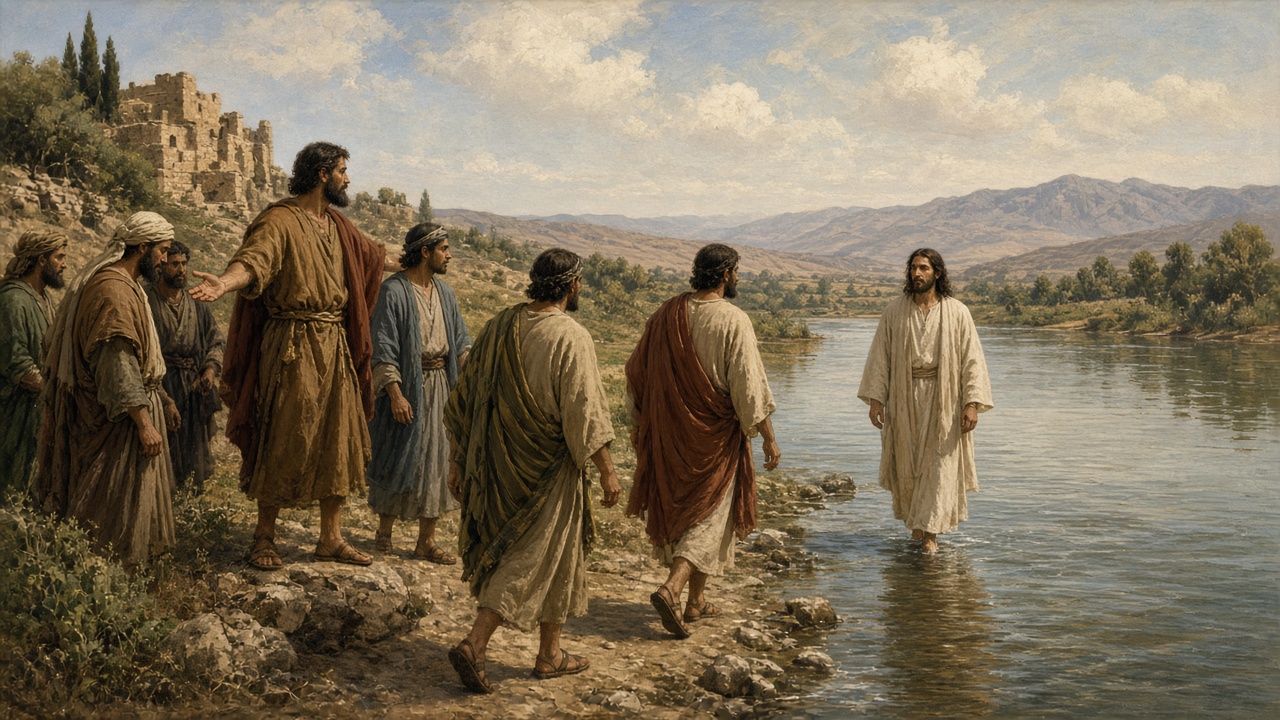
35The next day John was there again with two of his disciples. 36When he saw Jesus walking by, he said, “Look, the Lamb of God!” 37And when the two disciples heard him say this, they followed Jesus.
38Jesus turned and saw them following. “What do you want?” He asked.
They said to Him, “Rabbi” (which means Teacher), “where are You staying?”
39“Come and see,” He replied. So they went and saw where He was staying, and spent that day with Him. It was about the tenth hour.
40Andrew, Simon Peter’s brother, was one of the two who heard John’s testimony and followed Jesus. 41He first found his brother Simon and told him, “We have found the Messiah” (which is translated as Christ).
42Andrew brought him to Jesus, who looked at him and said, “You are Simon son of John. You will be called Cephas” (which is translated as Peter).
Jesus Calls Philip and Nathanael
43The next day Jesus decided to set out for Galilee. Finding Philip, He told him, “Follow Me.” 44Now Philip was from Bethsaida, the same town as Andrew and Peter.
45Philip found Nathanael and told him, “We have found the One Moses wrote about in the Law, the One the prophets foretold—Jesus of Nazareth, the son of Joseph.”
46“Can anything good come from Nazareth?” Nathanael asked.
“Come and see,” said Philip.
47When Jesus saw Nathanael approaching, He said of him, “Here is a true Israelite, in whom there is no deceit.”
48“How do You know me?” Nathanael asked.
Jesus replied, “Before Philip called you, I saw you under the fig tree.”
49“Rabbi,” Nathanael answered, “You are the Son of God! You are the King of Israel!”
50Jesus said to him, “Do you believe just because I told you I saw you under the fig tree? You will see greater things than these.” 51Then He declared, “Truly, truly, I tell you, you will all see heaven open and the angels of God ascending and descending on the Son of Man.”
Did you know?
The Word, John's Witness, and the First Disciples
- When the Jews of Jerusalem sent priests and Levites to ask who he was, John denied that he was the Christ, Elijah, or the Prophet, and described himself, in Isaiah's words, as a voice crying in the wilderness. He was of priestly descent: his father, Zacharias, belonged to the course of Abia, and his mother, Elisabeth, was of the daughters of Aaron. A note on the event dates this testimony to AD 27.Sources: the Bible text itself · John the Baptist · John's Witness
- All this happened at Bethany beyond the Jordan, where John was baptizing. A place note records that the Revised Version reads Bethany here instead of Bethabara, on the authority of the oldest manuscripts, and that the name appears to have belonged to a place east of the Jordan.Sources: the Bible text itself · Bethany
- Andrew, then a disciple of John and a man of Bethsaida, heard John call Jesus the Lamb of God, followed him, and is described as the first of Jesus' disciples; he then brought his brother Simon. Philip found Nathanael and told him about Jesus of Nazareth, and Nathanael asked whether anything good could come from there, a town not mentioned in the Old Testament. Nathanael, from Cana in Galilee, is called an Israelite in whom there is no deceit, and because this Gospel never names Bartholomew, he has been identified with him.Sources: the Bible text itself · Andrew · Nathanael · Nazareth
Notes written with AI assistance from open sources (Theographic Bible Metadata, CC BY-SA 4.0; Easton’s Bible Dictionary, public domain) and reviewed before publishing.
Places in this chapter
- Jerusalem · 31.777, 35.234 · verse 19
- Jordan · Today: Jordan River · 31.761, 35.558 · verse 28
- Galilee · 32.760, 35.527 · verse 43
- Nazareth · 32.702, 35.298 · verses 45, 46
Only places identified with high confidence are shown (90% or more according to the scholarly sources compiled by OpenBible). Period map: DARE (Digital Atlas of the Roman Empire), CC BY 4.0; modern map: © OpenStreetMap contributors; places: OpenBible.info (CC BY 4.0).
Credits and license for this translation
Berean Standard Bible
The Holy Bible in English: Berean Standard Bible
Public Domain
Language: English
Contributor: BSB Publishing, LLC
2026-10-02
Source: http://ebible.org/engbsb/ · eBible.org