Isaiah 64
Berean Standard Bible · Tap a verse to see its cross-references.
A Prayer for God’s Power
1If only You would rend the heavens and come down,
so that mountains would quake at Your presence,
2as fire kindles the brushwood
and causes the water to boil,
to make Your name known to Your enemies,
so that the nations will tremble at Your presence!
3When You did awesome works that we did not expect,
You came down, and the mountains trembled at Your presence.
4From ancient times no one has heard,
no ear has perceived,
no eye has seen any God besides You,
who acts on behalf of those who wait for Him.
5You welcome those who gladly do right,
who remember Your ways.
Surely You were angry, for we sinned.
How can we be saved if we remain in our sins?
6Each of us has become like something unclean,
and all our righteous acts are like filthy rags;
we all wither like a leaf,
and our iniquities carry us away like the wind.
7No one calls on Your name
or strives to take hold of You.
For You have hidden Your face from us
and delivered us into the hand of our iniquity.
8But now, O LORD, You are our Father;
we are the clay, and You are the potter;
we are all the work of Your hand.
9Do not be angry, O LORD, beyond measure;
do not remember our iniquity forever.
Oh, look upon us, we pray;
we are all Your people!
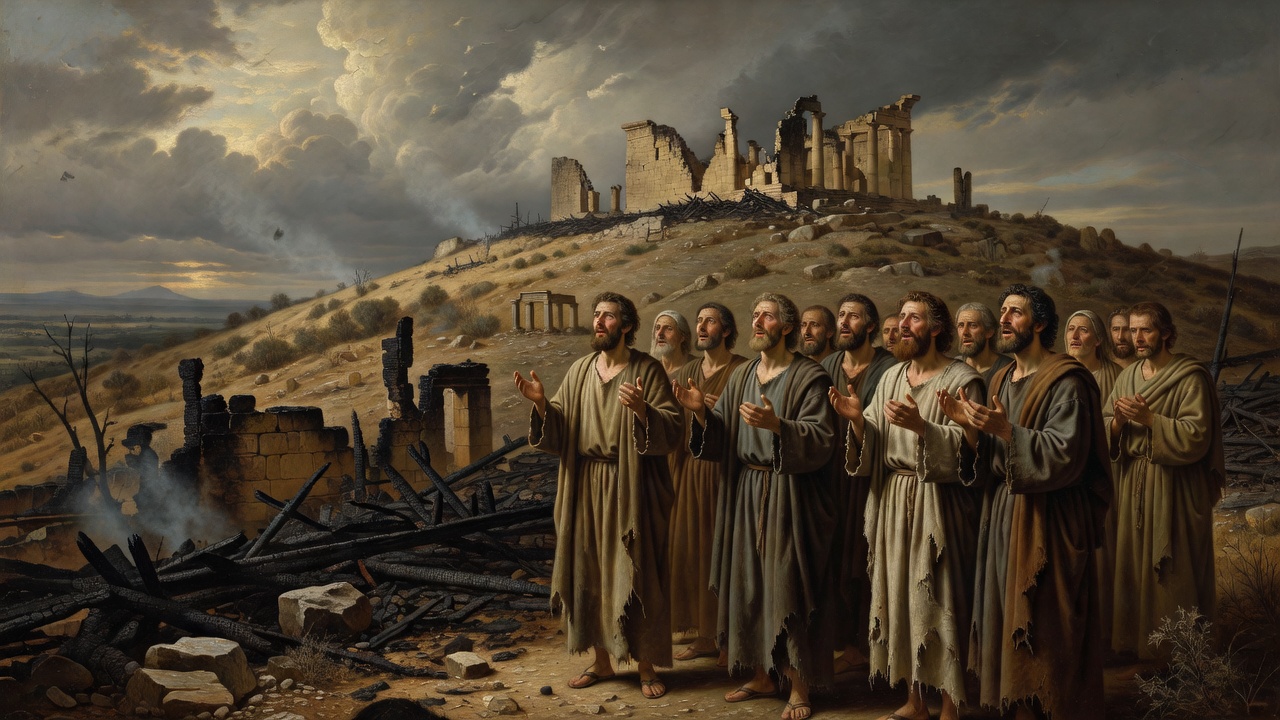
10Your holy cities have become a wilderness.
Zion has become a wasteland and Jerusalem a desolation.
11Our holy and beautiful temple,
where our fathers praised You,
has been burned with fire,
and all that was dear to us lies in ruins.
12After all this, O LORD,
will You restrain Yourself?
Will You keep silent
and afflict us beyond measure?
Did you know?
A Prayer for Mercy Amid Ruin
- The passage opens with a plea for God to rend the heavens and descend with world-shaking power, like fire that kindles brushwood. Yet it contrasts this desire for divine presence with a confession of human unworthiness, comparing people to withering leaves swept away by their own iniquities.Sources: the Bible text itself
- In Isaiah 64, the community appeals to God as a Father and craftsman, declaring, "we are the clay, and You are the potter." This imagery emphasizes human frailty and total dependence on God, pleading for divine mercy despite their acknowledged guilt.Sources: the Bible text itself
- The chapter laments the destruction of sacred spaces, describing Zion and Jerusalem as desolate wastelands. It specifically mourns the burning and ruin of the holy temple where past generations had offered praise.Sources: the Bible text itself · Zion · Jerusalem
Notes written with AI assistance from open sources (Theographic Bible Metadata, CC BY-SA 4.0; Easton’s Bible Dictionary, public domain) and reviewed before publishing.
Places in this chapter
Only places identified with high confidence are shown (90% or more according to the scholarly sources compiled by OpenBible). Period map: DARE (Digital Atlas of the Roman Empire), CC BY 4.0; modern map: © OpenStreetMap contributors; places: OpenBible.info (CC BY 4.0).
Credits and license for this translation
Berean Standard Bible
The Holy Bible in English: Berean Standard Bible
Public Domain
Language: English
Contributor: BSB Publishing, LLC
2026-10-02
Source: http://ebible.org/engbsb/ · eBible.org