Esther 8
Berean Standard Bible · Tap a verse to see its cross-references.
Esther Appeals for the Jews
1That same day King Xerxes awarded Queen Esther the estate of Haman, the enemy of the Jews. And Mordecai entered the king’s presence because Esther had revealed his relation to her. 2The king removed the signet ring he had recovered from Haman and presented it to Mordecai. And Esther appointed Mordecai over the estate of Haman.
3And once again, Esther addressed the king. She fell at his feet weeping and begged him to revoke the evil scheme of Haman the Agagite, which he had devised against the Jews.
4The king extended the gold scepter toward Esther, and she arose and stood before the king.
5“If it pleases the king,” she said, “and if I have found favor in his sight, and the matter seems proper to the king, and I am pleasing in his sight, may an order be written to revoke the letters that the scheming Haman son of Hammedatha, the Agagite, wrote to destroy the Jews in all the king’s provinces. 6For how could I bear to see the disaster that would befall my people? How could I bear to see the destruction of my kindred?”
The Decree of Xerxes
7So King Xerxes said to Esther the Queen and Mordecai the Jew, “Behold, I have given Haman’s estate to Esther, and he was hanged on the gallows because he attacked the Jews. 8Now you may write in the king’s name as you please regarding the Jews, and seal it with the royal signet ring. For a decree that is written in the name of the king and sealed with the royal signet ring cannot be revoked.”
9At once the royal scribes were summoned, and on the twenty-third day of the third month (the month of Sivan ), they recorded all of Mordecai’s orders to the Jews and to the satraps, governors, and princes of the 127 provinces from India to Cush —writing to each province in its own script, to every people in their own language, and to the Jews in their own script and language.
10Mordecai wrote in the name of King Xerxes and sealed it with the royal signet ring. He sent the documents by mounted couriers riding on swift horses bred from the royal mares.
11By these letters the king permitted the Jews in each and every city the right to assemble and defend themselves, to destroy, kill, and annihilate all the forces of any people or province hostile to them, including women and children, and to plunder their possessions. 12The single day appointed throughout all the provinces of King Xerxes was the thirteenth day of the twelfth month, the month of Adar.
13A copy of the text of the edict was to be issued in every province and published to all the people, so that the Jews would be ready on that day to avenge themselves on their enemies. 14The couriers rode out in haste on their royal horses, pressed on by the command of the king. And the edict was also issued in the citadel of Susa.
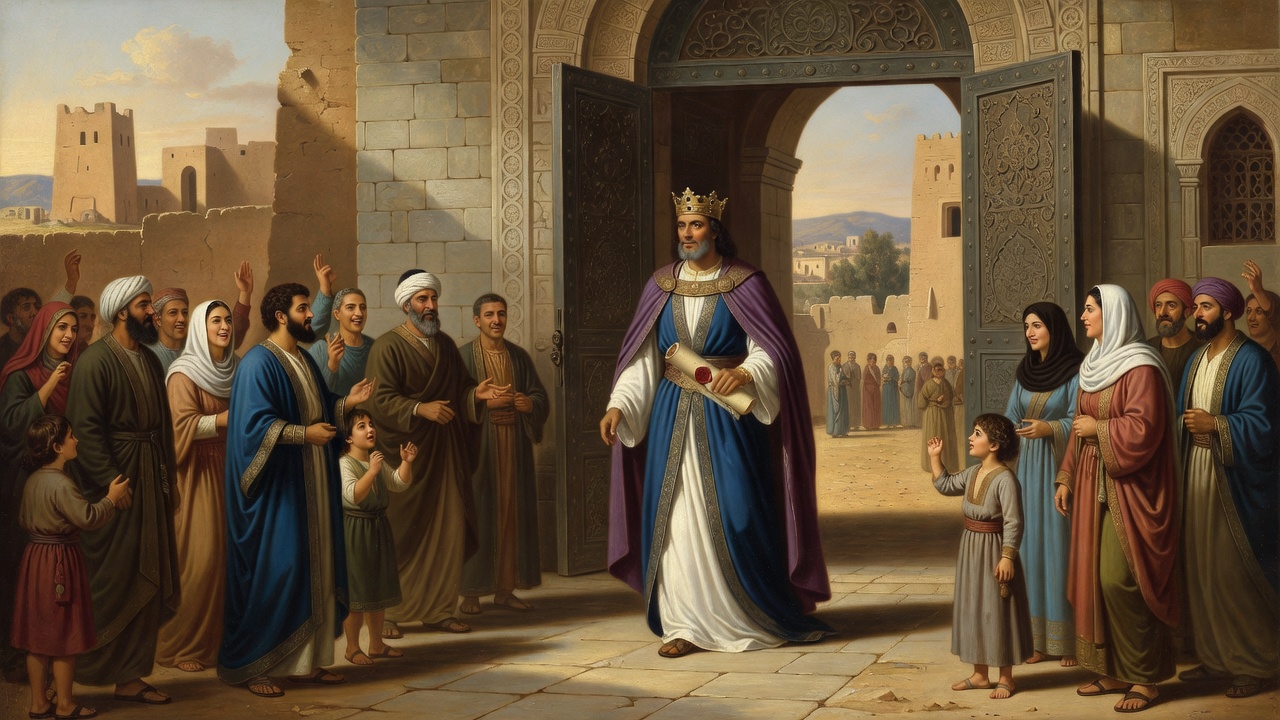
15Mordecai went out from the presence of the king in royal garments of blue and white, with a large gold crown and a purple robe of fine linen. And the city of Susa shouted and rejoiced.
16For the Jews it was a time of light and gladness, of joy and honor. 17In every province and every city, wherever the king’s edict and decree reached, there was joy and gladness among the Jews, with feasting and celebrating. And many of the people of the land themselves became Jews, because the fear of the Jews had fallen upon them.
Did you know?
A Royal Counter-Decree and Mordecai’s Elevation
- Under Persian custom, an official decree written in the king's name and sealed with the royal signet ring could not be revoked. Because Haman's previous decree could not be cancelled, King Ahasuerus permitted Esther and Mordecai to write a new decree authorizing the Jews throughout the empire to assemble and defend themselves.Sources: the Bible text itself · Ahasuerus
- The Persian Empire at this time encompassed 127 provinces, stretching from India—the region surrounding the Indus River—to Cush or Ethiopia, south of Egypt. Royal scribes translated Mordecai's decree into the distinct script and language of each province, which couriers then carried on swift royal horses.Sources: the Bible text itself · India · Ethiopia
- Mordecai was granted the king's signet ring previously held by Haman and was placed in charge of Haman's estate. When the decree was published, he emerged from the king's presence in royal garments of blue and white, wearing a large gold crown and a purple robe, prompting rejoicing throughout Susa.Sources: the Bible text itself · Mordecai · Susa
Notes written with AI assistance from open sources (Theographic Bible Metadata, CC BY-SA 4.0; Easton’s Bible Dictionary, public domain) and reviewed before publishing.
Places in this chapter
- Ethiopia · 16.935, 33.751 · verse 9
- India · 23.994, 67.431 · verse 9
- Susa · Today: Shush · 32.189, 48.258 · verses 14, 15
Only places identified with high confidence are shown (90% or more according to the scholarly sources compiled by OpenBible). Period map: DARE (Digital Atlas of the Roman Empire), CC BY 4.0; modern map: © OpenStreetMap contributors; places: OpenBible.info (CC BY 4.0).
Credits and license for this translation
Berean Standard Bible
The Holy Bible in English: Berean Standard Bible
Public Domain
Language: English
Contributor: BSB Publishing, LLC
2026-10-02
Source: http://ebible.org/engbsb/ · eBible.org