Deuteronomy 20
Berean Standard Bible · Tap a verse to see its cross-references.
Laws of Warfare
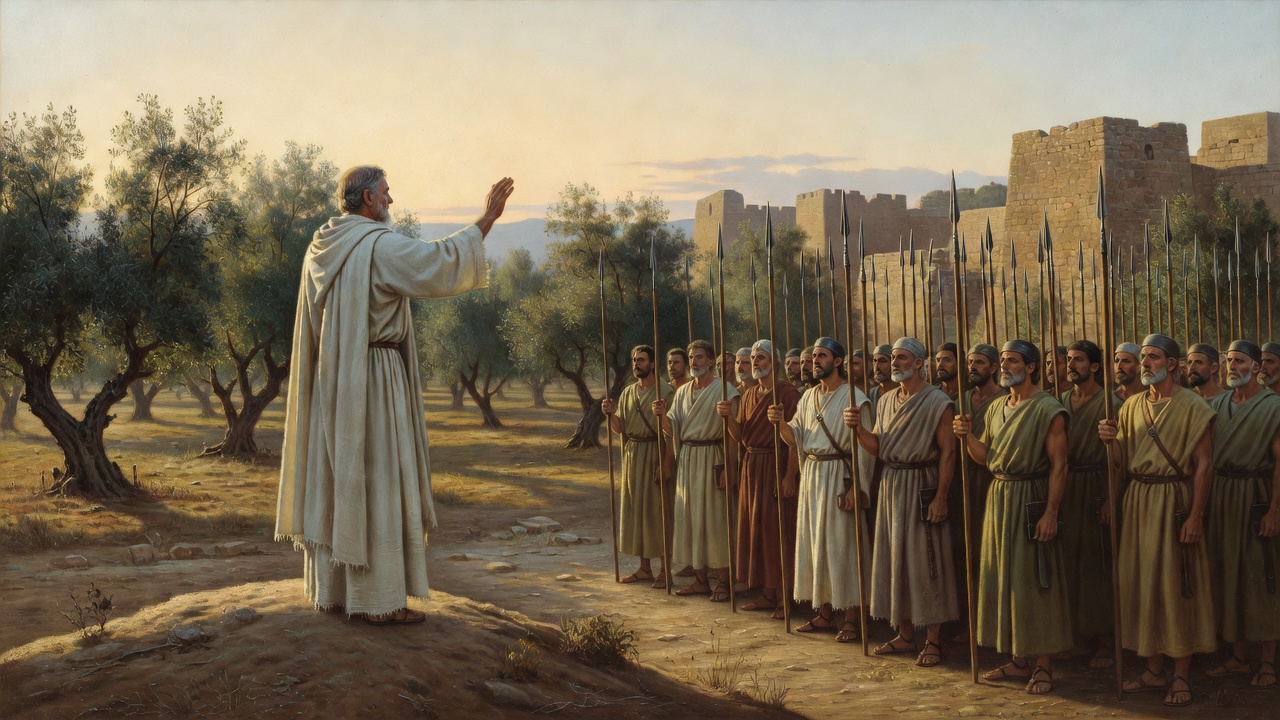
1When you go out to war against your enemies and see horses, chariots, and an army larger than yours, do not be afraid of them; for the LORD your God, who brought you out of the land of Egypt, is with you. 2When you are about to go into battle, the priest is to come forward and address the army, 3saying to them, “Hear, O Israel, today you are going into battle with your enemies. Do not be fainthearted or afraid; do not be alarmed or terrified because of them. 4For the LORD your God goes with you to fight for you against your enemies, to give you the victory.”
5Furthermore, the officers are to address the army, saying, “Has any man built a new house and not dedicated it? Let him return home, or he may die in battle and another man dedicate it. 6Has any man planted a vineyard and not begun to enjoy its fruit? Let him return home, or he may die in battle and another man enjoy its fruit. 7Has any man become pledged to a woman and not married her? Let him return home, or he may die in battle and another man marry her.”
8Then the officers shall speak further to the army, saying, “Is any man afraid or fainthearted? Let him return home, so that the hearts of his brothers will not melt like his own.”
9When the officers have finished addressing the army, they are to appoint commanders to lead it.
10When you approach a city to fight against it, you are to make an offer of peace. 11If they accept your offer of peace and open their gates, all the people there will become forced laborers to serve you.
12But if they refuse to make peace with you and wage war against you, lay siege to that city. 13When the LORD your God has delivered it into your hand, you must put every male to the sword. 14But the women, children, livestock, and whatever else is in the city—all its spoil—you may take as plunder, and you shall use the spoil of your enemies that the LORD your God gives you. 15This is how you are to treat all the cities that are far away from you and do not belong to the nations nearby.
16However, in the cities of the nations that the LORD your God is giving you as an inheritance, you must not leave alive anything that breathes. 17For you must devote them to complete destruction —the Hittites, Amorites, Canaanites, Perizzites, Hivites, and Jebusites—as the LORD your God has commanded you, 18so that they cannot teach you to do all the detestable things they do for their gods, and so cause you to sin against the LORD your God.
19When you lay siege to a city for an extended time while fighting against it to capture it, you must not destroy its trees by putting an axe to them, because you can eat their fruit. You must not cut them down. Are the trees of the field human, that you should besiege them? 20But you may destroy the trees that you know do not produce fruit. Use them to build siege works against the city that is waging war against you, until it falls.
Did you know?
Laws Concerning Warfare
- Before entering combat, Israelite officers announced specific exemptions from military duty, releasing men who had built a house not yet dedicated, planted a vineyard not yet harvested, become engaged to be married, or felt afraid.Sources: the Bible text itself
- The law established different warfare policies for distant cities compared to cities within the Promised Land; distant cities were first offered terms of peace, whereas the inhabitants of nearby nations were marked for complete destruction to avoid idolatry.Sources: the Bible text itself
- During long sieges, Israelite forces were forbidden from cutting down fruit-bearing trees to construct siege works, limiting their timber harvesting only to trees known not to produce food.Sources: the Bible text itself
Notes written with AI assistance from open sources (Theographic Bible Metadata, CC BY-SA 4.0; Easton’s Bible Dictionary, public domain) and reviewed before publishing.
Places in this chapter
- Egypt · 30.129, 31.308 · verse 1
Only places identified with high confidence are shown (90% or more according to the scholarly sources compiled by OpenBible). Period map: DARE (Digital Atlas of the Roman Empire), CC BY 4.0; modern map: © OpenStreetMap contributors; places: OpenBible.info (CC BY 4.0).
Credits and license for this translation
Berean Standard Bible
The Holy Bible in English: Berean Standard Bible
Public Domain
Language: English
Contributor: BSB Publishing, LLC
2026-10-02
Source: http://ebible.org/engbsb/ · eBible.org