Acts 23
Berean Standard Bible · Tap a verse to see its cross-references.
Paul before the Sanhedrin
1Paul looked directly at the Sanhedrin and said, “Brothers, I have conducted myself before God in all good conscience to this day.”
2At this, the high priest Ananias ordered those standing near Paul to strike him on the mouth.
3Then Paul said to him, “God will strike you, you whitewashed wall! You sit here to judge me according to the law, yet you yourself violate the law by commanding that I be struck.”
4But those standing nearby said, “How dare you insult the high priest of God!”
5“Brothers,” Paul replied, “I was not aware that he was the high priest, for it is written: ‘Do not speak evil about the ruler of your people.’”
6Then Paul, knowing that some of them were Sadducees and others Pharisees, called out in the Sanhedrin, “Brothers, I am a Pharisee, the son of a Pharisee. It is because of my hope in the resurrection of the dead that I am on trial.”
7As soon as he had said this, a dispute broke out between the Pharisees and Sadducees, and the assembly was divided. 8For the Sadducees say that there is neither a resurrection, nor angels, nor spirits, but the Pharisees acknowledge them all.
9A great clamor arose, and some scribes from the party of the Pharisees got up and contended sharply, “We find nothing wrong with this man. What if a spirit or an angel has spoken to him?” 10The dispute grew so violent that the commander was afraid they would tear Paul to pieces. He ordered the soldiers to go down and remove him by force and bring him into the barracks.
11The following night the Lord stood near Paul and said, “Take courage! As you have testified about Me in Jerusalem, so also you must testify in Rome.”
The Plot to Kill Paul
12When daylight came, the Jews formed a conspiracy and bound themselves with an oath not to eat or drink until they had killed Paul. 13More than forty of them were involved in this plot. 14They went to the chief priests and elders and said, “We have bound ourselves with a solemn oath not to eat anything until we have killed Paul. 15Now then, you and the Sanhedrin petition the commander to bring him down to you on the pretext of examining his case more carefully. We are ready to kill him on the way.”
16But when the son of Paul’s sister heard about the plot, he went into the barracks and told Paul. 17Then Paul called one of the centurions and said, “Take this young man to the commander; he has something to tell him.”
18So the centurion took him to the commander and said, “Paul the prisoner sent and asked me to bring this young man to you. He has something to tell you.”
19The commander took the young man by the hand, drew him aside, and asked, “What do you need to tell me?”
20He answered, “The Jews have agreed to ask you to bring Paul to the Sanhedrin tomorrow on the pretext of acquiring more information about him. 21Do not let them persuade you, because more than forty men are waiting to ambush him. They have bound themselves with an oath not to eat or drink until they have killed him; they are ready now, awaiting your consent.”
22So the commander dismissed the young man and instructed him, “Do not tell anyone that you have reported this to me.”
Paul Sent to Felix
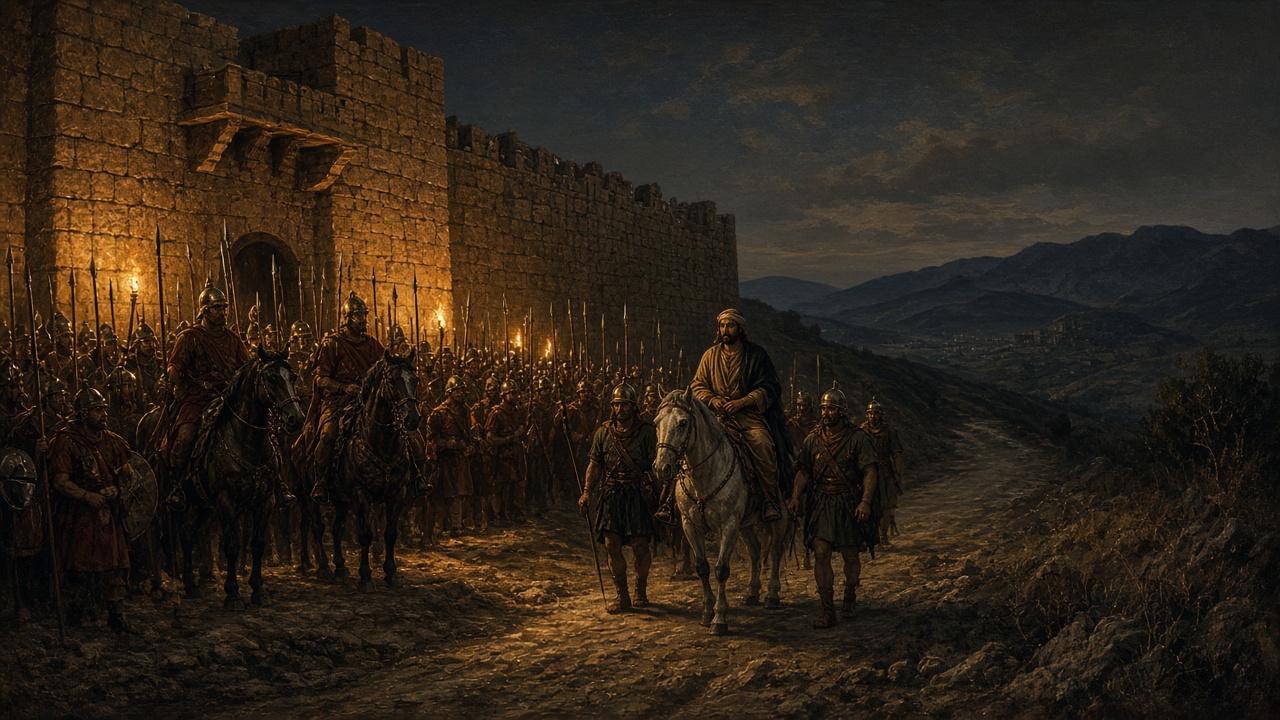
23Then he called two of his centurions and said, “Prepare two hundred soldiers, seventy horsemen, and two hundred spearmen to go to Caesarea in the third hour of the night. 24Provide mounts for Paul to take him safely to Governor Felix.” 25And he wrote the following letter:
26Claudius Lysias,
To His Excellency, Governor Felix:
Greetings.
27This man was seized by the Jews, and they were about to kill him when I came with my troops to rescue him. For I had learned that he is a Roman citizen, 28and since I wanted to understand their charges against him, I brought him down to their Sanhedrin. 29I found that the accusation involved questions about their own law, but there was no charge worthy of death or imprisonment.
30When I was informed that there was a plot against the man, I sent him to you at once. I also instructed his accusers to present their case against him before you.
31So the soldiers followed their orders and brought Paul by night to Antipatris. 32The next day they returned to the barracks and let the horsemen go on with him. 33When the horsemen arrived in Caesarea, they delivered the letter to the governor and presented Paul to him.
34The governor read the letter and asked what province Paul was from. Learning that he was from Cilicia, 35he said, “I will hear your case when your accusers arrive.” Then he ordered that Paul be kept under guard in Herod’s Praetorium.
Did you know?
Paul before the Sanhedrin and the road to Caesarea
- Ananias was the high priest before whom Paul was brought while Felix was procurator. After Paul said he had conducted himself before God in all good conscience, Ananias ordered those standing nearby to strike him on the mouth; Paul called him a whitewashed wall, and when they protested that he had insulted God's high priest, he answered that he had not known Ananias held that office. Easton's Bible Dictionary (1897) notes that this reply has occasioned some difficulty.Sources: Ananias (High Priest) · the Bible text itself
- More than forty men bound themselves by an oath not to eat or drink until they had killed Paul, and soldiers took him by night from Jerusalem as far as Antipatris. Antipatris, built by Herod the Great and named in honor of his father Antipater, lay on the great Roman road from Caesarea to Jerusalem, about twenty-eight miles from Caesarea. Caesarea, on the Mediterranean shore about seventy miles northwest of Jerusalem, was the capital of the Roman province of Judea and the seat of the procurators.Sources: the Bible text itself · Antipatris · Caesarea
- Claudius Lysias, described by Easton's Bible Dictionary as a Greek who had purchased Roman citizenship and taken the name Claudius, wrote to Governor Felix that the charges concerned questions of Jewish law and that there was no charge worthy of death or imprisonment. Felix, the Roman procurator of Judea, asked which province Paul was from; learning that he was from Cilicia, where Tarsus, Paul's birthplace, was one of the chief towns, he ordered that Paul be kept under guard in Herod's Praetorium until the accusers arrived.Sources: Claudius Lysias · Felix · Cilicia · the Bible text itself
Notes written with AI assistance from open sources (Theographic Bible Metadata, CC BY-SA 4.0; Easton’s Bible Dictionary, public domain) and reviewed before publishing.
Places in this chapter
- Jerusalem · 31.777, 35.234 · verse 11
- Rome · 41.892, 12.485 · verse 11
- Caesarea · Today: Caesarea Maritima · 32.500, 34.892 · verses 23, 32, 33
- Aphek · Today: Tell Ras el Ain · 32.105, 34.930 · verse 31
- Cilicia · 36.913, 34.892 · verse 34
Only places identified with high confidence are shown (90% or more according to the scholarly sources compiled by OpenBible). Period map: DARE (Digital Atlas of the Roman Empire), CC BY 4.0; modern map: © OpenStreetMap contributors; places: OpenBible.info (CC BY 4.0).
Credits and license for this translation
Berean Standard Bible
The Holy Bible in English: Berean Standard Bible
Public Domain
Language: English
Contributor: BSB Publishing, LLC
2026-10-02
Source: http://ebible.org/engbsb/ · eBible.org