Acts 14
Berean Standard Bible · Tap a verse to see its cross-references.
Paul and Barnabas at Iconium
1At Iconium, Paul and Barnabas went as usual into the Jewish synagogue, where they spoke so well that a great number of Jews and Greeks believed. 2But the unbelieving Jews stirred up the Gentiles and poisoned their minds against the brothers. 3So Paul and Barnabas spent considerable time there, speaking boldly for the Lord, who affirmed the message of His grace by enabling them to perform signs and wonders.
4The people of the city were divided. Some sided with the Jews, and others with the apostles. 5But when the Gentiles and Jews, together with their rulers, set out to mistreat and stone them, 6they found out about it and fled to the Lycaonian cities of Lystra and Derbe and to the surrounding region, 7where they continued to preach the gospel.
The Visit to Lystra and Derbe
8In Lystra there sat a man crippled in his feet, who was lame from birth and had never walked. 9This man was listening to the words of Paul, who looked intently at him and saw that he had faith to be healed. 10In a loud voice Paul called out, “Stand up on your feet!” And the man jumped up and began to walk.
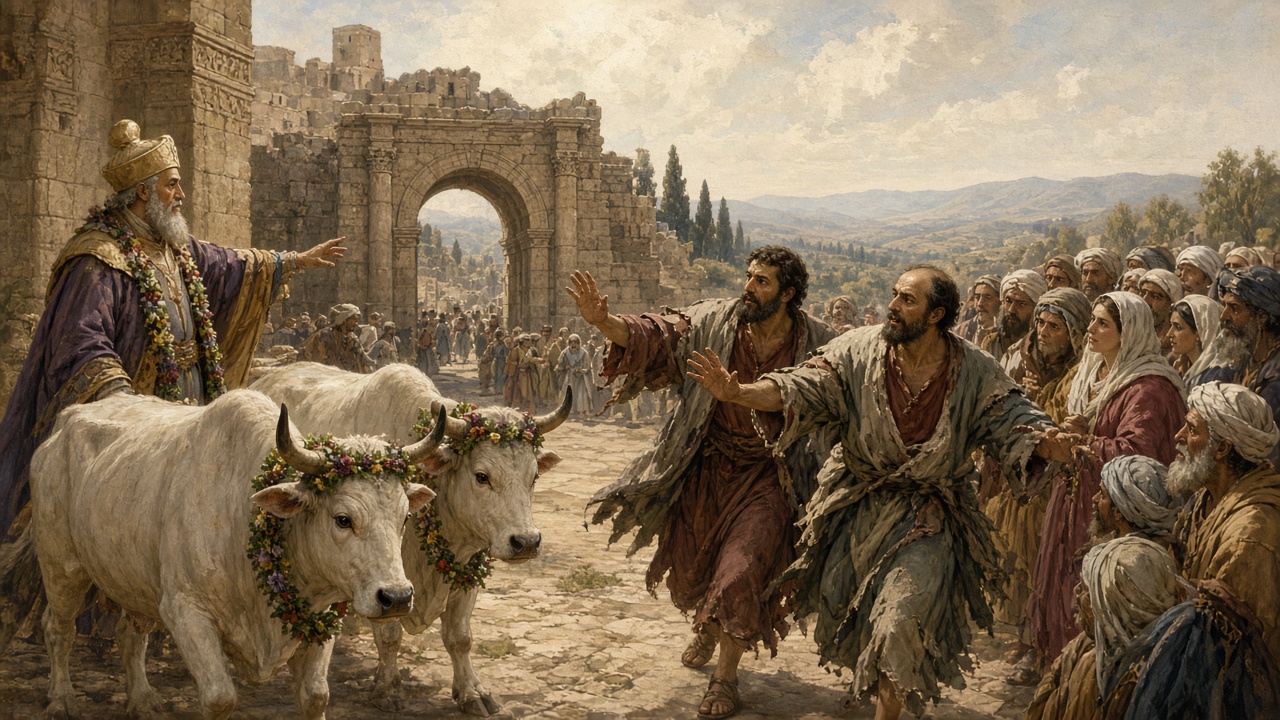
11When the crowds saw what Paul had done, they lifted up their voices in the Lycaonian language: “The gods have come down to us in human form!” 12Barnabas they called Zeus, and Paul they called Hermes, because he was the chief speaker. 13The priest of Zeus, whose temple was just outside the city, brought bulls and wreaths to the city gates, hoping to offer a sacrifice along with the crowds.
14But when the apostles Barnabas and Paul found out about this, they tore their clothes and rushed into the crowd, shouting, 15“Men, why are you doing this? We too are only men, human like you. We are bringing you good news that you should turn from these worthless things to the living God, who made heaven and earth and sea and everything in them. 16In past generations, He let all nations go their own way. 17Yet He has not left Himself without testimony to His goodness: He gives you rain from heaven and fruitful seasons, filling your hearts with food and gladness.”
18Even with these words, Paul and Barnabas could hardly stop the crowds from sacrificing to them.
19Then some Jews arrived from Antioch and Iconium and won over the crowds. They stoned Paul and dragged him outside the city, presuming he was dead. 20But after the disciples had gathered around him, he got up and went back into the city. And the next day he left with Barnabas for Derbe.
Strengthening the Disciples
21They preached the gospel to that city and made many disciples. Then they returned to Lystra, Iconium, and Antioch, 22strengthening the souls of the disciples and encouraging them to continue in the faith. “We must endure many hardships to enter the kingdom of God,” they said.
23Paul and Barnabas appointed elders for them in each church, praying and fasting as they entrusted them to the Lord, in whom they had believed.
24After passing through Pisidia, they came to Pamphylia. 25And when they had spoken the word in Perga, they went down to Attalia.
26From Attalia they sailed to Antioch, where they had been commended to the grace of God for the work they had just completed. 27When they arrived, they gathered the church together and reported all that God had done through them, and how He had opened the door of faith to the Gentiles. 28And they spent a long time there with the disciples.
Did you know?
Paul and Barnabas in Lycaonia
- Iconium was the capital of Lycaonia, an inland Roman province of Asia Minor whose chief towns were Iconium, Lystra, and Derbe. Easton's Bible Dictionary (1897) places Iconium, the modern Konieh, at the foot of Mount Taurus, about 120 miles inland; Lystra lay in a wild district, and Derbe was a small town about twenty miles from Lystra, on the eastern part of the upland plain.Sources: Iconium · Lycaonia · Lystra · Derbe
- When a man lame from birth began to walk, the crowds at Lystra shouted in the Lycaonian language that the gods had come down in human form, calling Barnabas Zeus and Paul Hermes because Paul was the chief speaker. Easton's Bible Dictionary (1897) uses the Roman names Jupiter and Mercury, and says Barnabas was probably taken for Jupiter because of a stately, venerable appearance; of the local speech, it says the language was probably ancient Assyrian, though others have thought it a corrupt Greek mixed with Syriac words.Sources: the Bible text itself · Lystra · Lycaonia
- This passage through Lycaonia belongs to Paul's first missionary journey, which a timeline dates to AD 45 and about a year. Easton's Bible Dictionary (1897) notes that Paul did not suffer persecution at Derbe; from there he and Barnabas returned to Lystra, Iconium, and Pisidian Antioch to strengthen the disciples and appoint elders, then passed on through Pisidia.Sources: First Missionary Journey · Derbe · Antioch (Pisidia) · the Bible text itself
Notes written with AI assistance from open sources (Theographic Bible Metadata, CC BY-SA 4.0; Easton’s Bible Dictionary, public domain) and reviewed before publishing.
Places in this chapter
- Iconium · Today: Konya · 37.872, 32.492 · verses 1, 19, 21
- Lycaonia · 38.000, 33.000 · verses 6, 11
- Lystra · Today: Tel Lystra · 37.602, 32.338 · verses 6, 8, 21
- Antioch · Today: Antioch in Pisidia · 38.306, 31.189 · verses 19, 21
- Pamphylia · 37.000, 31.000 · verse 24
- Pisidia · 38.306, 31.189 · verse 24
- Attalia · Today: Antalya · 36.881, 30.704 · verses 25, 26
- Perga · 36.960, 30.854 · verse 25
- Antioch · Today: Antioch on the Orontes · 36.227, 36.172 · verses 26, 27
Only places identified with high confidence are shown (90% or more according to the scholarly sources compiled by OpenBible). Period map: DARE (Digital Atlas of the Roman Empire), CC BY 4.0; modern map: © OpenStreetMap contributors; places: OpenBible.info (CC BY 4.0).
Credits and license for this translation
Berean Standard Bible
The Holy Bible in English: Berean Standard Bible
Public Domain
Language: English
Contributor: BSB Publishing, LLC
2026-10-02
Source: http://ebible.org/engbsb/ · eBible.org