Song of Songs 4
American Standard Version Byzantine Text · Tap a verse to see its cross-references.
Solomon Admires His Bride
The Bridegroom
1Behold, thou art fair, my love; behold, thou art fair;
Thine eyes are as doves behind thy veil.
Thy hair is as a flock of goats,
That lie along the side of mount Gilead.
2Thy teeth are like a flock of ewes that are newly shorn,
Which are come up from the washing,
Whereof every one hath twins,
And none is bereaved among them.
3Thy lips are like a thread of scarlet,
And thy mouth is comely.
Thy temples are like a piece of a pomegranate
Behind thy veil.
4Thy neck is like the tower of David
Built for an armory,
Whereon there hang a thousand bucklers,
All the shields of the mighty men.
5Thy two breasts are like two fawns
That are twins of a roe,
Which feed among the lilies.
6Until the day be cool, and the shadows flee away,
I will get me to the mountain of myrrh,
And to the hill of frankincense.
7Thou art all fair, my love;
And there is no spot in thee.
8Come with me from Lebanon, my bride,
With me from Lebanon:
Look from the top of Amana,
From the top of Senir and Hermon,
From the lions’ dens,
From the mountains of the leopards.
9Thou hast ravished my heart, my sister, my bride;
Thou hast ravished my heart with one of thine eyes,
With one chain of thy neck.
10How fair is thy love, my sister, my bride!
How much better is thy love than wine!
And the fragrance of thine oils than all manner of spices!
11Thy lips, O my bride, drop as the honeycomb:
Honey and milk are under thy tongue;
And the smell of thy garments is like the smell of Lebanon.
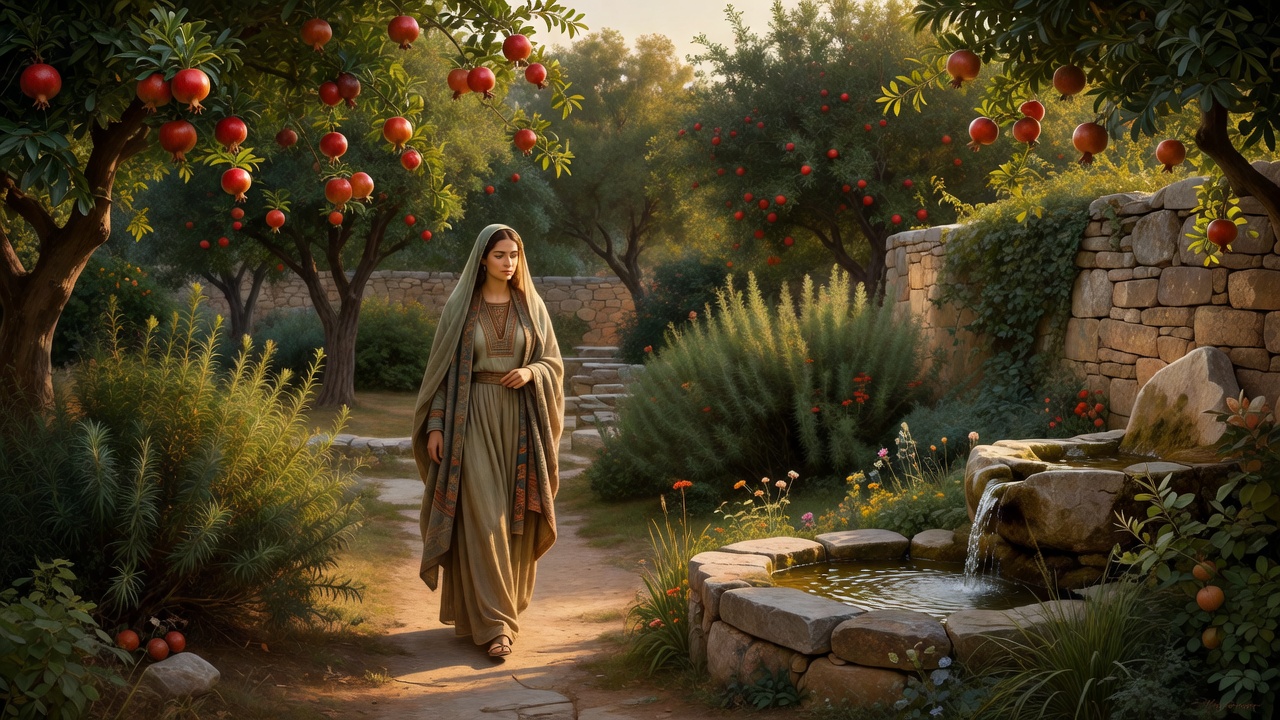
12A garden shut up is my sister, my bride;
A spring shut up, a fountain sealed.
13Thy shoots are an orchard of pomegranates, with precious fruits;
Henna with spikenard plants,
14Spikenard and saffron,
Calamus and cinnamon, with all trees of frankincense;
Myrrh and aloes, with all the chief spices.
15Thou art a fountain of gardens,
A well of living waters,
And flowing streams from Lebanon.
The Bride
16Awake, O north wind; and come, thou south;
Blow upon my garden, that the spices thereof may flow out.
Let my beloved come into his garden,
And eat his precious fruits.
Did you know?
The Bride's Beauty and the Garden of Spices
- The poem calls the bride down from the dramatic northern mountain ranges of Lebanon, including Amana, Senir, and Mount Hermon. Mount Hermon is the highest peak in the Anti-Lebanon range, and biblical sources note that Senir was the Amorite name for Hermon.Sources: the Bible text itself · Hermon · Senir · Lebanon
- The beloved's hair is compared to a flock of goats descending Mount Gilead, a fertile and mountainous region located east of the Jordan River.Sources: the Bible text itself · Gilead
- The bride is portrayed as an enclosed garden, a sealed fountain, and an orchard laden with precious spices such as nard, saffron, cinnamon, and frankincense, evoking exclusivity, refreshment, and fragrance.Sources: the Bible text itself
Notes written with AI assistance from open sources (Theographic Bible Metadata, CC BY-SA 4.0; Easton’s Bible Dictionary, public domain) and reviewed before publishing.
Places in this chapter
- Gilead · Today: Gilead 1 · 32.187, 35.692 · verse 1
- Lebanon · 33.540, 35.584 · verses 8, 11, 15
- Mount Hermon · 33.400, 35.850 · verse 8
- Senir · Today: Mount Hermon · 33.400, 35.850 · verse 8
Only places identified with high confidence are shown (90% or more according to the scholarly sources compiled by OpenBible). Period map: DARE (Digital Atlas of the Roman Empire), CC BY 4.0; modern map: © OpenStreetMap contributors; places: OpenBible.info (CC BY 4.0).
Credits and license for this translation
American Standard Version Byzantine Text
The Holy Bible with Apocrypha, American Standard Version conformed to the Byzantine Text New Testament
Public Domain
Language: English
Dialect: Archaic American
Changes to the ASV dedicated to the Public Domain by Adam Boyd in 2021. The ASV itself is in the Public Domain due to copyright expiration.
2026-10-02
Section headings adapted from the Berean Standard Bible (public domain); they are not part of this translation’s text.
Source: http://ebible.org/engasvbt/ · eBible.org