Matthew 2
American Standard Version Byzantine Text · Tap a verse to see its cross-references.
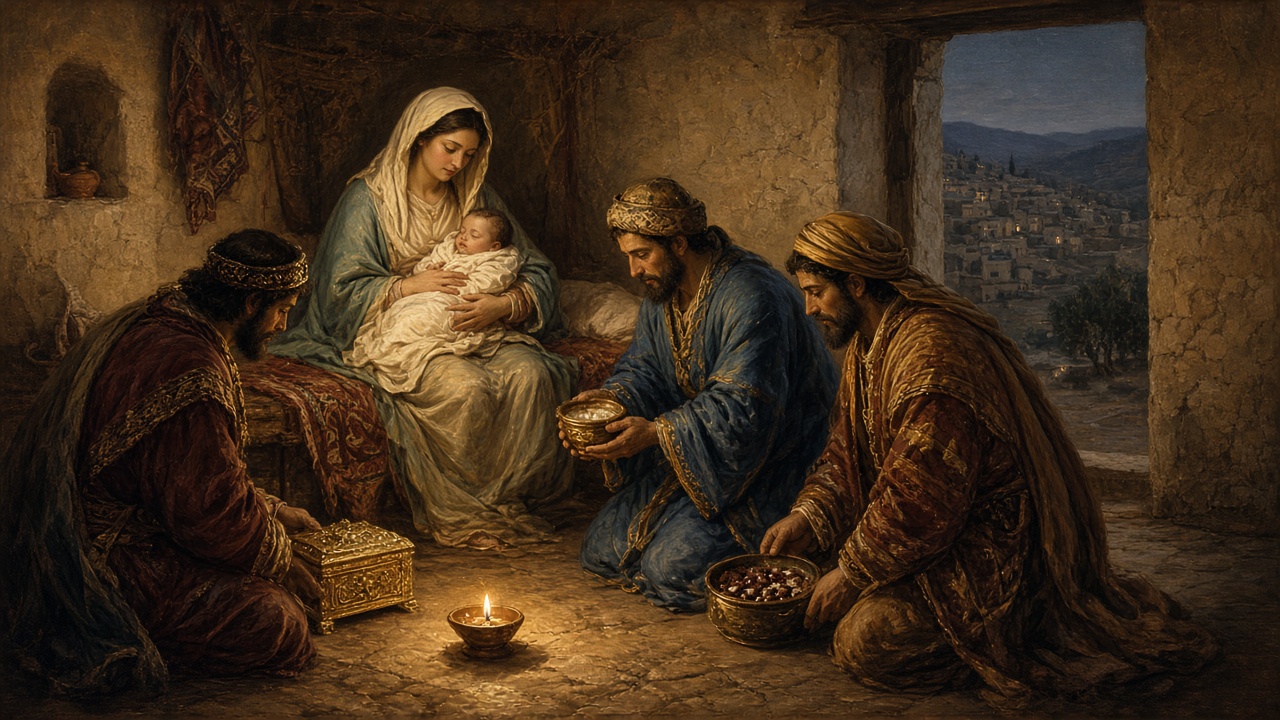
The Pilgrimage of the Magi
1Now when Jesus was born in Bethlehem of Judea in the days of Herod the king, behold, wise men from the east came to Jerusalem, 2saying, Where is he that is born King of the Jews? for we saw his star in the east, and are come to worship him. 3And when Herod the king heard it, he was troubled, and all Jerusalem with him. 4And gathering together all the chief priests and scribes of the people, he inquired of them where the Christ should be born. 5And they said unto him, In Bethlehem of Judea: for thus it is written through the prophet,
6And thou Bethlehem, land of Judah,
Art in no wise least among the princes of Judah:
For out of thee shall come forth a governor,
Who shall be shepherd of my people Israel.
7Then Herod privily called the wise men, and learned of them exactly what time the star appeared. 8And he sent them to Bethlehem, and said, Go and search out exactly concerning the young child; and when ye have found him, bring me word, that I also may come and worship him. 9And they, having heard the king, went their way; and lo, the star, which they saw in the east, went before them, till it came and stood over where the young child was. 10And when they saw the star, they rejoiced with exceeding great joy. 11And they came into the house and saw the young child with Mary his mother; and they fell down and worshiped him; and opening their treasures they offered unto him gifts, gold and frankincense and myrrh. 12And being warned of God in a dream that they should not return to Herod, they departed into their own country another way.
The Flight to Egypt
13Now when they were departed, behold, an angel of the Lord appeareth to Joseph in a dream, saying, Arise and take the young child and his mother, and flee into Egypt, and be thou there until I tell thee: for Herod will seek the young child to destroy him. 14And he arose and took the young child and his mother by night, and departed into Egypt; 15and was there until the death of Herod: that it might be fulfilled which was spoken by the Lord through the prophet, saying, Out of Egypt did I call my son.
Weeping and Great Mourning
16Then Herod, when he saw that he was mocked of the wise men, was exceeding wroth, and sent forth, and slew all the male children that were in Bethlehem, and in all the borders thereof, from two years old and under, according to the time which he had exactly learned of the wise men. 17Then was fulfilled that which was spoken by Jeremiah the prophet, saying,
18A voice was heard in Ramah,
Lamentation and weeping and great mourning,
Rachel weeping for her children;
And she would not be comforted, because they are not.
The Return to Nazareth
19But when Herod was dead, behold, an angel of the Lord appeareth in a dream to Joseph in Egypt, 20saying, Arise and take the young child and his mother, and go into the land of Israel: for they are dead that sought the young child’s life. 21And he arose and took the young child and his mother, and came into the land of Israel. 22But when he heard that Archelaus was reigning over Judea in the room of his father Herod, he was afraid to go thither; and being warned of God in a dream, he withdrew into the parts of Galilee, 23and came and dwelt in a city called Nazareth; that it might be fulfilled which was spoken through the prophets, that he should be called a Nazarene.
Did you know?
Magi, Herod, and Nazareth
- The King Herod of this chapter is Herod the Great. His son Archelaus, by Malthace, a Samaritan woman, inherited a third of the kingdom: Idumea, Judea, and Samaria. Until a few days before Herod's death another son, Antipas, had been named successor, but in his last moments Herod named Archelaus; for fear of him, Joseph turned aside from Judea and withdrew to Galilee.Sources: Archelaus · the Bible text itself
- Matthew links the deaths of the boys in Bethlehem to words spoken through the prophet Jeremiah: a voice in Ramah, Rachel weeping for her children. Rachel, one of Jacob's wives, died giving birth to Benjamin and was buried by the wayside on the road to Ephrath, that is Bethlehem, directly north of the town. Her sepulchre is regarded with great veneration by the Jews.Sources: the Bible text itself · Rachel · Bethlehem
- Bethlehem, in the hill country of Judah, was earlier called Ephrath and was also known as the city of David; under the Romans it lay in Judea, the southernmost of the three divisions of Palestine. Joseph and Mary went instead to Nazareth in Galilee, their home, a town not mentioned in the Old Testament. The name Nazareth is generally supposed to come from the Hebrew netser, a shoot or sprout, though some connect it with a word for guarding or watching.Sources: Bethlehem · Judea · Nazareth · the Bible text itself
Notes written with AI assistance from open sources (Theographic Bible Metadata, CC BY-SA 4.0; Easton’s Bible Dictionary, public domain) and reviewed before publishing.
Places in this chapter
- Bethlehem · 31.704, 35.208 · verses 1, 5, 6, 8, 9, 16
- East · Today: region around Amman · 31.955, 35.934 · verses 1, 2, 9
- Jerusalem · 31.777, 35.234 · verses 1, 3
- Judea · Today: Judea 1 · 31.777, 35.234 · verses 1, 5, 22
- Egypt · 30.129, 31.308 · verses 13, 14, 15, 19
- Galilee · 32.760, 35.527 · verse 22
- Nazareth · 32.702, 35.298 · verse 23
Only places identified with high confidence are shown (90% or more according to the scholarly sources compiled by OpenBible). Period map: DARE (Digital Atlas of the Roman Empire), CC BY 4.0; modern map: © OpenStreetMap contributors; places: OpenBible.info (CC BY 4.0).
Credits and license for this translation
American Standard Version Byzantine Text
The Holy Bible with Apocrypha, American Standard Version conformed to the Byzantine Text New Testament
Public Domain
Language: English
Dialect: Archaic American
Changes to the ASV dedicated to the Public Domain by Adam Boyd in 2021. The ASV itself is in the Public Domain due to copyright expiration.
2026-10-02
Section headings adapted from the Berean Standard Bible (public domain); they are not part of this translation’s text.
Source: http://ebible.org/engasvbt/ · eBible.org