Ezekiel 17
American Standard Version Byzantine Text · Tap a verse to see its cross-references.
The Parable of Two Eagles and a Vine
1And the word of Jehovah came unto me, saying, 2Son of man, put forth a riddle, and speak a parable unto the house of Israel; 3and say, Thus saith the Lord Jehovah: A great eagle with great wings and long pinions, full of feathers, which had diverse colors, came unto Lebanon, and took the top of the cedar: 4he cropped off the topmost of the young twigs thereof, and carried it unto a land of traffic; he set it in a city of merchants. 5He took also of the seed of the land, and planted it in a fruitful soil; he placed it beside many waters; he set it as a willow tree. 6And it grew, and became a spreading vine of low stature, whose branches turned toward him, and the roots thereof were under him: so it became a vine, and brought forth branches, and shot forth sprigs.
7There was also another great eagle with great wings and many feathers: and, behold, this vine did bend its roots toward him, and shot forth its branches toward him, from the beds of its plantation, that he might water it. 8It was planted in a good soil by many waters, that it might bring forth branches, and that it might bear fruit, that it might be a goodly vine. 9Say thou, Thus saith the Lord Jehovah: Shall it prosper? shall he not pull up the roots thereof, and cut off the fruit thereof, that it may wither; that all its fresh springing leaves may wither? and not by a strong arm or much people can it be raised from the roots thereof. 10Yea, behold, being planted, shall it prosper? shall it not utterly wither, when the east wind toucheth it? it shall wither in the beds where it grew.
The Parable Explained
11Moreover the word of Jehovah came unto me, saying, 12Say now to the rebellious house, Know ye not what these things mean? tell them, Behold, the king of Babylon came to Jerusalem, and took the king thereof, and the princes thereof, and brought them to him to Babylon. 13And he took of the seed royal, and made a covenant with him; he also brought him under an oath, and took away the mighty of the land; 14that the kingdom might be base, that it might not lift itself up, but that by keeping his covenant it might stand. 15But he rebelled against him in sending his ambassadors into Egypt, that they might give him horses and much people. Shall he prosper? shall he escape that doeth such things? shall he break the covenant, and yet escape? 16As I live, saith the Lord Jehovah, surely in the place where the king dwelleth that made him king, whose oath he despised, and whose covenant he brake, even with him in the midst of Babylon he shall die. 17Neither shall Pharaoh with his mighty army and great company help him in the war, when they cast up mounds and build forts, to cut off many persons. 18For he hath despised the oath by breaking the covenant; and behold, he had given his hand, and yet hath done all these things; he shall not escape. 19Therefore thus saith the Lord Jehovah: As I live, surely mine oath that he hath despised, and my covenant that he hath broken, I will even bring it upon his own head. 20And I will spread my net upon him, and he shall be taken in my snare, and I will bring him to Babylon, and will enter into judgment with him there for his trespass that he hath trespassed against me. 21And all his fugitives in all his bands shall fall by the sword, and they that remain shall be scattered toward every wind: and ye shall know that I, Jehovah, have spoken it.
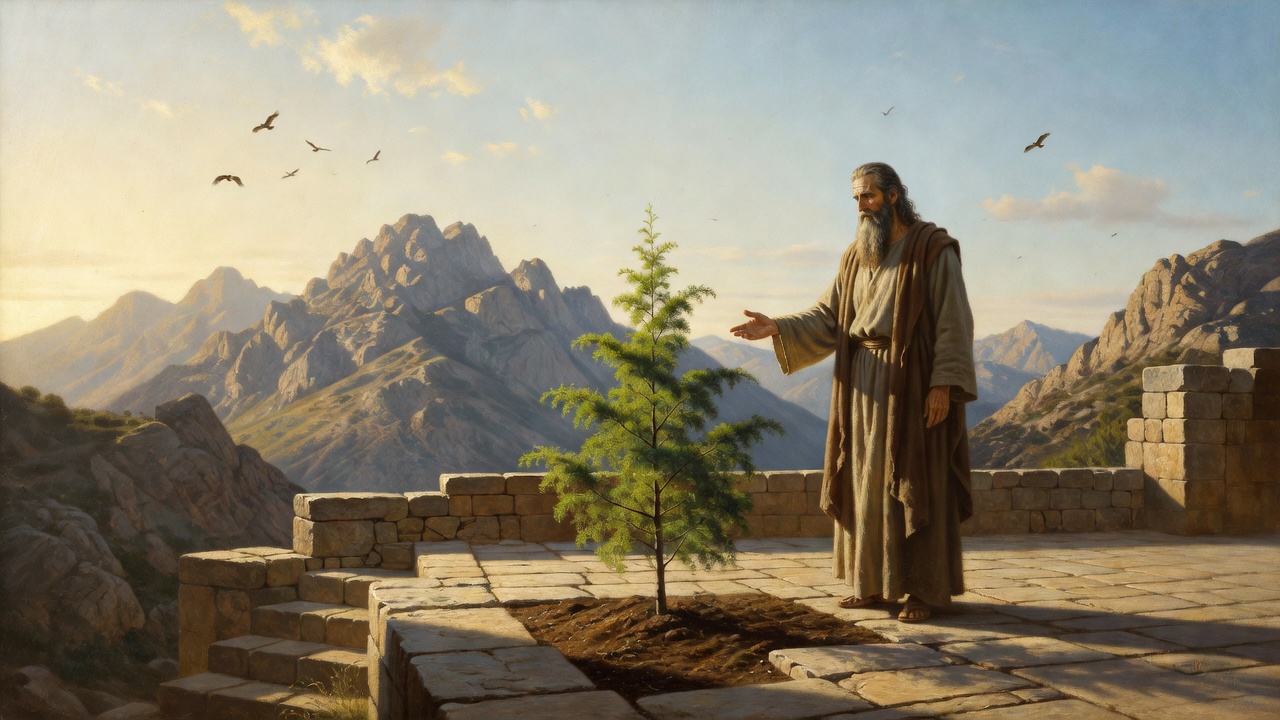
22Thus saith the Lord Jehovah: I will also take of the lofty top of the cedar, and will set it; I will crop off from the topmost of its young twigs a tender one, and I will plant it upon a high and lofty mountain: 23in the mountain of the height of Israel will I plant it; and it shall bring forth boughs, and bear fruit, and be a goodly cedar: and under it shall dwell all birds of every wing; in the shade of the branches thereof shall they dwell. 24And all the trees of the field shall know that I, Jehovah, have brought down the high tree, have exalted the low tree, have dried up the green tree, and have made the dry tree to flourish: I, Jehovah, have spoken and have done it.
Did you know?
The Parable of the Eagles and the Cedar
- Ezekiel presents a political allegory where the first great eagle represents the king of Babylon, who captured Jerusalem's royal leadership and established a vassal king under a solemn covenant. The second eagle represents Egypt and its Pharaoh, to whom the Judean ruler turned for cavalry and military assistance in defiance of his sworn allegiance.Sources: the Bible text itself · Babylon · Egypt · Pharaoh
- In the prophetic message, breaking a political vassal oath made under Babylon was treated not merely as diplomatic rebellion, but as spiritual treason against God, who regarded the sworn pledge as His own oath.Sources: the Bible text itself
- The chapter concludes with a reversal of human political schemes: God Himself promises to take a tender shoot from the top of the cedar and plant it upon the mountain heights of Israel, where it will grow into a majestic tree offering shelter to birds of every kind.Sources: the Bible text itself
Notes written with AI assistance from open sources (Theographic Bible Metadata, CC BY-SA 4.0; Easton’s Bible Dictionary, public domain) and reviewed before publishing.
Places in this chapter
- Lebanon · 33.540, 35.584 · verse 3
- Canaan · 32.767, 35.333 · verse 4
- Babylon · 32.543, 44.422 · verses 12, 14, 15, 16, 17, 20
- Jerusalem · 31.777, 35.234 · verses 12, 17
- Egypt · 30.129, 31.308 · verse 15
Only places identified with high confidence are shown (90% or more according to the scholarly sources compiled by OpenBible). Period map: DARE (Digital Atlas of the Roman Empire), CC BY 4.0; modern map: © OpenStreetMap contributors; places: OpenBible.info (CC BY 4.0).
Credits and license for this translation
American Standard Version Byzantine Text
The Holy Bible with Apocrypha, American Standard Version conformed to the Byzantine Text New Testament
Public Domain
Language: English
Dialect: Archaic American
Changes to the ASV dedicated to the Public Domain by Adam Boyd in 2021. The ASV itself is in the Public Domain due to copyright expiration.
2026-10-02
Section headings adapted from the Berean Standard Bible (public domain); they are not part of this translation’s text.
Source: http://ebible.org/engasvbt/ · eBible.org