Genesis 8
Anindilyakwa English Bible · Tap a verse to see its cross-references.
About the water drying up
1God did not forget Noah and the animals and birds in the boat. He sent a wind to dry up the water and make it go down. 2The water bubbling up from the ground was stopped and the sky was closed and no more rain fell.
3Then the water went down and down and kept on going down until the five months had passed. 4It was full moon again now. And the boat landed on a mountain called Ararat. 5And the water kept on going down and down.
Then two more months passed and it was new moon now. Then the mountain tops appeared from the water that had covered them. 6After forty days Noah opened a window in the boat. 7And he sent out a crow from the window. It flew away and kept on circling around and around. It didn't come back but it kept flying around until all the water was gone.
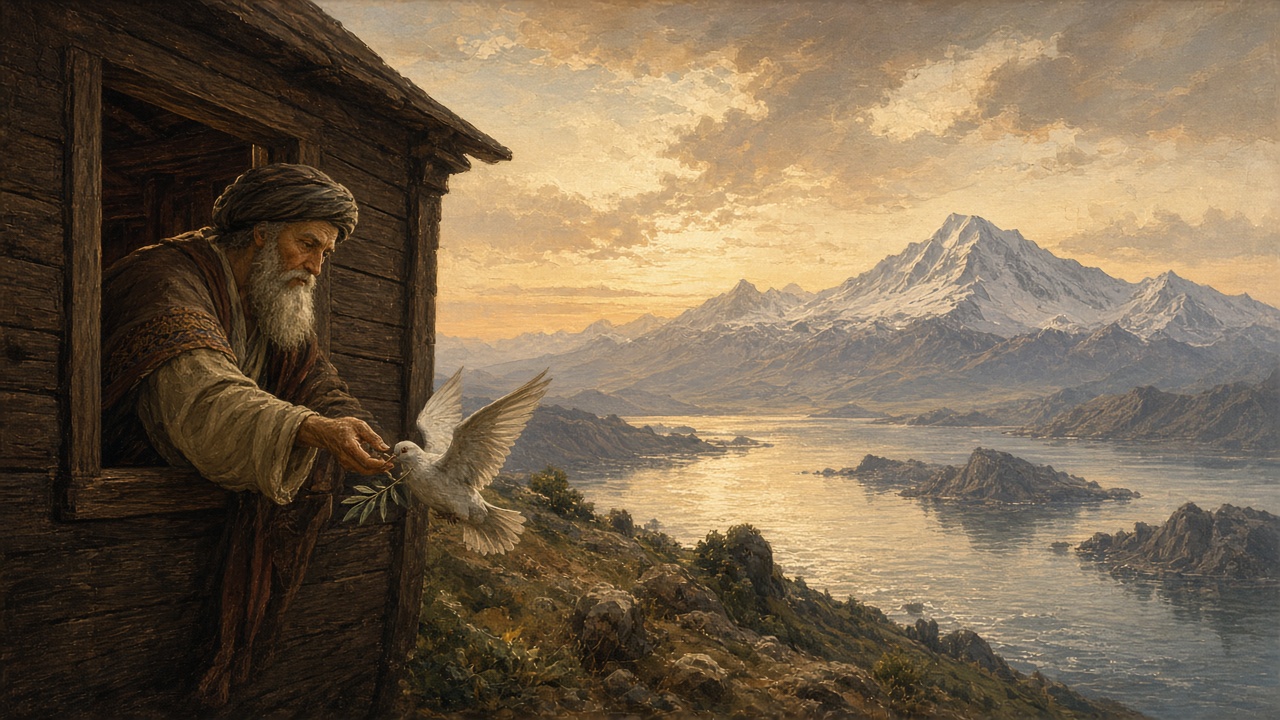
8While Noah was waiting for the crow, he opened the window again and sent out a dove to see if the water had all gone. 9He sent the dove out but it wandered around. There was still water everywhere. So it circled around and around and then came back to the boat, because there was nowhere for it to rest. Noah stretched out his hand and took the dove through the window and brought it back inside.
10Noah waited another seven days. Then he sent out the dove again. 11And then late in the afternoon it came back to him, bringing a green leaf to the boat. So Noah knew that there was no more water now.
12He waited another seven days and then he sent the dove out once more. This time it didn't come back to him.
13After the boat landed five months passed. Then at the new moon the water was all gone. Noah was an old man, he was 601 years old now. He opened the roof of the boat and looked out over the land and saw that the ground was getting dry.
14After two more months, before the new moon, the land was quite dry.
15Then God said to Noah, 16“Go out of the boat now. Go out with your wife and your sons and their wives. 17Let out all the birds and animals. Take them with you, so that they can increase and live all over the earth.”
18So Noah and his family went out of the boat. 19And the animals and birds all came out in groups of their own kind.
About Noah sacrificing animals to Yahweh
20Noah collected some stones and piled them up to make an altar so that he could sacrifice some animals for Yahweh. Then he took one each of the animals and birds that they could eat and burnt them whole, without cutting them, on the altar. He sacrificed them there and he praised Yahweh. 21When Yahweh smelled them he was pleased.
He said to himself, “That is the last time. I will never curse the earth again because people have done wrong. I know that even while people are young, they are still bad. Their thoughts are evil. But I will no longer destroy everything that lives in the world. I won't do it again.
22“This is the way it will be. People will grow food again in this world and gather it. The hot season and the cold season will follow one another until the world is finished. And night and day will always follow each other too.”
Did you know?
The Waters Recede
- The ark came to rest on the mountains of Ararat, a name meaning “sacred land” or “high land” for a country on whose mountains the ark settled after the flood. Easton's Bible Dictionary (1897) suggests those mountains were probably the Kurdish range of southern Armenia, though the name is also commonly applied to a high, almost inaccessible peak rising from the plain of the Araxes. In 2 Kings 19:37 and Isaiah 37:38 the Authorized Version renders the name “Armenia” and the Revised Version “land of Ararat,” while Jeremiah 51:27 uses it for central or southern Armenia.Sources: Ararat · the Bible text itself
- Noah’s Hebrew name means “rest,” and in this chapter the ark itself comes to rest as the waters go down. He was the son of Lamech and the grandson of Methuselah, and the father of Shem, Ham, and Japheth. Easton's Bible Dictionary describes him as the connecting link between the old world and the new, and as a second great progenitor of the human family.Sources: Noah · the Bible text itself
- Chronological notes place the Great Flood in 2347 BC, lasting one year; the subsiding of the waters in 2346 BC, over 220 days; and the leaving of the ark in 2346 BC, as a single day. In the chapter itself, the waters have gone down after 150 days and the ark rests on the seventeenth day of the seventh month; on the first day of the first month of Noah’s six hundred and first year the waters have dried up, and by the twenty-seventh day of the second month the earth is fully dry.Sources: The Great Flood · The flood subsides · Leaving the Ark · the Bible text itself
Notes written with AI assistance from open sources (Theographic Bible Metadata, CC BY-SA 4.0; Easton’s Bible Dictionary, public domain) and reviewed before publishing.
Places in this chapter
- Ararat · Today: Urartu · 39.703, 44.300 · verse 4
Only places identified with high confidence are shown (90% or more according to the scholarly sources compiled by OpenBible). Period map: DARE (Digital Atlas of the Roman Empire), CC BY 4.0; modern map: © OpenStreetMap contributors; places: OpenBible.info (CC BY 4.0).
Credits and license for this translation
Anindilyakwa English Bible
Portions of the Holy Bible in English easy for Anindilyakwa speakers in Australia to understand.
Copyright © 2021 Bible Society Australia
Language: English
This translation is made available to you under the terms of the
Creative Commons Attribution-Noncommercial-No Derivatives license 4.0.
You may share and redistribute this Bible translation or extracts from it in any format, provided that:
You include the above copyright and source information.
You do not sell this work for a profit.
You do not change any of the words or punctuation of the Scriptures.
Pictures included with Scriptures and other documents on this site are licensed just for use with those Scriptures and documents.
For other uses, please contact the respective copyright owners.
2021-11-23
Source: http://ebible.org/engaoi/ · eBible.org