Genesis 32
Anindilyakwa English Bible · Tap a verse to see its cross-references.
About Jacob counting his animals to give to his brother
1Jacob also left to go back to his father. As he went on his way some angels met him. 2When he saw them he said, “This is God's camp.” So he called the place Mahanaim, because Mahanaim means “two camps.” 3Jacob sent some men ahead with a message for his older brother Esau.
The men met Esau in the country of Edom, 4and they said to him, “Your brother Jacob is coming after us and he is ready to obey you. He has been staying with your uncle Laban for a very long time. 5He has cattle and donkeys and sheep and goats now, and also servants. He wants you to be pleased when you see him.”
6Then they went back to Jacob and said to him, “We went to your brother, and now he is coming to meet you. There are 400 men with him.” 7Jacob was frightened and worried when he heard that. So he separated the people who were with him into two groups. Then he also separated his cattle, sheep, goats and camels into two groups. 8He thought, “If Esau fights with the first group then the others will escape safely.”
9Then Jacob prayed to God. He said, “God of my grandfather Abraham and God of my father Isaac, listen to me! I am going back to my father's country and my people, because you told me to, Yahweh. You said you would do good for me. 10You didn't leave me all the time I was in Mesopotamia, you were kind to me. But I didn't do anything good for you. When I crossed the Jordan River the first time, I had nothing except a walking stick, but you have given me many good things. So today I have these two groups of people and two groups of animals. 11Please help me again now, so that my brother Esau won't kill me.
“I am frightened. I am afraid that Esau is coming to fight us and kill all of us men, and the women and children too. 12You promised me that you would do good for me and also that I would have many children. You told me that their children would go on having children until there are very many of them. They will be so many that no one will be able to count them, just as we can't count the grains of sand on the beach. So please don't forget your promise to me.”
13Jacob stayed there that night. In the morning he gathered some goats and other animals together and counted them to give to his older brother Esau. 14There were 200 female goats and 20 males, 15and 200 female sheep and 20 males, and 30 female camels and their young ones, and 40 female bullocks and 10 males and 20 female donkeys and 10 males. 16He separated the animals into five groups, goats, sheep, camels, bullocks and donkeys, all in separate groups. And he told five servants to look after them. He said to them, “Go on ahead now. Let one group go first and let the next group follow later.”
17He said to the first servant, “When my brother Esau meets you he will ask, ‘Who is your master? And where are you going? And whose are these goats and other animals?’ 18Then you must say, ‘They belong to Jacob. He is ready to obey you and he has sent these for you. He is coming after us.’”
19Jacob told all his servants who were looking after the sheep and other animals to say the same to Esau. He said to them, “When you meet Esau you must say to him, 20‘Yes, Jacob is ready to obey you and he is coming after us.’” Jacob was thinking, “First my brother will get these goats and other animals. Then later he will meet me. Maybe he will forgive me because of what I have given him.”
21Then Jacob sent the servants ahead with the animals, but he stayed there for the night.
About Jacob's new name
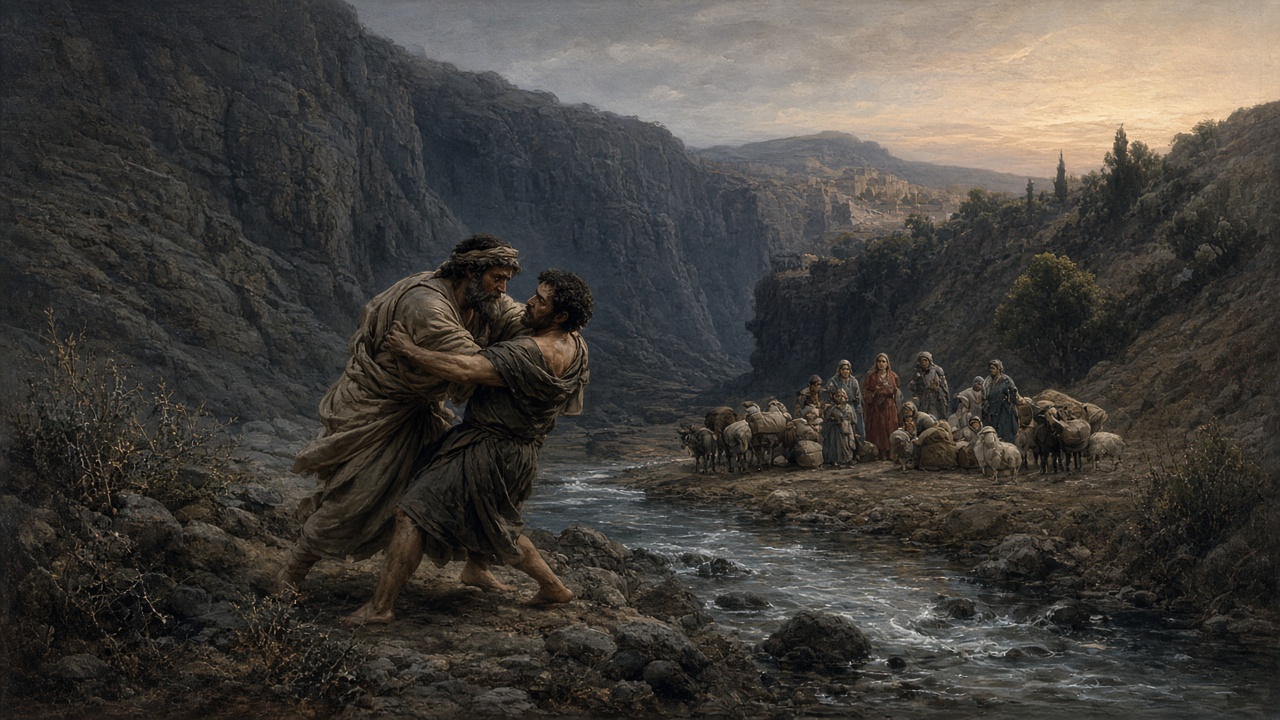
22That same night Jacob got up and sent off his two wives, Rachel and Leah, and they crossed the Jabbok River. He sent off the two women, Bilhah and Zilpah, the servants who were also his wives, and they crossed over with all his children. And he also sent all his belongings on ahead, 24but he stayed alone.
During the night a man came to Jacob and fought with him. They kept on and on fighting until it was nearly dawn. 25When the man saw that Jacob didn't weaken, he hit him on the hip. And Jacob's hip was hurt and thrown out of joint. 26The man said to Jacob, “Let me go now. Soon it will be dawn.”
Jacob answered, “If you bless me, then I will let you go.”
27The man asked, “What is your name?”
“I am Jacob,” he answered.
28The man said, “You won't be called Jacob any longer, you will have a new name Israel. You have shown people that you are strong with God and with men. So from today you will be called Israel.” God said that because Israel means “he fought with God.”
29Jacob said, “Tell me your name.”
But he answered, “Why do you want to know my name?” Then he blessed Jacob.
30After the man had gone away Jacob thought, “That was God himself! I have seen his face, and I am still alive.” So he called the place Peniel, because Peniel means, “God's face.”
31As the sun was coming up, Jacob left there and crossed the Jabbok River. But he was limping now, because his hip was aching. 32Even today when the Israelite people eat meat, they don't eat the muscle from the hip of bullocks and other animals, because that man struck Jacob on the hip.
Did you know?
At the Jabbok, on the Way to Esau
- Mahanaim means “two camps.” Jacob gave that name to the place near the Jabbok, beyond the Jordan, when the angels of God met him and he said, “This is the camp of God.” There he also divided his people, flocks, herds, and camels into two camps, hoping one might escape if Esau attacked the other.Sources: Mahanaim · the Bible text itself
- The Jabbok, whose name is explained as “a pouring out, or a wrestling,” is a stream east of the Jordan. It joins the Jordan about midway between the Sea of Galilee and the Dead Sea, after a course of about 65 miles through a wild, deep ravine. At its ford Jacob sent his two wives, two maidservants, eleven sons, and all he owned across, then remained alone and wrestled with a man until daybreak.Sources: Jabbok · the Bible text itself
- Jacob sent messengers to Esau in the land of Seir, the country of Edom, calling him lord and himself a servant. Seir is a mountainous region along the east side of the Arabah, from the southeastern end of the Dead Sea toward Akabah, the eastern branch of the Red Sea; the Edomites occupied it, and it was allotted to Esau’s descendants. Esau, the firstborn twin and a hunter, had sold his birthright for red lentil stew and was also called Edom, “red,” while Jacob—whose name means “one who follows on another’s heels,” or “supplanter”—had conspired with his mother to deceive Isaac.Sources: the Bible text itself · Seir · Esau (Edom) · Jacob (Israel)
Notes written with AI assistance from open sources (Theographic Bible Metadata, CC BY-SA 4.0; Easton’s Bible Dictionary, public domain) and reviewed before publishing.
Places in this chapter
- Edom · 30.746, 35.604 · verse 3
- Jordan · Today: Jordan River · 31.761, 35.558 · verse 10
- Jabbok · Today: Zarqa River · 32.115, 35.543 · verse 22
Only places identified with high confidence are shown (90% or more according to the scholarly sources compiled by OpenBible). Period map: DARE (Digital Atlas of the Roman Empire), CC BY 4.0; modern map: © OpenStreetMap contributors; places: OpenBible.info (CC BY 4.0).
Credits and license for this translation
Anindilyakwa English Bible
Portions of the Holy Bible in English easy for Anindilyakwa speakers in Australia to understand.
Copyright © 2021 Bible Society Australia
Language: English
This translation is made available to you under the terms of the
Creative Commons Attribution-Noncommercial-No Derivatives license 4.0.
You may share and redistribute this Bible translation or extracts from it in any format, provided that:
You include the above copyright and source information.
You do not sell this work for a profit.
You do not change any of the words or punctuation of the Scriptures.
Pictures included with Scriptures and other documents on this site are licensed just for use with those Scriptures and documents.
For other uses, please contact the respective copyright owners.
2021-11-23
Source: http://ebible.org/engaoi/ · eBible.org