Genesis 25
Anindilyakwa English Bible · Tap a verse to see its cross-references.
About Abraham's descendants
1Abraham had another wife whose name was Keturah. 2These are the names of the children Keturah gave birth to for Abraham. They were called Zimran, Jokshan, Medan, Midian, Ishbak and Shuah.
3Keturah's son Jokshan was the father of Sheba and Dedan. Dedan's descendants became so many that there were three groups. They were called the Asshurim, the Letushim and the Leummim people.
4Keturah's son Midian had five sons. They were called Ephah, Epher, Hanoch, Abida and Eldaah.
Keturah was the ancestor of all those people.
5While Abraham was still alive he gave presents to his sons, the sons of Hagar and Keturah. Then he sent all those sons away from his son Isaac. He sent them to the east to live there.
Then Abraham said, “When I die, all my cattle, sheep, goats, camels, donkeys and all my silver and gold and other things will all belong to Isaac.”
About Abraham's death
7Abraham lived for 175 years. 8They were good years. And then he died. 9His sons Isaac and Ishmael buried him in the cave called Machpelah that was near Mamre's place. First of all the cave had belonged to Ephron, the one whose father was Zohar the Hittite. 10Abraham had bought the cave from the Hittite people and both Abraham and his wife Sarah were buried there.
11After Abraham died, God blessed his son Isaac. He lived near the waterhole called “The Owner of the Waterhole is Alive and He Sees Me.”
About Ishmael's descendants
12Ishmael was Abraham's first son. His mother was Hagar, Sarah's Egyptian servant. 13He had twelve sons. The first was called Nebaioth. The names of the others were Kedar, Adbeel, Mibsam, 14Mishma, Dumah, Massa, 15Hadad, Tema, Jetur and Naphish and the last one was Kedemah. 16Those twelve men were the ancestors of separate tribes and their villages and camping places were called by their names.
17Their father Ishmael was a very old man now, and when he was 137 years old he died.
18Ishmael's descendants lived in the land between Havilah and Shur. That was their country, and when people went from Egypt over to Assyria they went through there. Ishmael's family lived away from Isaac's family and from Abraham's other descendants.
About Isaac's family
About Jacob and Esau
19This is the story of Abraham's son Isaac. 20Isaac was forty years old when he married Rebecca. Rebecca was the daughter of Bethuel who was an Aramean from Mesopotamia. And Rebecca's brother was Laban. 21Rebecca had no children. So Isaac prayed to Yahweh for her to have children. Yahweh heard his prayer and Rebecca became pregnant. 22She knew that she was going to have twins. Before they were born they struggled together inside her.
Rebecca said, “Oh dear, what has happened to me?” So she prayed to Yahweh about the children.
23Yahweh said to her,
“There are two people inside you.
They will be the ancestors of two nations.
Their people will be against each other and live separately.
One brother will be stronger than the other,
and the older brother will work for the younger one.”
24Twin boys were born. 25The first one was reddish and his skin was hairy, so he was named Esau, because Esau means “hairy.” 26When the second one was born, he was holding on tightly to the heel of the first. So he was named Jacob, because Jacob means “he is holding the heel.” But when people talk about others and say, “He is holding the heel,” that means, “he is tricking people.” Their father Isaac was sixty years old when they were born.
27The two boys grew up. Esau was good at hunting and he loved being out in the bush. But Jacob was a quiet man who liked to stay at home. 28Isaac loved Esau more, because he liked eating the animals he killed, but Rebecca loved Jacob.
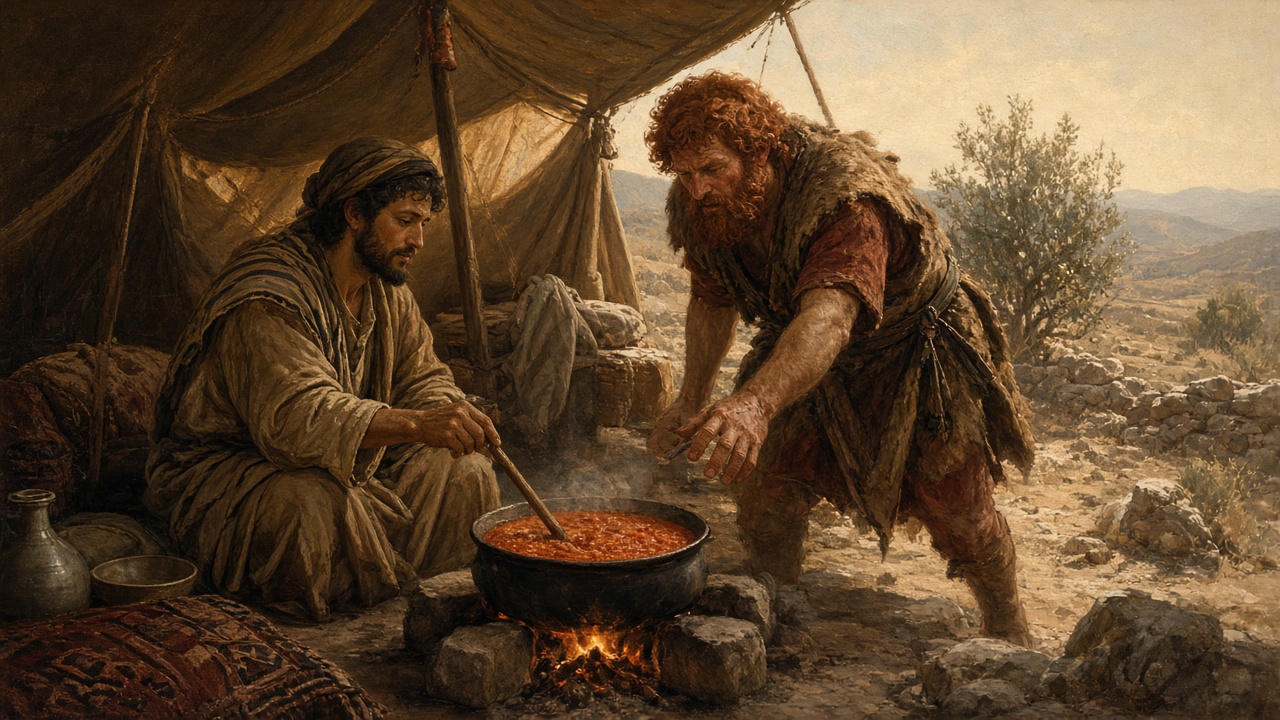
29One day Jacob was cooking some bean soup and Esau came back from hunting. He was hungry 30and he said to his younger brother Jacob, “I am very hungry. Give me some of that red soup.” That is why Esau had two names. One was Esau and the other was Edom, because Edom means “red.”
31“Yes, I will give you some,” Jacob answered. “But you must tell me that I am the firstborn and the leader now, and not you.”
32Esau said, “All right! I am dying of hunger, so what good is it to me if I am the firstborn?”
33Jacob said, “I want you to make a promise and not change it. You must promise me that I will be the firstborn and the leader now.” So Esau agreed and made the promise. 34Then Jacob gave him some damper and some of the soup he had cooked. Esau ate the damper and drank the soup and he got up and left, saying, “What does it matter? Let him be the firstborn!”
Did you know?
Abraham’s heirs and the twin brothers
- Keturah, whose name Easton's Bible Dictionary (1897) explains as “incense,” is introduced here as another wife of Abraham. That dictionary says he probably married her after Sarah’s death, though her nationality is unknown, and notes that 1 Chronicles calls her a concubine. She bore him six sons, including Jokshan and Midian, the father of the Midianites; while Abraham was still alive he gave gifts to the sons of his concubines and sent them away from Isaac to the land of the east.Sources: Keturah · Midian · the Bible text itself
- Isaac and Ishmael together buried Abraham in the cave of Machpelah near Mamre, in the field Abraham had bought from Ephron the Hittite, where Sarah already lay. Easton's Bible Dictionary (1897) explains Machpelah as “portion” or “double cave,” set on a hillside east of Hebron and facing Mamre, a place called the oaks—or, in a margin, the terebinths—of Mamre.Sources: Machpelah · Mamre · the Bible text itself
- Esau, Rebekah’s firstborn twin, was born red and covered with hair like a fur coat. Easton's Bible Dictionary (1897) links the further name Edom, “red,” to the red lentil stew for which he sold his birthright, and explains Jacob as “one who follows on another’s heels” or “supplanter,” matching the report that Jacob was born grasping Esau’s heel. Esau grew up as a skillful hunter and a man of the field, while Jacob was a quiet man who stayed at home.Sources: Esau (Edom) · Jacob (Israel) · the Bible text itself
Notes written with AI assistance from open sources (Theographic Bible Metadata, CC BY-SA 4.0; Easton’s Bible Dictionary, public domain) and reviewed before publishing.
Places in this chapter
- East · Today: region around Amman · 31.955, 35.934 · verse 6
- Machpelah · Today: Cave of the Patriarchs · 31.525, 35.111 · verse 9
- Negeb · 31.245, 34.841 · verse 11
- Assyria · 36.359, 43.153 · verse 18
- Egypt · 30.129, 31.308 · verse 18
Only places identified with high confidence are shown (90% or more according to the scholarly sources compiled by OpenBible). Period map: DARE (Digital Atlas of the Roman Empire), CC BY 4.0; modern map: © OpenStreetMap contributors; places: OpenBible.info (CC BY 4.0).
Credits and license for this translation
Anindilyakwa English Bible
Portions of the Holy Bible in English easy for Anindilyakwa speakers in Australia to understand.
Copyright © 2021 Bible Society Australia
Language: English
This translation is made available to you under the terms of the
Creative Commons Attribution-Noncommercial-No Derivatives license 4.0.
You may share and redistribute this Bible translation or extracts from it in any format, provided that:
You include the above copyright and source information.
You do not sell this work for a profit.
You do not change any of the words or punctuation of the Scriptures.
Pictures included with Scriptures and other documents on this site are licensed just for use with those Scriptures and documents.
For other uses, please contact the respective copyright owners.
2021-11-23
Source: http://ebible.org/engaoi/ · eBible.org