Genesis 14
Anindilyakwa English Bible · Tap a verse to see its cross-references.
About Abram rescuing Lot
1There was a man called Chedorlaomer who was a powerful king in his own city called Elam. He became ruler over five other kings, Bera, Birsha, Shinah, Shemeber and the king of the city called Bela. That city had two names, Bela and Zoar. Bera was the king of Sodom, Birsha was the king of Gomorrah, Shinah was the king of Admah and Shemeber was the king of Zeboiim.
Chedorlaomer had been ruler over the other five kings for a long time. He had ruled over them and all their people for twelve years. The next year the five kings decided that they wouldn't obey him any longer.
The next year Chedorlaomer took his soldiers to a place called Ashteroth Karnaim, and three other kings took their soldiers there to help him. Their names were Amraphel, Arioch and Tidal. Amraphel was the king of Babylonia, Arioch was the king of Ellasar and Tidal was the king of Goiim.
Those four kings had a lot of soldiers and they helped each other. They fought against the people called Rephaim in Ashteroth Karnaim. Then they went to Ham and fought against the people called Zuzim. Then they went to a flat place called Kiriathaim and fought against the people called Emim. They killed many of the Rephaim and the Zuzim and the Emim.
From there they went to the hill country of Edom and fought against the Horite people. They killed many of the people and ran after some of them, driving them away until they reached Elparan on the edge of the desert.
From there they turned around and came back to a place called Kadesh. At that time it was called Enmishpat, but today it is called Kadesh. They kept on fighting people and they took all the country that belonged to the Amalekites. Then they fought the Amorite people who lived in Hazazon Tamar and they killed many of them.
Then the five kings of Sodom, Gomorrah, Admah, Zeboiim and Bela got their soldiers together in a flat place called Siddim to fight the four kings of Elam, Goiim, Babylonia and Ellasar. At that time there was no sea there, but today there is a sea there called the Dead Sea. 10There were a lot of pits full of tar like very sticky mud in that flat place. Two of the kings, the king of Sodom and the king of Gomorrah, tried to run away from the fighting, but they fell into the pits of tar and couldn't get out. But the other three kings ran away to the hills.
11Then the four kings of Elam, Goiim, Babylonia and Ellasar went to Sodom and Gomorrah with their men and took all the people and the food and everything else from both those places. Lot, Abram's nephew, was living in Sodom and so they took him too with all his things. Then they went away.
13One man escaped from Chedorlaomer and the other kings, and he went to Abram, the Hebrew, because Abram was Lot's uncle. Abram was living near the special trees that belonged to Mamre, the Amorite. Mamre and his two brothers, Eshcol and Aner, were Abram's friends. So the man who had escaped found Abram and told him that his nephew Lot had been taken away.
14When Abram knew that Chedorlaomer and the other kings had taken his nephew Lot, he called together all his fighting men, 318 of them. Then Abram and his men followed Chedorlaomer and the other kings and their men a long way until they reached a town called Dan. 15At Dan Abram spread out his soldiers and fought Chedorlaomer and the other kings and their men at night. Abram and his men killed many men belonging to Chedorlaomer and the other kings and they ran after the rest until they reached a place called Hobah, which is on the other side of Damascus. 16Then they grabbed everything that Chedorlaomer and the others had taken from Sodom and Gomorrah. And Abram took his nephew Lot home with all his things. And he also brought back the women and other people Chedorlaomer and the others had taken from Sodom and Gomorrah.
About Melchizedek and Abram
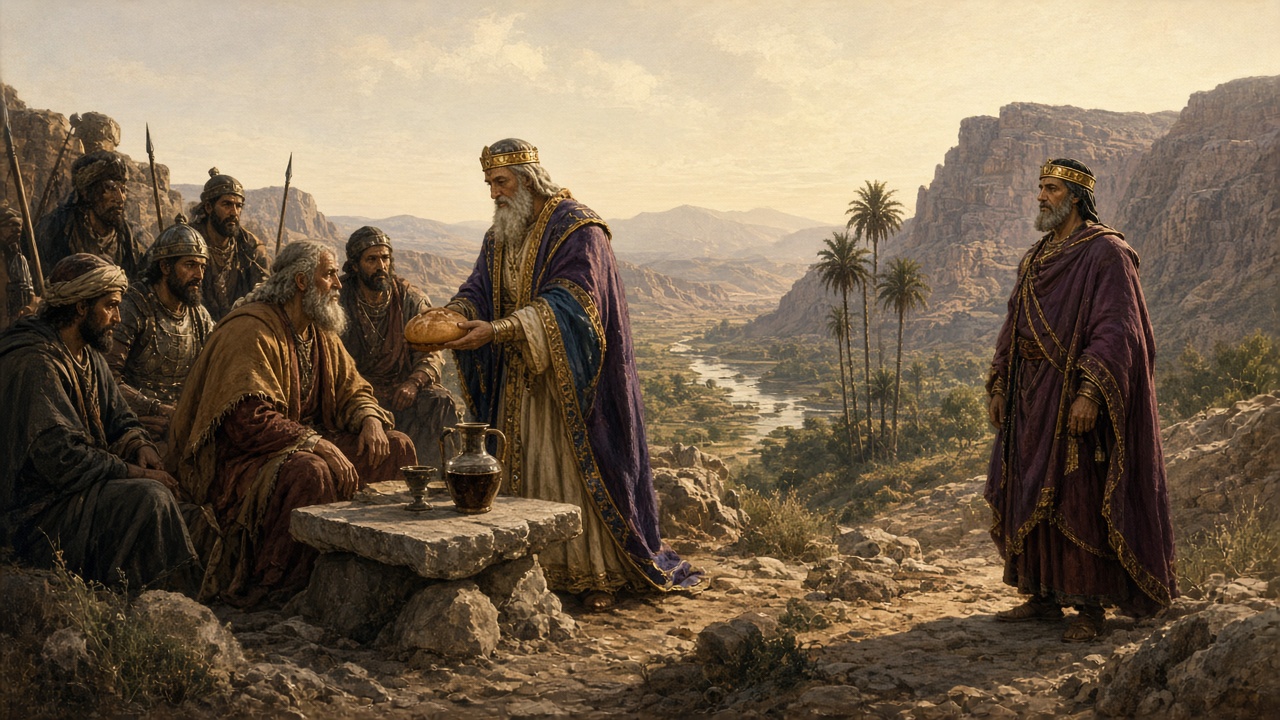
17When Abram came back after fighting Chedorlaomer and the other kings, the king of Sodom went to meet him. They met in a flat place called Shaveh, which is also called the King's Valley. 18A man called Melchizedek came to Abram too. He was the king of Salem and also a priest of God, the God who is greatest. He brought damper and wine to Abram.
19Then Melchizedek prayed to God and said,
“You are the greatest God,
the one who made heaven and all the world.
Bless Abram.
20You have looked after him and helped him today
and so he has chased all those soldiers away.
And now we praise you!”
Then Abram gave Melchizedek one tenth of all the good things he had taken from Chedorlaomer and the other kings, and brought back with him.
21The king of Sodom said to Abram, “Keep all these things for yourself, but give me back all my people.”
22Abram answered, “I will not keep anything of yours, not even a piece of string or a sandal strap. I say this to you and I use Yahweh's name. He is the one who made heaven and all the world. I am telling you this so that Yahweh, the greatest God, will hear and I won't change it. Then you can never say, ‘I have helped Abram to become rich.’ 24I will not take anything for myself. But my men have already eaten food, so that is ours, and no more. But let these men, Aner, Eshcol and Mamre take their share.”
Did you know?
The Campaign of the Four Kings
- Easton's Bible Dictionary (1897) identifies the four invading kings with names on ancient inscriptions: Chedorlaomer with Khudur-Lagamar of Elam, Amraphel with Khammu-rabi of Shinar (southern Chaldea), Arioch, king of Ellasar, with Eri-Aku of Larsa, and Tidal with Tudkhula. It explains Eri-Aku as an Elamite name meaning “servant of the moon-god,” later changed to Rimsin, and takes Goiim—“nations”—as Gutium, east of the Tigris and north of Elam.Sources: Chedorlaomer · Amraphel · Arioch (king of Ellasar) · Tidal
- The five local kings drew up for battle in the Valley of Siddim, which this chapter equates with the Salt Sea, and the valley was full of tar pits into which some of the fleeing men fell. Easton's Bible Dictionary places that valley at the south end of the Dead Sea, between Engedi and the cities of the plain, and calls the pits bitumen pits.Sources: the Bible text itself · Vale of Siddim
- Abram lived near the oaks of Mamre the Amorite, a brother of Eshcol and Aner, and the three were bound by treaty to him. Easton's Bible Dictionary calls Mamre and Eshcol Amorite chiefs and Aner a Canaanite chief, and notes that they joined Abram in pursuing Chedorlaomer and recovering Lot.Sources: the Bible text itself · Mamre · Eshcol · Aner
Notes written with AI assistance from open sources (Theographic Bible Metadata, CC BY-SA 4.0; Easton’s Bible Dictionary, public domain) and reviewed before publishing.
Places in this chapter
- Elam · 32.189, 48.258 · verses 1, 9
- Shinar · Today: Babylonia · 32.543, 44.422 · verses 1, 9
- Salt Sea · Today: Dead Sea · 31.500, 35.500 · verse 3
- Shaveh-kiriathaim · Today: within 1 km of Al Qurayyat · 31.541, 35.686 · verse 5
- Dan · Today: Tel Dan · 33.249, 35.652 · verse 14
- Damascus · 33.511, 36.306 · verse 15
- Valley of Shaveh · Today: intersection of Kidron Valley and Valley of Hinnom · 31.767, 35.236 · verse 17
- Salem · Today: Jerusalem · 31.777, 35.234 · verse 18
Only places identified with high confidence are shown (90% or more according to the scholarly sources compiled by OpenBible). Period map: DARE (Digital Atlas of the Roman Empire), CC BY 4.0; modern map: © OpenStreetMap contributors; places: OpenBible.info (CC BY 4.0).
Credits and license for this translation
Anindilyakwa English Bible
Portions of the Holy Bible in English easy for Anindilyakwa speakers in Australia to understand.
Copyright © 2021 Bible Society Australia
Language: English
This translation is made available to you under the terms of the
Creative Commons Attribution-Noncommercial-No Derivatives license 4.0.
You may share and redistribute this Bible translation or extracts from it in any format, provided that:
You include the above copyright and source information.
You do not sell this work for a profit.
You do not change any of the words or punctuation of the Scriptures.
Pictures included with Scriptures and other documents on this site are licensed just for use with those Scriptures and documents.
For other uses, please contact the respective copyright owners.
2021-11-23
Source: http://ebible.org/engaoi/ · eBible.org