Genesis 11
Anindilyakwa English Bible · Tap a verse to see its cross-references.
About a tower in Babylon
1At first, the people who lived at that time were living in different places but they all spoke the same language. 2They lived in the east, and as they wandered around they found a flat place called Babylonia and they stayed there.
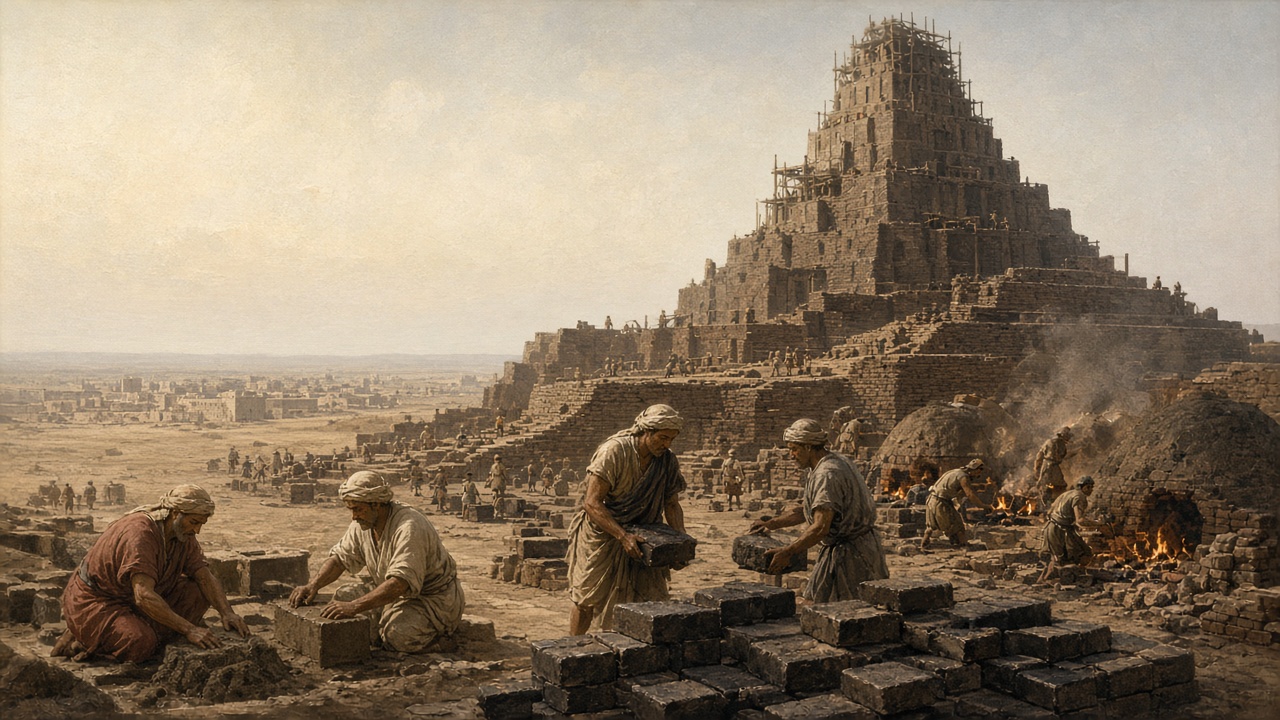
3Then those people talked about building houses. They said, “Let us make some houses out of mud.” So they wet some mud with water and made bricks and put them in the hot sun until they became hard. And they got some sticky tar. They put the bricks down one by one, and put some tar in between them so that the houses would be strong. And so they made their mud houses.
4Then they said, “Come on, let us make a lot of houses. And let us make one very tall one. It won't be like these others, it will be really tall. Let us make it so tall it will reach the sky. We want to show each other that we are strong, and also show our grandchildren that their grandfathers were good at work and very clever. Let us do this now so that we won't live all over the country, but all together in one place.”
5Then the people made many small houses and one very high tower. And Yahweh came down to see them. 6“They are all one people,” he said, “and they speak one language. First they have made this tower, and soon they will be doing other things. They will go on doing more and more things, whatever they want to do.
7“Let us go down and mix up their language so that they won't understand each other.”
8And Yahweh went down and mixed up their language and sent them all over the world. So the people stopped building the city. 9They called the city Babylon because Yahweh mixed up their language there and Babylon means “he mixed up the language.” And so Yahweh sent the people all over the world and they didn't know each other any more.
About Shem's descendants
10This is about Shem's descendants. After the flood two years went by and then Shem was 100 years old and he had a son called Arpachshad. 11After that he lived another 500 years and had other children.
12When Arpachshad was 35 years old, he had a son called Shelah. 13After that, he lived another 403 years and had other children.
14When Shelah was 30 years old, he had a son called Eber. 15After that, he lived another 403 years and had other children.
16When Eber was 34 years old, he had a son called Peleg. 17After that, he lived another 430 years and had other children.
18When Peleg was 30 years old, he had a son called Reu. 19After that, he lived another 209 years and had other children.
20When Reu was 32 years old, he had a son called Serug. 21After that, he lived another 207 years and had other children.
22When Serug was 30 years old, he had a son called Nahor. 23After that, he lived another 200 years and had other children.
24When Nahor was 29 years old, he had a son called Terah. 25After that, he lived another 119 years and had other children.
26After Terah was 70 years old, he had three sons called Abram, Nahor and Haran.
About Terah's descendants
27These are the descendants of Terah. His three sons were Abram, Nahor and Haran. Haran had a son called Lot, 28and Haran died in Ur, the city where he was born. Ur was in the country of Babylonia. Haran died there while his father Terah was still alive. 29Abram had a wife, Sarai, who was his younger sister but she had a different mother. People used to marry their sisters like that in that country. Nahor's wife was Milcah, Haran's daughter. Haran had another son called Iscah. 30Sarai was not able to have children.
31Terah took his son Abram and his grandson Lot, the one whose father Haran had died, and his daughter-in-law Sarai, Abram's wife, and they left the city of Ur to go to the land of Canaan.
Some time later they reached a city called Haran and they stayed there. 32The old man Terah, Abram's father, died in that city when he was 205 years old.
About Abram's family
Did you know?
Babel and the Road from Ur
- Travelers in this chapter settle on a plain in Shinar and build with baked brick and tar instead of stone and mortar. A dictionary treats Shinar as probably Babylonia or southern Mesopotamia, extending almost to the Persian Gulf, says the tower of Babel was built there, and describes the land's early inhabitants as people who made bricks and built cities.Sources: the Bible text itself · Shinar
- The unfinished city is named Babel because, the narrative says, there the Lord confused the language of the whole world and scattered its people. A dictionary explains the name as 'confusion' and suggests the tower was probably meant as a rallying-point on the wide plain of Shinar, after a migration from the uplands of Armenia, so the builders would not be scattered.Sources: the Bible text itself · Babel
- The chapter ends with Terah leaving Ur of the Chaldeans for Canaan with Abram, Sarai, and his grandson Lot, then settling in Haran, where he dies at 205; his son Haran had already died in Ur. A dictionary calls Ur that son's birthplace, the largest city of Shinar or northern Chaldea, and a center of trade and political power, and places Haran, now Harran and called Charran in the Greek Old Testament and in Acts, on the Belik, a Euphrates tributary in Upper Mesopotamia, where Abram stayed until Terah died.Sources: the Bible text itself · Terah · Ur of the Chaldees · Haran
Notes written with AI assistance from open sources (Theographic Bible Metadata, CC BY-SA 4.0; Easton’s Bible Dictionary, public domain) and reviewed before publishing.
Places in this chapter
- Shinar · Today: Babylonia · 32.543, 44.422 · verse 2
- Chaldea · 30.962, 46.104 · verses 28, 31
- Canaan · 32.767, 35.333 · verse 31
- Haran · Today: Harran · 36.864, 39.033 · verses 31, 32
Only places identified with high confidence are shown (90% or more according to the scholarly sources compiled by OpenBible). Period map: DARE (Digital Atlas of the Roman Empire), CC BY 4.0; modern map: © OpenStreetMap contributors; places: OpenBible.info (CC BY 4.0).
Credits and license for this translation
Anindilyakwa English Bible
Portions of the Holy Bible in English easy for Anindilyakwa speakers in Australia to understand.
Copyright © 2021 Bible Society Australia
Language: English
This translation is made available to you under the terms of the
Creative Commons Attribution-Noncommercial-No Derivatives license 4.0.
You may share and redistribute this Bible translation or extracts from it in any format, provided that:
You include the above copyright and source information.
You do not sell this work for a profit.
You do not change any of the words or punctuation of the Scriptures.
Pictures included with Scriptures and other documents on this site are licensed just for use with those Scriptures and documents.
For other uses, please contact the respective copyright owners.
2021-11-23
Source: http://ebible.org/engaoi/ · eBible.org