Matthew 13
Wycliffe Bible · Tap a verse to see its cross-references.
The Parable of the Sower
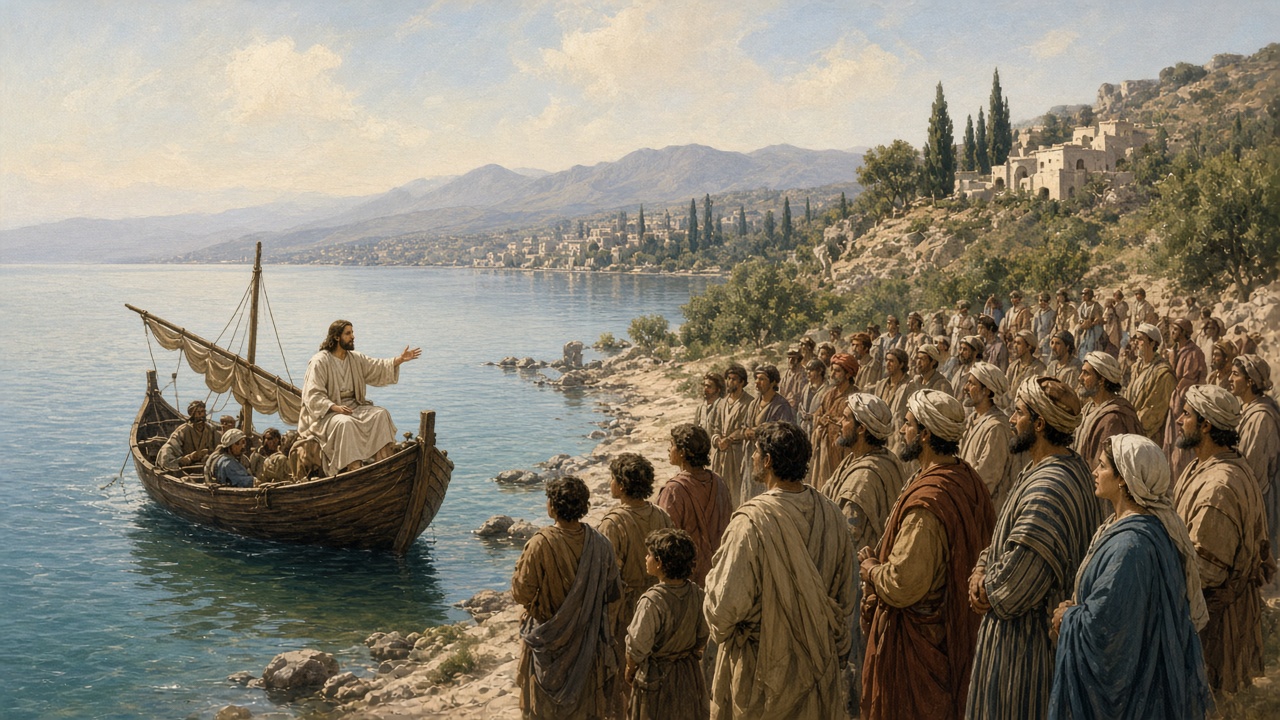
1In that dai Jhesus yede out of the hous, and sat bisidis the see. 2And myche puple was gaderid to hym, so that he wente up in to a boot, and sat; and al the puple stood on the brenke. 3And he spac to hem many thingis in parablis, and seide, Lo! he that sowith, yede out to sowe his seed. 4And while he sowith, summe seedis felden bisidis the weie, and briddis of the eir camen, and eeten hem. 5But othere seedis felden in to stony places, where thei hadden not myche erthe; and anoon thei sprongen vp, for thei hadden not depnesse of erthe. 6But whanne the sonne was risun, thei swaliden, and for thei hadden not roote, thei drieden vp. 7And other seedis felden among thornes; and thornes woxen vp, and strangeleden hem. 8But othere seedis felden in to good lond, and yauen fruyt; summe an hundrid foold, an othir sixti foold, an othir thritti foold. 9He that hath eris of heryng, here he.
The Purpose of Jesus’ Parables
10And the disciplis camen nyy, and seiden to him, Whi spekist thou in parablis to hem? 11And he answeride, and seide to hem, `For to you it is youun to knowe the priuytees of the kyngdom of heuenes; but it is not youun to hem. 12For it shal be youun to hym that hath, and he shal haue plente; but if a man hath not, also that thing that he hath shal be takun awei fro hym. 13Therfor Y speke to hem in parablis, for thei seynge seen not, and thei herynge heren not, nether vndurstonden; 14that the prophesie of Ysaie `seiynge be fulfillid `in hem, With heryng ye schulen here, and ye shulen not vndurstonde; and ye seynge schulen se, and ye shulen not se; 15for the herte of this puple is greetli fattid, and thei herden heuyli with eeris, and thei han closed her iyen, lest sumtime thei seen with iyen, and with eeris heeren, and vndirstonden in herte, and thei be conuertid, and Y heele hem. 16But youre iyen that seen ben blesside, and youre eeris that heren. 17Forsothe Y seie to you, that manye profetis and iust men coueitiden to se tho thingis that ye seen, and thei sayn not, and to heere tho thingis that ye heren, and thei herden not.
The Parable of the Sower Explained
18Therfor here ye the parable of the sowere. 19Ech that herith the word of the rewme, and vndirstondith not, the yuel spirit cometh, and rauyschith that that is sowun in his herte; this it is, that is sowun bisidis the weie. 20But this that is sowun on the stony loond, this it is, that herith the word of God, and anoon with ioye takith it. 21And he hath not roote in hym silf, but is temporal. For whanne tribulacioun and persecucioun is maad for the word, anoon he is sclaundrid. 22But he that is sowun in thornes, is this that heerith the word, and the bisynesse of this world, and the fallace of ritchessis strangulith the word, and it is maad with outen fruyt. 23But he that is sowun in to good loond, is this that herith the word, and vnderstondeth, and bryngith forth fruyt. And summe makith an hundrid fold, treuli anothir sixti fold, and another thritti fold.
The Parable of the Weeds
24Anothir parable Jhesus puttide forth to hem, and seide, The kyngdom of heuenes is maad lijk to a man, that sewe good seed in his feld. 25And whanne men slepten, his enemy cam, and sewe aboue taris in the myddil of whete, and wente awei. 26But whanne the erbe was growed, and made fruyt, thanne the taris apperiden. 27And the seruauntis of the hosebonde man camen, and seiden to hym, Lord, whether hast thou not sowun good seed in thi feeld? where of thanne hath it taris? 28And he seide to hem, An enemy hath do this thing. And the seruauntis seiden to him, `Wolt thou that we goon, and gaderen hem? 29And he seide, Nay, lest perauenture ye in gaderynge taris drawen vp with hem the whete bi the roote. 30Suffre ye hem bothe to wexe in to repyng tyme; and in the tyme of ripe corne Y shal seie to the reperis, First gadere ye to gidere the taris, and bynde hem to gidere in knytchis to be brent, but gadere ye whete in to my berne.
The Parable of the Mustard Seed
31Another parable Jhesus puttide forth to hem, and seide, The kyngdom of heuenes is lijk to a corn of seneuey, which a man took, and sewe in his feeld. 32Which is the leeste of alle seedis, but whanne it hath woxen, it is the moste of alle wortis, and is maad a tre; so that briddis of the eir comen, and dwellen in the bowis therof.
The Parable of the Leaven
33Another parable Jhesus spac to hem, The kyngdom of heuenes is lijk to sour douy, which a womman took, and hidde in thre mesuris of mele, til it were alle sowrid.
I Will Open My Mouth in Parables
34Jhesus spac alle thes thingis in parablis to the puple, and he spac not to hem with out parablis, that it schulde be fulfillid, 35that is seid bi the prophete, seiynge, Y shal opene my mouth in parablis; Y shal telle out hid thingis fro the makyng of the world.
The Parable of the Weeds Explained
36Thanne he lefte the puple, and cam in to an hous; and hise disciplis camen to him, and seiden, Expowne to vs the parable of taris of the feeld. 37Which answeride, and seide, He that sowith good seed is mannus sone; 38the feeld is the world; but the good seed, these ben sones of the kyngdom, but taris, these ben yuele children; 39the enemye that sowith hem is the feend; and the ripe corn is the endyng of the world, the reperis ben aungels. 40Therfor as taris ben gaderid togidere, and ben brent in fier, so it shal be in the endyng of the world. 41Mannus sone shal sende hise aungels, and thei schulen gadere fro his rewme alle sclaundris, and hem that doon wickidnesse; 42and thei schulen sende hem in to the chymney of fier, there shal be weping and betyng to gidere of teeth. 43Thanne iuste men schulen schyne as the sunne, in the rewme of her fadir. He that hath eeris of heryng, here he.
The Parables of the Treasure and the Pearl
44The kyngdom of heuenes is lijk to tresour hid in a feld, which a man that fyndith, hidith; and for ioye of it he goith, and sillith alle thingis that he hath, and bieth thilk feeld. 45Eftsoone the kyngdom of heuenes is lijk to a marchaunt, that sechith good margaritis; 46but whanne he hath foundun o precious margarite, he wente, and selde alle thingis that he hadde, and bouyte it.
The Parable of the Net
47Eft the kyngdom of heuenes is lijk to a nette cast into the see, and that gaderith to gidere of al kynde of fisschis; 48which whanne it was ful, thei drowen vp, and seten bi the brenke, and chesen the goode in to her vessels, but the yuel thei kesten out. 49So it schal be in the endyng of the world. Aungels schulen go out, and schulen departe yuel men fro the myddil of iuste men. 50And thei shulen sende hem in to the chymnei of fier; ther shal be weping and gryntyng of teeth. 51Han ye vndirstonde alle these thingis? Thei seien to hym, Yhe. 52He seith to hem, Therfor euery wise man of lawe in the kyngdom of heuenes, is lijk to an hosebonde man, that bryngith forth of his tresoure newe thingis and elde.
The Rejection at Nazareth
53And it was doon, whanne Jhesus hadde endid these parablis, he passide fro thennus. 54And he cam in to his cuntrei, and tauyte hem in her synagogis, so that thei wondriden, and seiden, Fro whennus this wisdam and vertues camen to this? 55Whether `is not this the sone of a carpentere? Whether his modir be not seid Marie? and hise britheren, James, and Joseph, and Symount, and Judas? and hise sistris, 56whether thei alle ben not among us? Fro whennus thanne `alle thes thingis camen to this? 57And so thei weren sclaundrid in hym. But Jhesus seide to hem, A profete is not with oute worschip, but in his owen cuntre, and in his owen hous. 58And he dide not there manye vertues, for the vnbileue of hem.
Did you know?
Parables of the Kingdom of Heaven
- On the day this chapter describes, Jesus left the house and sat by the sea. The crowd grew so large that he got into a boat and taught from there, while the people stood on the shore, and he told them nothing except in parables. One timeline dates these seaside parables to AD 28.Sources: the Bible text itself · Seaside Parables and Miracle
- When the disciples asked why he spoke to the people in parables, Jesus answered that the knowledge of the mysteries of the kingdom of heaven had been given to them, but not to the crowds. He said Isaiah’s prophecy was fulfilled in the crowds: they would keep hearing and seeing, yet never understand or perceive, because their heart had grown callous. Easton’s Bible Dictionary (1897) describes Isaiah as the son of Amoz, who prophesied during the reigns of Uzziah, Jotham, Ahaz, and Hezekiah.Sources: the Bible text itself · Isaiah
- Jesus later came to his hometown, taught in the synagogue, and the people took offense at him. They asked whether he was the carpenter’s son, named his mother Mary and his brothers James, Joseph, Simon, and Judas, and noted that his sisters were living among them; because of their unbelief he did not do many miracles there. Mary is identified as the wife of Joseph and the mother of Jesus, Simon as one of the Lord’s brothers, and one timeline dates this second rejection at Nazareth to AD 29.Sources: the Bible text itself · Mary (Mother of Jesus) · Simon · 2nd Rejection at Nazareth
Notes written with AI assistance from open sources (Theographic Bible Metadata, CC BY-SA 4.0; Easton’s Bible Dictionary, public domain) and reviewed before publishing.
Places in this chapter
- Nazareth · 32.702, 35.298 · verse 54
Only places identified with high confidence are shown (90% or more according to the scholarly sources compiled by OpenBible). Period map: DARE (Digital Atlas of the Roman Empire), CC BY 4.0; modern map: © OpenStreetMap contributors; places: OpenBible.info (CC BY 4.0).
Credits and license for this translation
Wycliffe Bible
This is the Pentateuch and Gospels from The Holy Bible, containing the Old and New Testaments, with the apocryphal books, in the earliest English version made from the latin Vulgate by John Wycliffe and his followers. c.1395
Public Domain
Language: Middle English (English)
Dialect: Middle
Translation by: John Wycliffe
2016-11-08
Section headings adapted from the Berean Standard Bible (public domain); they are not part of this translation’s text.
Source: http://ebible.org/engWycliffe/ · eBible.org