Luke 6
Wycliffe Bible · Tap a verse to see its cross-references.
The Lord of the Sabbath
1And it was don in the secounde firste sabat, whanne he passid bi cornes, hise disciplis pluckiden eeris of corn; and thei frotynge with her hondis, eeten. 2And summe of the Farisees seiden to hem, What doon ye that, that is not leeueful in the sabotis? 3And Jhesus answeride, and seide to hem, Han ye not redde, what Dauith dide, whanne he hungride, and thei that weren with hym; 4hou he entride in to the hous of God, and took looues of proposicioun, and eet, and yaf to hem that weren with hem; whiche looues it was not leeueful to eete, but oonli to prestis. 5And he seide to hem, For mannus sone is lord, yhe, of the sabat.
Jesus Heals on the Sabbath
6And it was don in another sabat, that he entride in to a synagoge, and tauyte. And a man was there, and his riyt hoond was drie. 7And the scribis and Farisees aspieden hym, if he wolde heele hym in the sabat, that thei schulden fynde cause, whereof thei schulden accuse hym. 8And he wiste the thouytis of hem, and he seide to the man that hadde a drie hoond, Rise vp, and stonde in to the myddil. And he roos, and stood. 9And Jhesus seide to hem, Y axe you, if it is leueful to do wel in the sabat, or yuel? to make a soule saaf, or to leese? 10And whanne he hadde biholde alle men aboute, he seide to the man, Hold forth thin hoond. And he held forth, and his hond was restorid to helthe. 11And thei weren fulfillid with vnwisdom, and spaken togidir, what thei schulden do of Jhesu.
The Twelve Apostles
12And it was don in tho daies, he wente out in to an hil to preye; and he was al nyyt dwellynge in the preier of God. 13And whanne the day was come, he clepide hise disciplis, and chees twelue of hem, whiche he clepide also apostlis; 14Symount, whom he clepide Petir, and Andrew, his brothir, James and Joon, 15Filip and Bartholomew, Matheu and Thomas, James Alphei, and Symount, that is clepid Zelotes, 16Judas of James, and Judas Scarioth, that was traytoure.
Jesus Heals the Multitudes
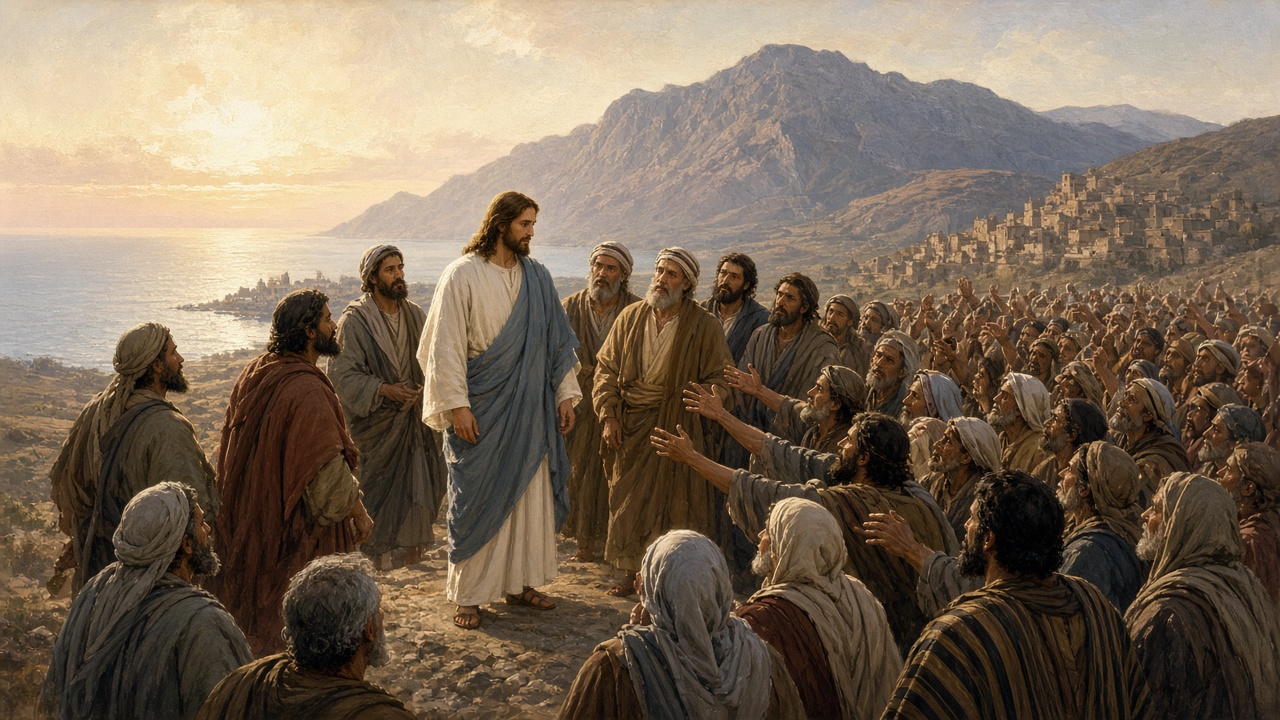
17And Jhesus cam doun fro the hil with hem, and stood in a feeldi place; and the cumpeny of hise disciplis, and a greet multitude of puple, of al Judee, and Jerusalem, and of the see coostis, and of Tyre and Sidon, 18that camen to here hym, and to be heelid of her siknessis; and thei that weren trauelid of vncleene spiritis, weren heelid. 19And al puple souyte to touche hym, for vertu wente out of hym, and heelide alle.
The Beatitudes
20And whanne hise iyen weren cast vp in to hise disciplis, he seide, Blessid be ye, `pore men, for the kyngdom of God is youre. 21Blessid be ye, that now hungren, for ye schulen be fulfillid. Blessid be ye, that now wepen, for ye schulen leiye. 22Ye schulen be blessid, whanne men schulen hate you, and departe you awei, and putte schenschip to you, and cast out youre name as yuel, for mannus sone. 23Joye ye in that dai, and be ye glad; for lo! youre meede is myche in heuene; for aftir these thingis the fadris of hem diden to prophetis.
Woes to the Satisfied
24Netheles wo to you, riche men, that han youre coumfort. 25Wo to you that ben fulfillid, for ye schulen hungre. Wo to you that now leiyen, for ye schulen morne, and wepe. 26Wo to you, whanne alle men schulen blesse you; aftir these thingis the fadris of hem diden to profetis.
Love Your Enemies
27But Y seie to you that heren, loue ye youre enemyes, do ye wel to hem that hatiden you; 28blesse ye men that cursen you, preye ye for men that defamen you. 29And to him that smytith thee on o cheeke, schewe also the tothir; and fro hym that takith awei fro thee a cloth, nyle thou forbede the coote. 30And yyue to eche that axith thee, and if a man takith awei tho thingis that ben thine, axe thou not ayen. 31And as ye wolen that men do to you, do ye also to hem in lijk maner. 32And if ye louen hem that louen you, what thanke is to you? for synful men louen men that louen hem. 33And if ye don wel to hem that don wel to you, what grace is to you? synful men don this thing. 34And if ye leenen to hem of whiche ye hopen to take ayen, what thanke is to you? for synful men leenen to synful men, to take ayen as myche. 35Netheles loue ye youre enemyes, and do ye wel, and leene ye, hopinge no thing therof, and youre mede schal be myche, and ye schulen be the sones of the Heyest, for he is benygne on vnkynde men and yuele men. 36Therfor be ye merciful, as youre fadir is merciful.
Judging Others
37Nyle ye deme, and ye schulen not be demed. Nyle ye condempne, and ye schulen not be condempned; foryyue ye, and it schal be foryouun to you. 38Yyue ye, and it schal be youun to you. Thei schulen yyue in to youre bosum a good mesure, and wel fillid, and schakun togidir, and ouerflowynge; for bi the same mesure, bi whiche ye meeten, it schal be metun `ayen to you. 39And he seide to hem a liknesse, Whether the blynde may leede the blynde? ne fallen thei not bothe `in to the diche? 40A disciple is not aboue the maistir; but eche schal be perfite, if he be as his maister. 41And what seest thou in thi brotheris iye a moot, but thou biholdist not a beem, that is in thin owne iye? 42Or hou maist thou seie to thi brother, Brothir, suffre, Y schal caste out the moot of thin iye, and thou biholdist not a beem in thin owne iye? Ipocrite, first take out the beem of thin iye, and thanne thou schalt se to take the moot of thi brotheris iye.
A Tree and Its Fruit
43It is not a good tree, that makith yuel fruytis, nether an yuel tree, that makith good fruytis; 44for euery tre is knowun of his fruyt. And men gaderen not figus of thornes, nethir men gaderen a grape of a buysche of breris. 45A good man of the good tresoure of his herte bryngith forth good thingis, and an yuel man of the yuel tresoure bryngith forth yuel thingis; for of the plente of the herte the mouth spekith.
The House on the Rock
46And what clepen ye me, Lord, Lord, and doon not tho thingis that Y seie. 47Eche that cometh to me, and herith my wordis, and doith hem, Y schal schewe to you, to whom he is lijk. 48He is lijk to a man that bildith an hous, that diggide deepe, and sette the foundement on a stoon. And whanne greet flood was maad, the flood was hurtlid to that hous, and it miyte not moue it, for it was foundid on a sad stoon. 49But he that herith, and doith not, is lijk to a man bildynge his hous on erthe with outen foundement; in to which the flood was hurlid, and anoon it felle doun; and the fallyng doun of that hous was maad greet.
Did you know?
The Sabbath, the Twelve, and the Plain
- On a Sabbath, as Jesus passed through the grainfields, his disciples picked heads of grain, rubbed them in their hands, and ate them, and some Pharisees called this unlawful. Jesus recalled that David and his hungry companions ate consecrated bread from the house of God, bread lawful only for the priests, and said that the Son of Man is Lord of the Sabbath. On another Sabbath he restored a man’s withered right hand in the synagogue while scribes and Pharisees watched for a reason to accuse him; a chronology dates both episodes to AD 28.Sources: the Bible text itself · Corn on the Sabbath · Healing a Withered Hand
- After spending the night in prayer on the mountain, Jesus called his disciples and chose twelve, whom he designated apostles. Among them were Simon, whom he named Peter, and Peter’s brother Andrew, fishermen from Bethsaida on the western coast of the Sea of Galilee, and Matthew, a tax collector at Capernaum who had formerly been known as Levi.Sources: the Bible text itself · Simon Peter · Andrew · Matthew
- Jesus came down with them and stood on a level place, where people from Judea, Jerusalem, and the sea coast of Tyre and Sidon had gathered to hear him and to be healed. Tyre and Sidon were ancient Phoenician cities on the Mediterranean; Sidon, the older city, lay about twenty-five miles north of Tyre. A chronology dates this teaching to AD 28 and titles it the Sermon on the Mount, though the narrative places Jesus on level ground after he came down from the mountain.Sources: the Bible text itself · Tyre · Sidon · Sermon on the Mount
Notes written with AI assistance from open sources (Theographic Bible Metadata, CC BY-SA 4.0; Easton’s Bible Dictionary, public domain) and reviewed before publishing.
Places in this chapter
- Jerusalem · 31.777, 35.234 · verse 17
- Judea · Today: Judea 1 · 31.777, 35.234 · verse 17
- Sidon · Today: Sandikli archaeological site in Sidon · 33.561, 35.372 · verse 17
- Tyre · 33.271, 35.196 · verse 17
Only places identified with high confidence are shown (90% or more according to the scholarly sources compiled by OpenBible). Period map: DARE (Digital Atlas of the Roman Empire), CC BY 4.0; modern map: © OpenStreetMap contributors; places: OpenBible.info (CC BY 4.0).
Credits and license for this translation
Wycliffe Bible
This is the Pentateuch and Gospels from The Holy Bible, containing the Old and New Testaments, with the apocryphal books, in the earliest English version made from the latin Vulgate by John Wycliffe and his followers. c.1395
Public Domain
Language: Middle English (English)
Dialect: Middle
Translation by: John Wycliffe
2016-11-08
Section headings adapted from the Berean Standard Bible (public domain); they are not part of this translation’s text.
Source: http://ebible.org/engWycliffe/ · eBible.org