John 8
Wycliffe Bible · Tap a verse to see its cross-references.
The Woman Caught in Adultery
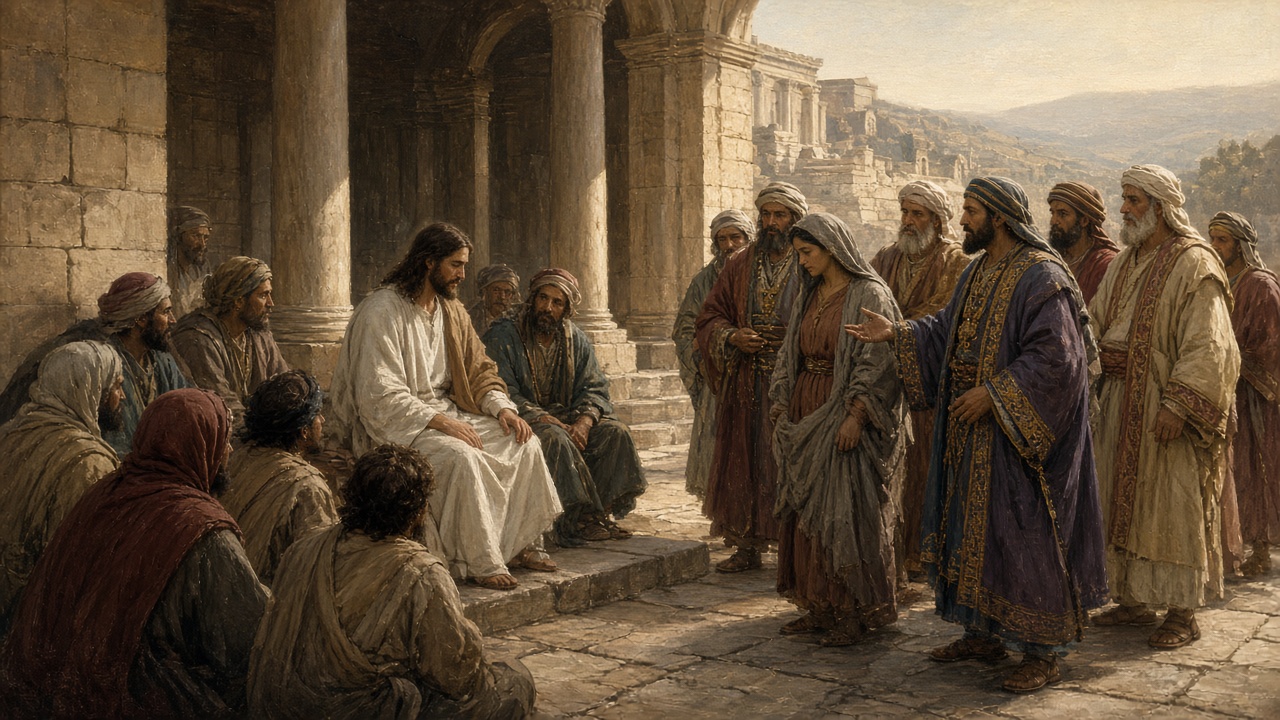
1But Jhesus wente in to the mount of Olyuete. 2And eerli eft he cam in to the temple; and al the puple cam to hym; and he sat, and tauyte hem. 3And scribis and Fariseis bryngen a womman takun in auoutrye, and thei settiden hir in the myddil, 4and seiden to hym, Maystir, this womman is now takun in auoutrie. 5And in the lawe Moises comaundide vs to stoone suche; therfor what seist thou? 6And thei seiden this thing temptynge hym, that thei myyten accuse hym. And Jhesus bowide hym silf doun, and wroot with his fyngur in the erthe. 7And whanne thei abiden axynge hym, he reiside hym silf, and seide to hem, He of you that is without synne, first caste a stoon in to hir. 8And eft he bowide hym silf, and wroot in the erthe. 9And thei herynge these thingis, wenten awei oon aftir anothir, and thei bigunnen fro the eldre men; and Jhesus dwelte aloone, and the womman stondynge in the myddil. 10And Jhesus reiside hym silf, and seide to hir, Womman, where ben thei that accusiden thee? no man hath dampned thee. 11Sche seide, No man, Lord. Jhesus seide `to hir, Nethir Y schal dampne thee; go thou, and now aftirward nyle thou synne more.
Jesus the Light of the World
12Therfor eft Jhesus spak to hem, and seide, Y am the liyt of the world; he that sueth me, walkith not in derknessis, but schal haue the liyt of lijf. 13Therfor the Fariseis seiden, Thou berist witnessyng of thi silf; thi witnessyng is not trewe. 14Jhesus answerde, and seide to hem, And if Y bere witnessyng of my silf, my witnessyng is trewe; for Y woot fro whennus Y cam, and whidur Y go. 15But ye witen not fro whennus Y cam, ne whidur Y go. For ye demen aftir the fleisch, but Y deme no man; 16and if Y deme, my doom is trewe, for Y am not aloone, but Y and the fadir that sente me. 17And in youre lawe it is writun, that the witnessyng of twei men is trewe. 18Y am, that bere witnessyng of my silf, and the fadir that sente me, berith witnessyng of me. 19Therfor thei seiden to hym, Where is thi fadir? Jhesus answeride, Nether ye knowen me, nethir ye knowen my fadir; if ye knewen me, perauenture ye schulden knowe also my fadir. 20Jhesus spak these wordis in the tresorie, techynge in the temple; and no man took hym, for his our cam not yit. 21Therfor eft Jhesus seide to hem, Lo! Y go, and ye schulen seke me, and ye schulen die in youre synne; whidur Y go, ye moun not come. 22Therfor the Jewis seiden, Whether he schal sle hym silf, for he seith, Whidur Y go, ye moun not come? 23And he seide to hem, Ye ben of bynethe, Y am of aboue; ye ben of this world, Y am not of this world. 24Therfor Y seide to you, that ye schulen die in youre synnes; for if ye bileuen not that Y am, ye schulen die in youre synne. 25Therfor thei seiden to hym, Who art thou? Jhesus seide to hem, The bigynnyng, which also speke to you. 26Y haue many thingis to speke, and deme of you, but he that sente me is sothefast; and Y speke in the world these thingis, that Y herde of hym. 27And thei knewen not, that he clepide his fadir God. 28Therfor Jhesus seith to hem, Whanne ye han areisid mannus sone, thanne ye schulen knowe, that Y am, and of my silf Y do no thing; but as my fadir tauyte me, Y speke these thingis. 29And he that sente me is with me, and lefte me not aloone; for Y do euermore tho thingis, that ben plesynge to hym.
The Truth Will Set You Free
30Whanne he spak these thingis, manye bileueden in hym. 31Therfor Jhesus seide to the Jewis, that bileueden in hym, If ye dwellen in my word, verili ye schulen be my disciplis; 32and ye schulen knowe the treuthe, and the treuthe schal make you fre. 33Therfor the Jewis answeriden to hym, We ben the seed of Abraham, and we serueden neuere to man; hou seist thou, That ye schulen be fre? 34Jhesus answeride to hem, Treuli, treuli, Y seie to you, ech man that doith synne, is seruaunt of synne. 35And the seruaunt dwellith not in the hows with outen ende, but the sone dwellith with outen ende. 36Therfor if the sone make you fre, verili ye schulen be fre. 37Y woot that ye ben Abrahams sones, but ye seken to sle me, for my word takith not in you. 38Y speke tho thingis, that Y say at my fadir; and ye doen tho thingis, that ye sayn at youre fadir. 39Thei answerden, and seiden to hym, Abraham is oure fadir. Jhesus seith to hem, If ye ben the sones of Abraham, do ye the werkis of Abraham. 40But now ye seken to sle `me, a man that haue spoken to you treuthe, that Y herde of God; Abraham dide not this thing. 41Ye doen the werkis of youre fadir. Therfor thei seiden to hym, We ben not borun of fornycacioun; we han o fadir, God. 42But Jhesus seith to hem, If God were youre fadir, sotheli ye schulden loue me; for Y passide forth of God, and cam; for nether Y cam of my silf, but he sente me. 43Whi knowen ye not my speche? for ye moun not here my word. 44Ye ben of the fadir, the deuel, and ye wolen do the desyris of youre fadir. He was a mansleere fro the bigynnyng, and he stood not in treuthe; for treuthe is not in hym. Whanne he spekith lesyng, he spekith of his owne; for he is a liere, and fadir of it. 45But for Y seie treuthe, ye bileuen not to me. 46Who of you schal repreue me of synne? if Y sey treuthe, whi bileuen ye not to me? 47He that is of God, herith the wordis of God; therfor ye heren not, for ye ben not of God.
Before Abraham Was Born, I Am
48Therfor the Jewis answeriden, and seiden, Whether we seien not wel, that thou art a Samaritan, and hast a deuel? 49Jhesus answerde, and seide, Y haue not a deuel, but Y onoure my fadir, and ye han vnhonourid me. 50For Y seke not my glorye; there is he, that sekith, and demeth. 51Treuli, treuli, Y seie to you, if ony man kepe my word, he schal not taste deth with outen ende. 52Therfor the Jewis seiden, Now we han knowun, that thou hast a deuel. Abraham is deed, and the prophetis, and thou seist, If ony man kepe my word, he schal not taste deth withouten ende. 53Whether thou art grettere than oure fader Abraham, that is deed, and the prophetis ben deed; whom makist thou thi silf? 54Jhesus answeride, If Y glorifie my silf, my glorie is nouyt; my fadir, is that glorifieth me, whom ye seien, that he is youre God. 55And ye han not knowun hym, but Y haue knowun hym; and if Y seie that Y knowe hym not, Y schal be a liere lich to you; but Y knowe hym, and Y kepe his word. 56Abraham, youre fadir, gladide to se my dai; and he saiy, and ioyede. 57Thanne the Jewis seiden to hym, Thou hast not yit fifti yeer, and hast thou seien Abraham? 58Therfor Jhesus seide to hem, Treuli, treuli, Y seie to you, bifor that Abraham schulde be, Y am. 59Therfor thei token stonys, to caste to hym; but Jhesus hidde hym, and wente out of the temple.
Did you know?
Light, Law, and Abraham
- John 8 opens as Jesus goes to the Mount of Olives and returns early in the morning to the temple courts, where he sits and teaches the people who gather. The Mount of Olives is a ridge east of Jerusalem, separated from the city by the Kidron valley and named for the olive trees that cover its sides.Sources: the Bible text itself · Mount of Olives
- Scribes and Pharisees bring in a woman caught in adultery and ask Jesus what he says about Moses' command in the Law to stone such a woman, seeking to test him and to gain a basis for accusing him. Still in the temple courts, near the treasury, Jesus later says, "I am the light of the world." A dated event list places both episodes in AD 29, each lasting one day.Sources: the Bible text itself · Woman Caught in Adultery · Light of the World/I am discourse
- When Jesus says that the truth will set them free, his hearers answer that they are Abraham's descendants and have never been slaves to anyone. Abraham is called "father of a multitude"; he was the son of Terah and the heir of the promises. After Jesus declares, "before Abraham was born, I am," they pick up stones to throw at him.Sources: the Bible text itself · Abraham
Notes written with AI assistance from open sources (Theographic Bible Metadata, CC BY-SA 4.0; Easton’s Bible Dictionary, public domain) and reviewed before publishing.
Places in this chapter
- Mount of Olives · 31.778, 35.246 · verse 1
Only places identified with high confidence are shown (90% or more according to the scholarly sources compiled by OpenBible). Period map: DARE (Digital Atlas of the Roman Empire), CC BY 4.0; modern map: © OpenStreetMap contributors; places: OpenBible.info (CC BY 4.0).
Credits and license for this translation
Wycliffe Bible
This is the Pentateuch and Gospels from The Holy Bible, containing the Old and New Testaments, with the apocryphal books, in the earliest English version made from the latin Vulgate by John Wycliffe and his followers. c.1395
Public Domain
Language: Middle English (English)
Dialect: Middle
Translation by: John Wycliffe
2016-11-08
Section headings adapted from the Berean Standard Bible (public domain); they are not part of this translation’s text.
Source: http://ebible.org/engWycliffe/ · eBible.org