John 4
Wycliffe Bible · Tap a verse to see its cross-references.
Jesus and the Samaritan Woman
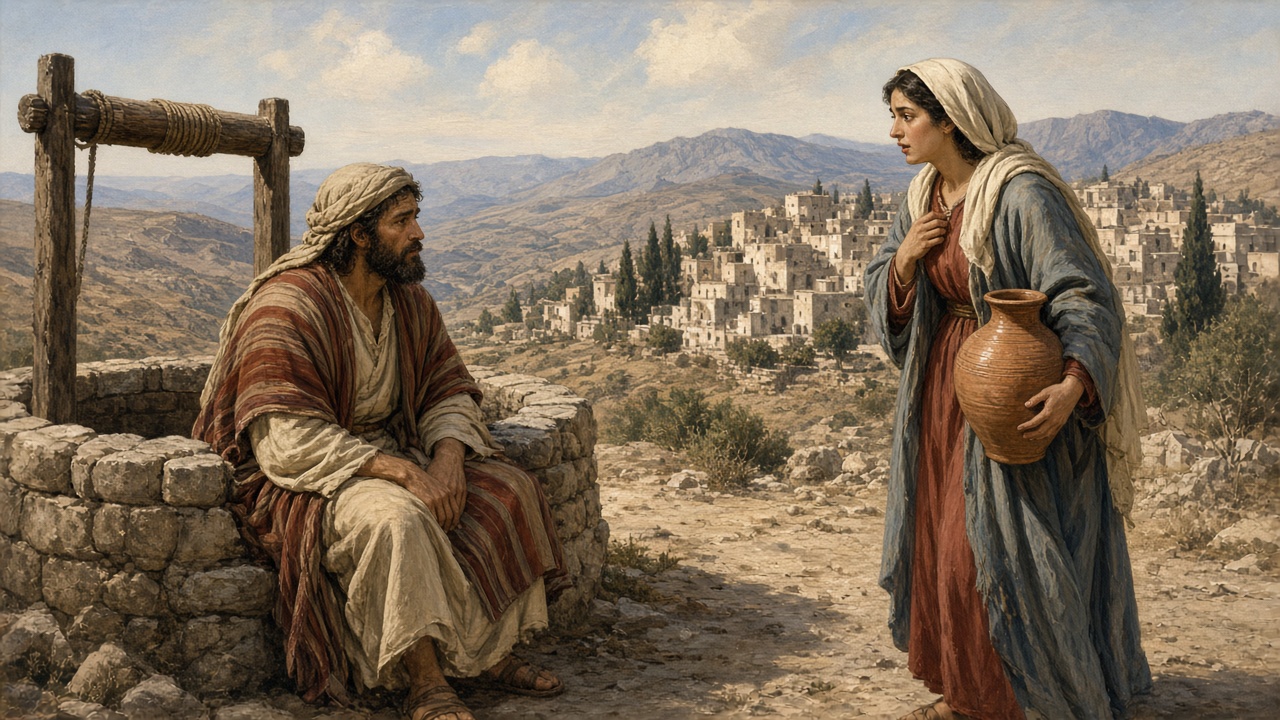
1Therfor as Jhesu knew, that the Farisees herden, that Jhesu makith and baptisith mo disciplis than Joon, 2thouy Jhesus baptiside not, but hise disciplis, he lefte Judee, 3and wente ayen in to Galilee. 4And it bihofte hym to passe bi Samarie. 5Therfor Jhesus cam in to a citee of Samarie, that is seid Sicar, bisidis the place, that Jacob yaf to Joseph, his sone. 6And the welle of Jacob was there; and Jhesus was weri of the iourney, and sat thus vpon the welle. And the our was, as it were the sixte. 7And a womman cam fro Samarie, to drawe watir. And Jhesus seith to hir, Yyue me drynk. 8And hise disciplis weren gon in to the citee, to bie mete. 9Therfor thilke womman of Samarie seith to him, Hou thou, `whanne thou art a Jewe, axist of me drynk, that am a womman of Samarie? for Jewis vsiden not to dele with Samaritans. 10Jhesus answerde, and seide to hir, If thou wistist the yifte of God, and who `he is, that seith to thee, Yyue me drynk, thou perauenture woldist haue axid of hym, and he schulde haue youun to thee quyk watir. 11The womman seith to him, Sire, thou hast not where ynne to drawe, and the pit is deep; wherof thanne hast thou quik watir? 12Whethir thou art grettere than oure fadir Jacob, that yaf to vs the pit? and he drank therof, and hise sones, and hise beestis. 13Jhesus answerde, and seide to hir, Eche man that drynkith of this watir, schal thirste efte soone; but he that drynkith of the watir that Y schal yyue hym, schal not thirste with outen ende; but the watir that Y schal yyue hym, 14schal be maad in hym a welle `of watir, spryngynge vp in to euerlastynge lijf. 15The womman seith to hym, Sire, yyue me this watir, that Y thirste not, nether come hidur to drawe. 16Jhesus seith to hir, Go, clepe thin hosebonde, and come hidir. 17The womman answerde, and seide, Y haue noon hosebonde. Jhesus seith to hir, Thou seidist wel, That Y haue noon hosebonde; 18for thou hast hadde fyue hosebondis, and he that thou hast, is not thin hosebonde. This thing thou seidist sotheli. 19The womman seith to hym, Lord, Y se, that thou art a prophete. 20Oure fadris worschipiden in this hil, and ye seien, that at Jerusalem is a place, where it bihoueth to worschipe. 21Jhesus seith to hir, Womman, bileue thou to me, for the our schal come, whanne nether in this hil, nethir in Jerusalem, ye schulen worschipe the fadir. 22Ye worschipen that ye knowen not; we worschipen that that we knowen; for helthe is of the Jewis. 23But the tyme is comun, and now it is, whanne trewe worschiperis schulen worschipe the fadir in spirit and treuthe; for also the fadir sekith suche, that worschipen hym. 24God is a spirit, and it bihoueth hem that worschipen hym, to worschipe in spirit and treuthe. 25The womman seith to hym, Y woot that Messias is comun, that is seid Crist; therfor whanne he cometh, he schal telle vs alle thingis. 26Jhesus seith to hir, Y am he, that spekith with thee.
The Disciples Return and Marvel
27And anoon hise disciplis camen, and wondriden, that he spak with the womman; netheles no man seide to hym, What sekist thou, or, What spekist thou with hir? 28Therfor the womman lefte hir watir pot, and wente in to the citee, and seide to tho men, 29Come ye, and se ye a man, that seide to me alle thingis that Y haue don; whether he be Crist? 30And thei wenten out of the citee, and camen to hym. 31In the mene while hise disciplis preieden hym, and seiden, Maistir, ete. 32But he seide to hem, Y haue mete to ete, that ye knowen not. 33Therfor disciplis seiden togidir, Whether ony man hath brouyt him mete to ete? 34Jhesus seith to hem, My mete is, that Y do the wille of hym that sente me, that Y perfourme the werk of hym. 35Whether ye seien not, that yit foure monethis ben, and rype corn cometh? Lo! Y seie to you, lifte vp youre iyen, and se ye the feeldis, for now thei ben white to repe. 36And he that repith takith hire, and gaderith fruyt in to euerlastynge lijf; that bothe he that sowith, and he that repith, haue ioye togidere. 37In this thing is the word trewe, for anothir is that sowith, and anothir that repith. 38Y sente you to repe, that that ye `haue not trauelid; `othere men han trauelid, and ye han entrid `in to her trauels.
Many Samaritans Believe
39And of that citee many Samaritans bileueden in hym, for the word of the womman, that bare witnessyng, That he seide to me alle thingis that Y haue don. 40Therfor whanne Samaritans camen to hym, thei preieden hym to dwelle there; and he dwelte there twey daies. 41And many mo bileueden for his word, 42and seiden to the womman, That now not for thi speche we bileuen; for we han herd, and we witen, that this is verili the sauyour of the world.
Jesus Heals the Official’s Son
43And aftir twei daies he wente out fro thennus, and wente in to Galilee. 44And he bar witnessyng, that a profete in his owne cuntre hath noon onour. 45Therfor whanne he cam in to Galilee, men of Galilee resseyueden hym, whanne thei hadden seyn alle thingis that he hadde don in Jerusalem in the feeste dai; for also thei hadden comun to the feeste dai. 46Therfor he cam eftsoone in to the Cane of Galile, where he made the watir wiyn. And `a litil kyng was, whos sone was sijk at Cafarnaum. 47Whanne this hadde herd, that Jhesu schulde come fro Judee in to Galilee, he wente to hym, and preiede hym, that he schulde come doun, and heele his sone; for he bigan to die. 48Therfor Jhesus seide to him, But ye se tokenes and grete wondris, ye bileuen not. 49The litil kyng seith to hym, Lord, come doun, bifor that my sone die. 50Jhesus seith to hym, Go, thi sone lyueth. The man bileuede to the word, that Jhesus seide to hym, and he wente. 51And now whanne he cam doun, the seruauntis camen ayens hym, and telden to hym, and seiden, That his sone lyuede. 52And he axide of hem the our, in which he was amendid. And thei seiden to hym, For yistirdai in the seuenthe our the feuer lefte him. 53Therfor the fadir knewe, that thilke our it was, in which Jhesus seide to hym, Thi sone lyueth; and he bileuede, and al his hous. 54Jhesus dide eft this secounde tokene, whanne he cam fro Judee in to Galilee.
Did you know?
Living Water in Samaria
- Jesus left Judea to return to Galilee, and the Gospel says he had to pass through Samaria. Under the Romans in Jesus' time, Judea was the southernmost of Palestine's three divisions, distinguished from Samaria and Galilee, and the narrative notes that Jews did not associate with Samaritans.Sources: the Bible text itself · Judea
- He came to Sychar, near the plot of ground that Jacob had given his son Joseph, and, weary from the journey, sat down by Jacob's well. Easton's Bible Dictionary (1897) records that from the time of the Crusaders Sychar was usually identified with Shechem, but that explorations had identified it with 'Askar, a small Samaritan town on the southern base of Ebal, about a mile north of the well.Sources: the Bible text itself · Sychar
- The woman contrasted worship on this mountain with the Jewish claim that one must worship in Jerusalem, and she spoke of a coming Messiah, called Christ. When the disciples returned from buying food in the town, they were surprised that Jesus was speaking with a woman.Sources: the Bible text itself
Notes written with AI assistance from open sources (Theographic Bible Metadata, CC BY-SA 4.0; Easton’s Bible Dictionary, public domain) and reviewed before publishing.
Places in this chapter
- Galilee · 32.760, 35.527 · verses 3, 43, 45, 46, 47, 54
- Judea · Today: Judea 1 · 31.777, 35.234 · verses 3, 47, 54
- Samaria · Today: Samaria 2 · 32.276, 35.195 · verses 4, 5, 7, 9
- Jerusalem · 31.777, 35.234 · verses 20, 21, 45
- Mount Gerizim · 32.199, 35.273 · verse 20
Only places identified with high confidence are shown (90% or more according to the scholarly sources compiled by OpenBible). Period map: DARE (Digital Atlas of the Roman Empire), CC BY 4.0; modern map: © OpenStreetMap contributors; places: OpenBible.info (CC BY 4.0).
Credits and license for this translation
Wycliffe Bible
This is the Pentateuch and Gospels from The Holy Bible, containing the Old and New Testaments, with the apocryphal books, in the earliest English version made from the latin Vulgate by John Wycliffe and his followers. c.1395
Public Domain
Language: Middle English (English)
Dialect: Middle
Translation by: John Wycliffe
2016-11-08
Section headings adapted from the Berean Standard Bible (public domain); they are not part of this translation’s text.
Source: http://ebible.org/engWycliffe/ · eBible.org