Genesis 46
Wycliffe Bible · Tap a verse to see its cross-references.
Jacob’s Journey to Egypt
1And Israel yede forth with alle thingis that he hadde, and he cam to the pit of ooth; and whanne sacrifices weren slayn there to God of his fadir Isaac, 2he herde God bi a visioun in that nyyt clepynge hym, `and seiynge to hym, Jacob! Jacob! To whom he answeride, Lo! Y am present. 3God seide to hym, Y am the strongeste God of thi fadir; nyle thou drede, go doun in to Egipt, for Y schal make thee there in to a greet folk; 4Y schal go doun thidir with thee, and Y schal brynge thee turnynge ayen fro thennus, and Joseph schal sette his hond on thin iyen. 5Jacob roos fro the pit of ooth, and the sones token him, with her litle children, and wyues, in the waynes whiche Farao hadde sent to bere the eld man, 6and alle thingis whiche he weldide in the lond of Canaan; and he cam in to Egipt with his seed,
Those Who Went to Egypt
7hise sones, and her sones, and douytris, and al the generacioun togidere.
The Children of Leah
8Forsothe thes ben the names of the sones of Israel, that entriden in to Egipte; he with hise fre children. The firste gendrid Ruben; 9the sones of Ruben, Enoch, and Fallu, and Esrom, and Carmi. 10The sones of Symeon, Jemuhel, and Jamyn, and Ahoth, and Jachyn, and Sab, and Saber, and Saul, the sone of a womman of Canaan. 11The sones of Leuy, Gerson, Caath, and Merarie. 12The sones of Juda, Her and Onam, and Sela, and Fares, and Zara. Forsothe Her and Onam dieden in the lond of Canaan; and the sones of Fares weren borun, Esrom, and Amul. 13The sones of Isacar, Thola, and Fua, and Jobab, and Semron. 14The sones of Zabulon, Sared, and Thelom, and Jahel. 15These ben the sones of Lia, whiche sche childide in Mesopotanye of Sirie, with Dyna, hir douyter; alle the soules of hise sones and douytris, thre and thretti.
The Children of Zilpah
16The sones of Gad, Sefion, and Aggi, Suny, and Hesebon, Heri, and Arodi, and Areli. 17The sones of Aser, Jamne, and Jesua, and Jesui, and Beria; and Sara, the sister of hem. The sones of Beria, Heber and Melchiel. 18These weren the sones of Zelfa, whom Laban yaf to Lia, his douyter, and Jacob gendryde these sixtene persones.
The Children of Rachel
19The sones of Rachel, `wijf of Jacob, weren Joseph and Beniamyn. 20And sones weren borun to Joseph in the loond of Egipt, Manasses and Effraym, whiche Asenech, `douytir of Putifar, preest of Helipoleos, childide to hym. 21The sones of Beniamin weren Bela, and Becor, and Asbel, Gera, and Naaman, and Jechi, `Ros, and Mofym, and Ofym, and Ared. 22These weren the sones of Rachel, whiche Jacob gendride; alle the persones weren fouretene.
The Children of Bilhah
23The sone of Dan, Vsym. 24The sones of Neptalym, Jasiel, and Guny, and Jeser, and Salem. 25These weren `the sones of Bala, whom Laban yaf to Rachel his douytir. 26And Jacob gendride these; alle the soules weren seuene. And alle the men that entriden with Jacob in to Egipt, and yeden out of his thiy, with out `the wyues of his sones, weren sixti and sixe. 27Forsothe the sones of Joseph, that weren borun to hym in `the loond of Egipt, weren two men. Alle the soulis of `the hows of Jacob, that entriden in to Egipt, weren seuenti.
Jacob Arrives in Egypt
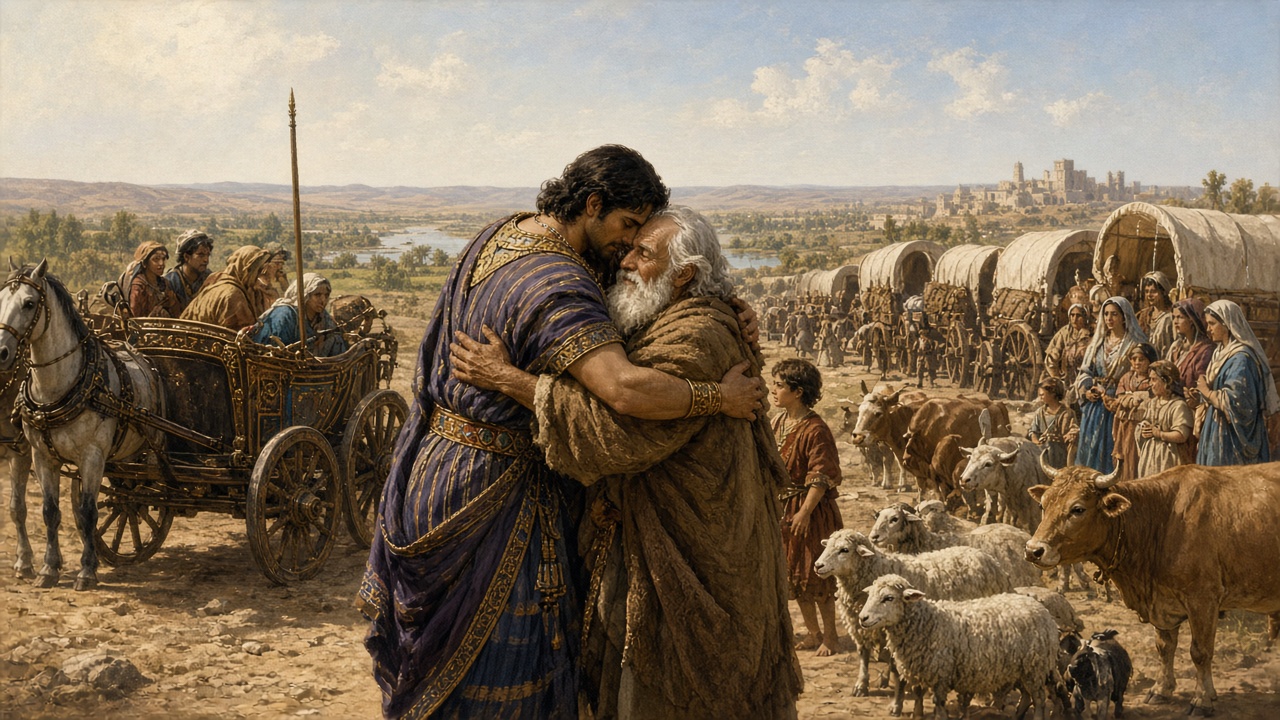
28Forsothe Jacob sente Judas bifore hym to Joseph, that he schulde telle to hym, and he schulde `come in to Gessen. 29And whanne Jacob hadde come thidir, Joseph stiede in his chare to mete his fadir at the same place. And he siy Jacob, and felde on `his necke, and wepte bitwixe collyngis. 30And the fadir seide to Joseph, Now Y schal die ioiful, for Y siy thi face, and Y leeue thee lyuynge. 31And Joseph spak to hise brithren, and to al `the hows of his fadir, I schal stie, and `Y schal telle to Farao, and Y schal seie to hym, My britheren, and the hows of my fadir, that weren in the lond of Canaan, ben comun to me, 32and thei ben men kepers of scheep, and han bisynesse of flockis to be fed; thei brouyten with hem her scheep and grete beestis, and alle thingis whiche thei miyten haue. 33And whanne Farao schal clepe you, and schal seie, What is youre werk? 34ye schulen answere, We ben thi seruauntis, men scheepherdis, fro oure childhed til in to present tyme, bothe we and oure fadris. Sotheli ye schulen seye these thingis, that ye moun dwelle in the lond of Gessen, for Egipcians wlaten alle keperis of scheep.
Did you know?
Israel Goes Down to Egypt
- As Israel set out for Egypt with all that he had, he stopped at Beersheba and offered sacrifices to the God of his father Isaac. Beersheba, meaning well of the oath or well of seven, was a well Abraham dug and named after a compact with Abimelech; when Isaac reopened it, he gave it the same name. It was a favorite dwelling of both patriarchs, and there that night God spoke to Jacob in a vision, telling him not to fear going down to Egypt, for he would make him a great nation there.Sources: the Bible text itself · Beersheba
- Jacob sent Judah ahead to Joseph for directions to Goshen, an Egyptian district east of the Nile, apparently near the royal residence, where the family remained until the Exodus. Easton's Bible Dictionary (1897) calls it the best of the land, now a desert, and also the land of Rameses. Joseph told his brothers to say they had raised livestock from youth, so they might settle there, because shepherds were detestable to the Egyptians; that dictionary suggests Pharaoh was probably Apopi, last of the Hyksos, who welcomed these Asiatic shepherds, while native Egyptians abhorred them, though some argue Joseph arrived later, under Thothmes III, after the Hyksos were expelled.Sources: the Bible text itself · Goshen · Pharaoh (of Joseph)
- The chapter counts sixty-six of Jacob's direct descendants who came to Egypt, not counting the wives of his sons, and seventy when Joseph's two sons already born in Egypt are included. Leah's sons and her daughter Dinah are named in that tally, although Easton's Bible Dictionary (1897) says Leah herself had died in Canaan before the journey and was buried in the cave of Machpelah; Rachel had died earlier giving birth to Benjamin and was buried on the way to Ephrath, that is, Bethlehem. Manasseh and Ephraim were born to Joseph in Egypt by Asenath, daughter of Potiphera, priest of On, a center of sun-worship that the Septuagint and Vulgate call Heliopolis.Sources: the Bible text itself · Leah · Rachel · On
Notes written with AI assistance from open sources (Theographic Bible Metadata, CC BY-SA 4.0; Easton’s Bible Dictionary, public domain) and reviewed before publishing.
Places in this chapter
- Egypt · 30.129, 31.308 · verses 1, 3, 4, 5, 6, 7, 8, 20, 26, 27
- Canaan · 32.767, 35.333 · verses 6, 12, 31
- Heliopolis · Today: Ain Shams · 30.129, 31.308 · verse 20
- Goshen · Today: Goshen 1 · 30.799, 31.834 · verses 28, 29, 34
Only places identified with high confidence are shown (90% or more according to the scholarly sources compiled by OpenBible). Period map: DARE (Digital Atlas of the Roman Empire), CC BY 4.0; modern map: © OpenStreetMap contributors; places: OpenBible.info (CC BY 4.0).
Credits and license for this translation
Wycliffe Bible
This is the Pentateuch and Gospels from The Holy Bible, containing the Old and New Testaments, with the apocryphal books, in the earliest English version made from the latin Vulgate by John Wycliffe and his followers. c.1395
Public Domain
Language: Middle English (English)
Dialect: Middle
Translation by: John Wycliffe
2016-11-08
Section headings adapted from the Berean Standard Bible (public domain); they are not part of this translation’s text.
Source: http://ebible.org/engWycliffe/ · eBible.org