Genesis 44
Wycliffe Bible · Tap a verse to see its cross-references.
Benjamin and the Silver Cup
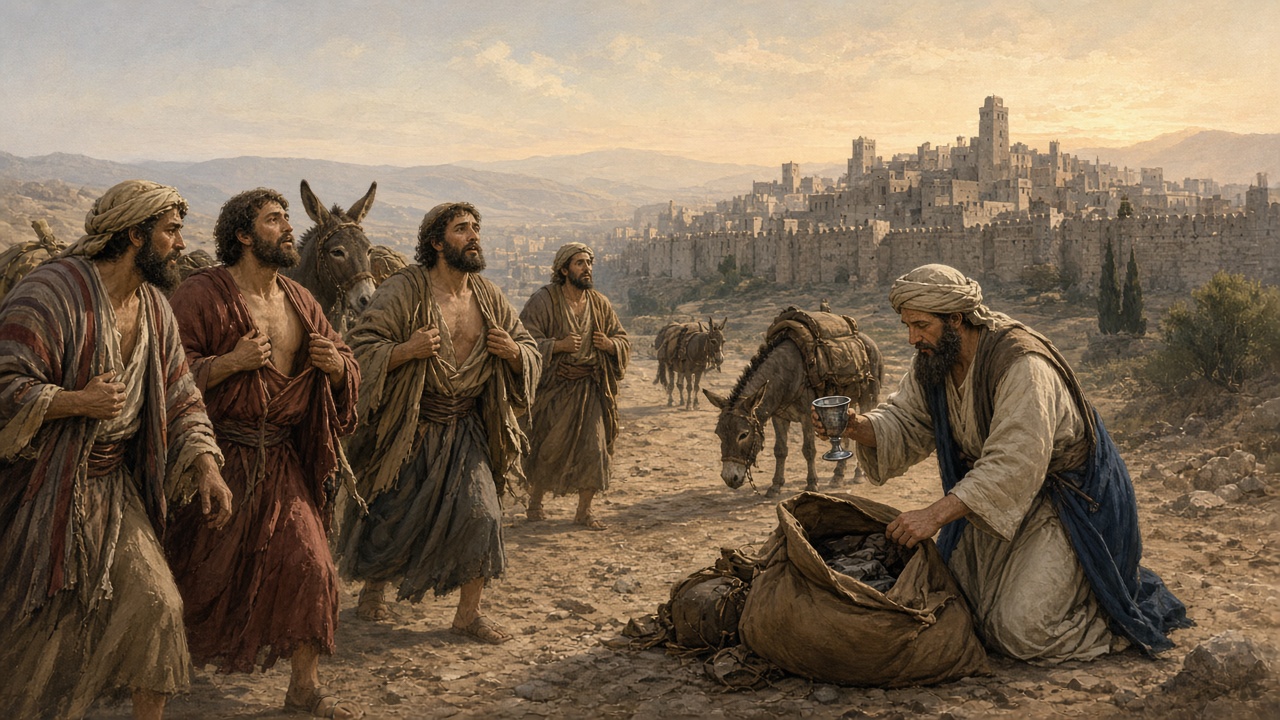
1Forsothe Joseph comaundid the dispendere of his hous, and seide, Fille thou her sackis with wheete, as myche as tho moun take, and putte thou the money of ech in the hiynesse of the sak; 2forsothe put thou in the mouth of the sak of the yongere my silueren cuppe, and the prijs of wheete which he yaf; and it was doon so. 3And whanne the morewtid roos, thei weren delyuered with her assis. 4And now thei hadden go out of the citee, and hadden go forth a litil; thanne Joseph seide, whanne the dispendere of his hous was clepid, Rise thou, pursue the men, and seye thou whanne thei ben takun, Whi han ye yolde yuel for good? 5The cuppe, which ye han stole, is thilk in which my lord drynkith, and in which he is wont to dyuyne; ye han do a ful wickid thing. 6He dide as Joseph comaundid, and whanne thei weren takun, he spak bi ordre. 7Whiche answeriden, Whi spekith oure lord so, that thi seruauntis han do so greet trespas? 8We brouyten ayen to thee fro the lond of Chanaan the monei which we founden in the hiynesse of sackis, and hou is it suynge that we han stole fro `the hows of thi lord gold ether siluer? 9At whom euere of thi seruauntis this that thou sekist is foundun, die he, and we schulen be seruauntis of my lord. 10Which seide to hem, Be it doon bi youre sentence; at whom it is foundun, be he my seruaunt; forsothe ye schulen be gilteles. 11And so thei diden doun hastili the sackis on erthe, and alle openyden tho whiche he souyte; 12and bigan at the more til to the leeste, and foond the cuppe in `the sak of Beniamyn. 13And whanne thei hadden `to-rent her clothis, and hadden chargid eft the assis, thei turneden ayen in to the citee. 14And Judas entride `the firste with brithren to Joseph; for he hadde not go yit fro the place; and alle felden togidere on erthe bifore hym. 15To whiche he seide, Whi wolden ye do so? whether ye witen not, that noon is lijk me in the kunnyng of dyuinyng? 16To whom Judas seide, What schulen we answere to my lord, ether what schulen we speke, ether moun iustli ayenseie? God hath founde the wickidnesse of thi seruauntis; lo! alle we ben the seruauntis of my lord, bothe we and he at whom the cuppe is foundun. 17Joseph answeride, Fer be it fro me, that Y do so; he be my seruaunt that stal the cuppe; forsothe go ye fre to youre fadir.
Judah Pleads for Benjamin
18Sotheli Judas neiyede neer, and seide tristili, My lord, Y preye, thi seruaunt speke a word in thin eeris, and be thou not wrooth to thi seruaunt; for aftir Farao thou art my lord. 19Thou axidist first thi seruauntis, Han ye a fadir, ether a brother? 20And we answeriden to thee, my lord, An eld fadir is to vs, and a litil child that was borun in his eelde, whos brother of the same wombe is deed, and his modir hath hym aloone; forsothe his fadir loueth hym tendirli. 21And thou seidist to thi seruauntis, Brynge ye hym to me, and Y schal sette myn iyen on hym. 22We maden suggestioun to thee, my lord, the child may not forsake his fadir; for if he schal leeue the fadir, he schal die. 23And thou seidist to thi seruauntis, If youre leeste brother schal not come with you, ye schulen no more se my face. 24Therfor whanne we hadden stied to thi seruaunt, oure fadir, we telden to hym alle thingis whiche my lord spak; and oure fadir seide, 25Turne ye ayen, and bie ye to you a litil of wheete; 26to whom we seiden, We moun not go; if oure leeste brother schal go doun with vs, we schulen go forth togidere; ellis, if he is absent, we doren not se the `face of the lord. 27To whiche thingis the fadir answeride, Ye witen that my wiif childide twei sones to me; 28oon yede out, and ye seiden, a beeste deuouride hym, and hidir to he apperith not; 29if ye taken also this sone, and ony thing bifallith to hym in the weye, ye schulen lede forth myn hoor heeris with morenyng to hellis. 30Therfor if Y entre to thi seruaunt, oure fadir, and the child faile, sithen his lijf hangith of the lijf of the child, 31and he se that the child is not with vs, he schal die, and thi seruauntis schulen lede forth hise hoor heeris with sorewe to hellis. 32Be Y propirli thi seruaunt, which resseyuede this child on my feith, and bihiyte, and seide, If Y schal not brynge ayen hym, Y schal be gilti of synne ayens my fadir in al tyme; 33and so Y schal dwelle thi seruaunt for the child in to the seruyce of my lord, and the child stie with hise britheren; 34for Y may not go ayen to my fadir, if the child is absent, lest Y stonde a witnesse of the wretchidnesse that schal oppresse my fadir.
Did you know?
The Hidden Cup and Judah's Plea
- Judah, Jacob's fourth son by Leah, speaks for the brothers and offers to remain as a slave in the boy's place so that Benjamin may return with his brothers. Easton's Bible Dictionary (1897) notes that Judah had earlier intervened to spare Joseph's life, and that he took the lead in the family's affairs, including in the appeal recorded in this chapter.Sources: Judah (patriarch) · the Bible text itself
- Benjamin was the younger of Jacob's two sons by Rachel; she died giving birth to him and called him Ben-oni, "son of my pain," before his father named him Benjamin. The brothers tell Joseph that the boy is the only son of his mother still living, and that their father believes the other was torn to pieces. They say this to Joseph himself—Rachel's elder son, loved by Jacob as the child of his old age—while still speaking to him as a lord equal to Pharaoh.Sources: Benjamin (patriarch) · Joseph (son of Jacob) · the Bible text itself
- On Joseph's orders, the steward hid Joseph's silver cup—the cup he drank from and used for divination—in Benjamin's sack, along with the silver paid for the grain. When it was found, the brothers tore their clothes and returned to the city. Joseph then asked whether they did not know that a man like him could divine the truth, although the narrative shows that he had arranged for the cup to be found.Sources: the Bible text itself
Notes written with AI assistance from open sources (Theographic Bible Metadata, CC BY-SA 4.0; Easton’s Bible Dictionary, public domain) and reviewed before publishing.
Places in this chapter
- Canaan · 32.767, 35.333 · verse 8
Only places identified with high confidence are shown (90% or more according to the scholarly sources compiled by OpenBible). Period map: DARE (Digital Atlas of the Roman Empire), CC BY 4.0; modern map: © OpenStreetMap contributors; places: OpenBible.info (CC BY 4.0).
Credits and license for this translation
Wycliffe Bible
This is the Pentateuch and Gospels from The Holy Bible, containing the Old and New Testaments, with the apocryphal books, in the earliest English version made from the latin Vulgate by John Wycliffe and his followers. c.1395
Public Domain
Language: Middle English (English)
Dialect: Middle
Translation by: John Wycliffe
2016-11-08
Section headings adapted from the Berean Standard Bible (public domain); they are not part of this translation’s text.
Source: http://ebible.org/engWycliffe/ · eBible.org