Genesis 40
Wycliffe Bible · Tap a verse to see its cross-references.
The Cupbearer and the Baker
1Whanne these thingis weren doon so, it bifelde that twei geldyngis, the boteler and the baker `of the kyng of Egipt, synneden to her lord. 2And Farao was wrooth ayens hem, for the toon was `souereyn to boteleris, the tother was `souereyn to bakeris. 3And he sente hem in to the prisoun of the prince of knyytis, in which also Joseph was boundun. 4And the keper of the prisoun bitook hem to Joseph, which also `mynystride to hem. Sumdel of tyme passide, and thei weren hooldun in kepyng, and bothe sien a dreem in o nyyt, 5bi couenable expownyng to hem. 6And whanne Joseph hadde entrid to hem eerli, and hadde seyn hem sori, 7he axide hem, and seide, Whi is youre `face soriere to dai than it ys wont? 8Whiche answeriden, We seiyen a dreem, and `noon is that expowneth to vs. And Joseph seide to hem, Whether expownyng is not of God? Telle ye to me what ye han seyn. 9The `souereyn of boteleris telde first his dreem; Y seiy that a vyne bifore me, 10in which weren thre siouns, wexide litil and litil in to buriounnyngis, and that aftir flouris grapys wexiden ripe, 11and the cuppe of Farao was in myn hond; therfor Y took the grapis, and presside out in to the cuppe which Y helde, and Y yaf drynk to Farao. 12Joseph answerde, This is the expownyng of the dreem; thre siouns ben yit thre daies, 13aftir whiche Farao schal haue mynde of thi seruyce, and he schal restore thee in to the firste degree, and thou schal yyue to hym the cuppe, bi thin office, as thou were wont to do bifore. 14Oneli haue thou mynde on me, whanne it is wel to thee, and thou schalt do merci with me, that thou make suggestioun to Farao, that he lede me out of this prisoun; 15for theefli Y am takun awei fro the lond of Ebrews, and here Y am sent innocent in to prisoun. 16The `maister of bakeris seiye that Joseph hadde expowned prudentli the dreem, and he seide, And Y seiy a dreem, that Y hadde thre panyeris of mele on myn heed, 17and Y gesside that Y bar in o panyere, that was heiyere, alle metis that ben maad bi craft of bakers, and that briddis eeten therof. 18Joseph answerde, This is the expownyng of the dreem; thre panyeris ben yit thre daies, 19aftir whiche Farao schal take awei thin heed, and he schal hange thee in a cros, and briddis schulen todrawe thi fleischis. 20Fro thennus the thridde dai was the dai of birthe of Farao, which made a greet feeste to hise children, and hadde mynde among metis on the maistir `of boteleris, and on the prince of bakeris; 21and he restoride the oon in to his place, that he schulde dresse cuppe to `the kyng, 22and he hangide `the tothir in a gebat, that the treuthe of `the expownere schulde be preued. 23And netheles whanne prosperitees bifelden, the `souereyn of boteleris foryat `his expownere.
Did you know?
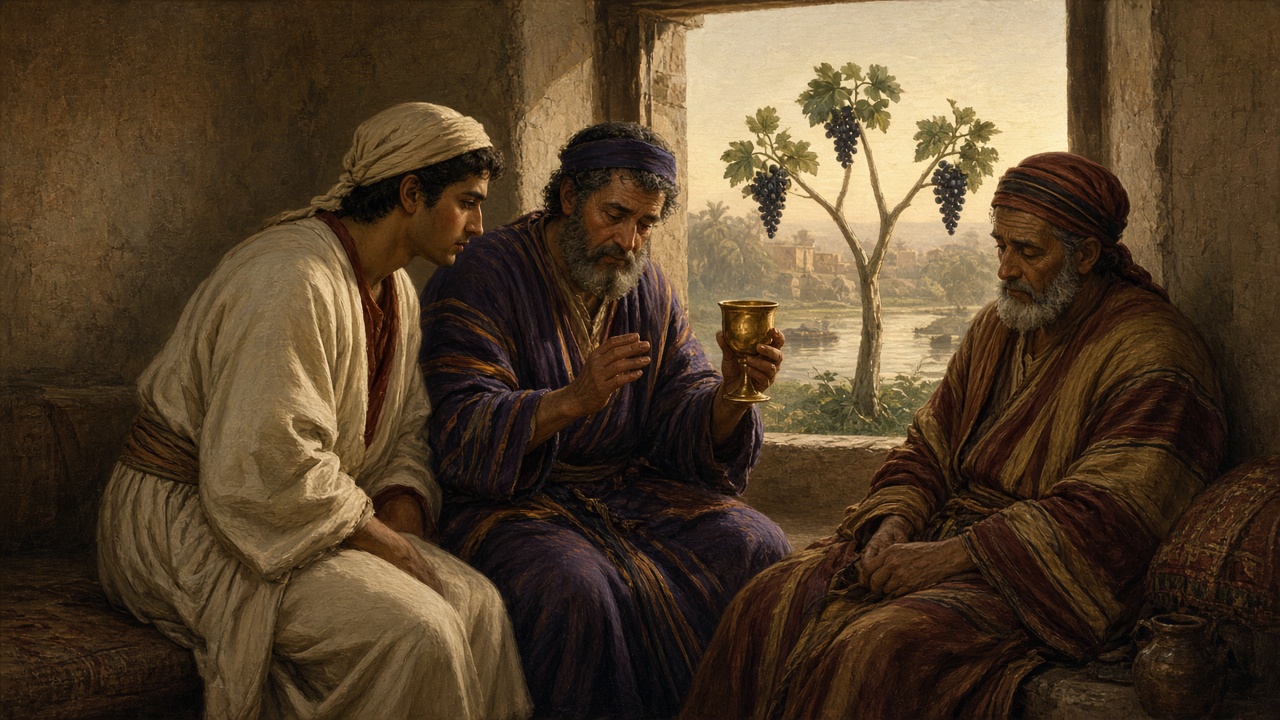
Dreams in Pharaoh's Prison
- Pharaoh was angry with two officers, the chief cupbearer and the chief baker, and put them in the house of the captain of the guard, the same prison where Joseph was confined. The captain assigned them to Joseph, who became their personal attendant.Sources: the Bible text itself
- On the same night the cupbearer and the baker each dreamed, and Joseph said that interpretations belong to God. He took the three branches and the three baskets to mean three days: Pharaoh would lift up the cupbearer's head and restore him, but lift off the baker's head and hang him on a tree. On the third day, Pharaoh's birthday, the king held a feast for his officials, restored the cupbearer, and hanged the baker.Sources: the Bible text itself
- Joseph asked the cupbearer to remember him and mention him to Pharaoh after his restoration. He said he had been kidnapped from the land of the Hebrews and had done nothing for which he should have been put in the dungeon. Easton's Bible Dictionary (1897) identifies the Pharaoh of Joseph's days as probably Apopi, or Apopis, the last of the Hyksos kings; some argue instead that Joseph came to Egypt later, under Thothmes III.Sources: the Bible text itself · Pharaoh (of Joseph)
Notes written with AI assistance from open sources (Theographic Bible Metadata, CC BY-SA 4.0; Easton’s Bible Dictionary, public domain) and reviewed before publishing.
Places in this chapter
Only places identified with high confidence are shown (90% or more according to the scholarly sources compiled by OpenBible). Period map: DARE (Digital Atlas of the Roman Empire), CC BY 4.0; modern map: © OpenStreetMap contributors; places: OpenBible.info (CC BY 4.0).
Credits and license for this translation
Wycliffe Bible
This is the Pentateuch and Gospels from The Holy Bible, containing the Old and New Testaments, with the apocryphal books, in the earliest English version made from the latin Vulgate by John Wycliffe and his followers. c.1395
Public Domain
Language: Middle English (English)
Dialect: Middle
Translation by: John Wycliffe
2016-11-08
Section headings adapted from the Berean Standard Bible (public domain); they are not part of this translation’s text.
Source: http://ebible.org/engWycliffe/ · eBible.org