Genesis 37
Wycliffe Bible · Tap a verse to see its cross-references.
Joseph’s Dreams
1Forsothe Jacob dwellide in the lond of Canaan, in which his fadir was a pilgrym; and these weren the generaciouns of hym. 2Joseph whanne he was of sixtene yeer, yit a child, kepte a flok with hise britheren, and was with the sones of Bala and Zelfa, wyues of his fadir; and he accuside his britheren at the fadir of `the worste synne. 3Forsothe Israel louyde Joseph ouer alle hise sones, for he hadde gendrid hym in eelde; and he made to Joseph a cote of many colours. 4Forsothe hise britheren sien that he was loued of the fader more than alle, and thei hatiden hym, and myyten not speke ony thing pesibli to hym. 5And it bifelde that he telde to hise britheren a sweuene seyn, which cause was `the seed of more hatrede. 6And Joseph seide to his britheren, Here ye the sweuene which Y seiy, 7Y gesside that we bounden to gidere handfuls, and that as myn handful roos, and stood, and that youre handfuls stoden aboute and worschipiden myn handful. 8Hise britheren answerden, Whether thou shalt be oure kyng, ethir we shulen be maad suget to thi lordschip? Therfor this cause of sweuenys and wordis mynystride the nurschyng of enuye, and of hatrede. 9Also Joseph seiy another sweuene, which he telde to the britheren, and seide, Y seiy bi a sweuene that as the sunne, and moone, and enleuen sterris worschipiden me. 10And whanne he hadde teld this sweuene to his fadir, and britheren, his fadir blamyde him, and seide, What wole this sweuene to it silf which thou hast seyn? Whether Y and thi modir, and thi britheren, schulen worschipe thee on erthe? 11Therfor hise britheren hadden enuye to hym. Forsothe the fadir bihelde pryuely the thing,
Joseph Sold into Egypt
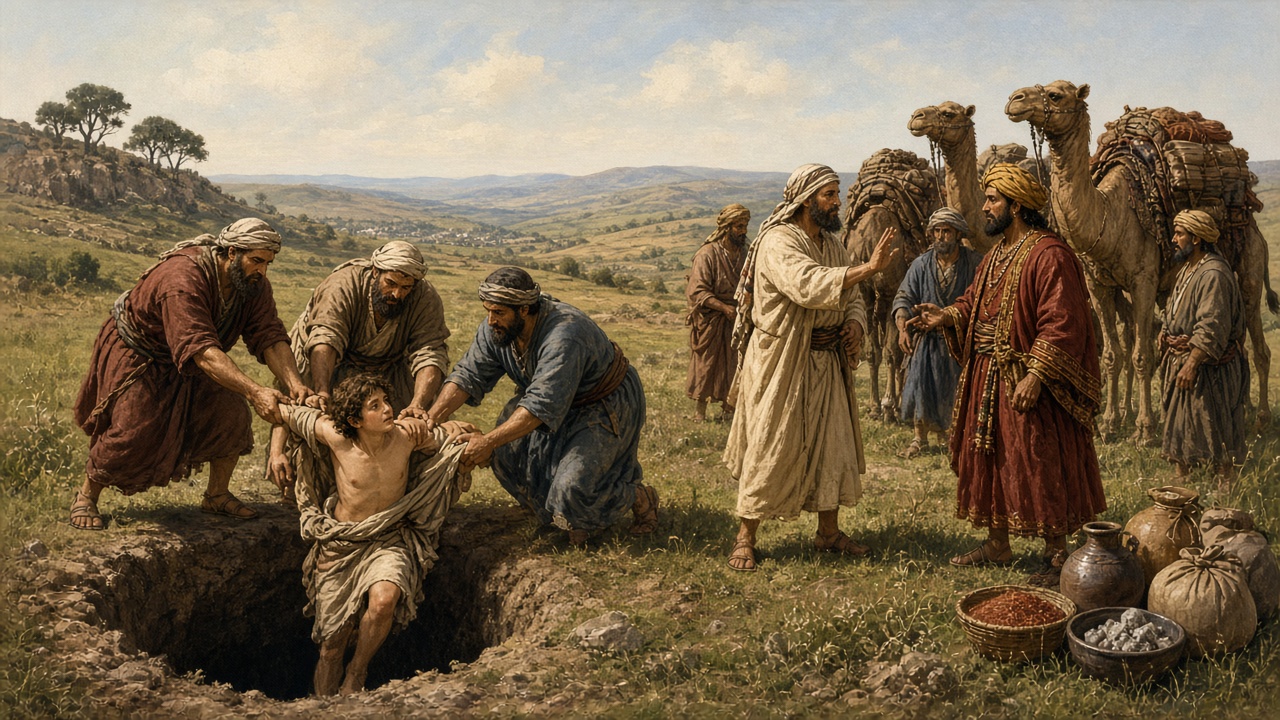
12and whanne his britheren dwelliden in Sichem, aboute flockis of the fadir `to be kept, 13Israel seide to Joseph, Thi britheren kepen scheep in Sichymys; come thou, Y schal sende thee to hem. 14And whanne Joseph answerde, Y am redi, Israel seide, Go thou, and se whether alle thingis ben esi anentis thi britheren, and scheep; and telle thou to me what is doon. He was sent fro the valey of Ebron, and cam into Sichem; 15and a man foond hym errynge in the feeld, and `the man axide, what he souyte. 16And he answerde, Y seke my britheren, schewe thou to me where thei kepten flockis. 17And the man seide to hym, Thei yeden awei fro this place; forsothe Y herde hem seiynge, Go we into Dothaym. And Joseph yede aftir his britheren, and foond hem in Dothaym. 18And whanne thei hadden seyn hym afer, bifor that he neiyede to hem, 19thei thouyten to sle hym, and spaken to gidere, Lo! the dremere cometh, come ye, 20sle we hym, and sende we into an eld sisterne, and we schulen seie, A wielde beeste ful wickid hath deuourid hym; and thanne it schal appere what hise dremes profiten to hym. 21Sotheli Ruben herde this, and enforside to delyuere hym fro her hondis, 22and seide, Sle we not the lijf of hym, nether schede we out his blood, but caste ye hym into an eeld cisterne, which is in the wildirnesse, and kepe ye youre hondis gilteles. Forsothe he seide this, willynge to delyuere hym fro her hondis, and to yelde to his fadir. 23Therfor anoon as Joseph cam to hise britheren, thei dispuyliden hym of the coote, doun to the heele, and of many colours, and senten into the eeld cisterne, 24that hadde no water. 25And thei saten `to ete breed; and thei sien that Ismaelitis weigoers camen fro Galaad, and that her camels baren swete smellynge spiceries, and `rosyn, and stacten, into Egipt. 26Therfor Judas seide to hise britheren, What schal it profite to vs, if we schulen sle oure brother, and schulen hide his blood? 27It is betere that he be seeld to Ismalitis, and oure hondis be not defoulid, for he is oure brother and fleisch. The britheren assentiden to these wordis; 28and whanne marchauntis of Madian passiden forth, thei drowen hym out of the cisterne, and seelden hym to Ismaelitis, for thriytti platis of siluer; whiche ledden hym in to Egipt. 29And Ruben turnede ayen to the cisterne, and foond not the child; 30and he to-rente his closis, and he yede to hise britheren, and seide, The child apperith not, and whidir schal Y go?
Jacob Mourns Joseph
31Forsothe thei token his coote, and dippiden in the blood of a kide, which thei hadden slayn; and senten men that baren to the fadir, 32and seiden, We han founde this coote, se, whether it is the coote of thi sone, ether nai. 33And whanne the fader hadde knowe it, he seide, It is the coote of my sone, a wielde beeste ful wickid hath ete hym, a beeste hath deuourid Joseph. 34And he to-rente his clothis, and he was clothid with an heire, and biweilide his sone in myche tyme. 35Sothely whanne hise fre children weren gaderid to gidere, that thei schulden peese the sorewe of the fadir, he nolde take counfort, but seide, Y schal go doun in to helle, and schal biweile my sone. And the while Jacob contynude in wepyng, 36Madianytis seelden Joseph into Egipt to Putifar, chast `and onest seruaunt of Farao, maistir of the chyualrie.
Did you know?
Joseph Sold by His Brothers
- Israel loved Joseph more than his other sons because he was the child of his old age, and he made him a robe of many colors. Easton's Bible Dictionary (1897) reads the Hebrew of Genesis 37:3 as a long, full garment with sleeves, the kind worn by the children of nobles. When the brothers saw that favor, they hated him and could not speak a kind word to him.Sources: Joseph (son of Jacob) · the Bible text itself
- Jacob sent seventeen-year-old Joseph from the Valley of Hebron to see how his brothers and the flocks were faring; they had pastured near Shechem and then gone on to Dothan. Easton's Bible Dictionary (1897) calls Dothan a famous pasture ground with two wells, identified with modern Tell-Dothan about twelve miles north of Samaria among the hills of Gilboa, and says it is mentioned on monuments in 1600 BC. There the brothers saw a caravan of Ishmaelites coming from Gilead, their camels carrying spices, balm, and myrrh on the way down to Egypt.Sources: Dothan · Gilead · the Bible text itself
- Reuben, Jacob's eldest son by Leah, tried to save Joseph from death and planned to return him to their father. Judah then persuaded the brothers to sell Joseph to the Ishmaelites rather than shed his blood. In Egypt the Midianites sold him to Potiphar, an officer of Pharaoh and captain of the guard; Easton's Bible Dictionary (1897) explains that name as 'dedicated to Ra,' the sun-god, and takes the title to mean, probably, chief of the state police, with a margin reading 'chief of the executioners.'Sources: Reuben · Judah (patriarch) · Potiphar · the Bible text itself
Notes written with AI assistance from open sources (Theographic Bible Metadata, CC BY-SA 4.0; Easton’s Bible Dictionary, public domain) and reviewed before publishing.
Places in this chapter
- Canaan · 32.767, 35.333 · verse 1
- Shechem · Today: Tell Balatah · 32.214, 35.282 · verses 12, 13, 14
- Valley of Hebron · 31.525, 35.102 · verse 14
- Egypt · 30.129, 31.308 · verses 25, 28, 36
- Gilead · Today: Gilead 1 · 32.187, 35.692 · verse 25
Only places identified with high confidence are shown (90% or more according to the scholarly sources compiled by OpenBible). Period map: DARE (Digital Atlas of the Roman Empire), CC BY 4.0; modern map: © OpenStreetMap contributors; places: OpenBible.info (CC BY 4.0).
Credits and license for this translation
Wycliffe Bible
This is the Pentateuch and Gospels from The Holy Bible, containing the Old and New Testaments, with the apocryphal books, in the earliest English version made from the latin Vulgate by John Wycliffe and his followers. c.1395
Public Domain
Language: Middle English (English)
Dialect: Middle
Translation by: John Wycliffe
2016-11-08
Section headings adapted from the Berean Standard Bible (public domain); they are not part of this translation’s text.
Source: http://ebible.org/engWycliffe/ · eBible.org