Genesis 29
Wycliffe Bible · Tap a verse to see its cross-references.
Jacob Meets Rachel
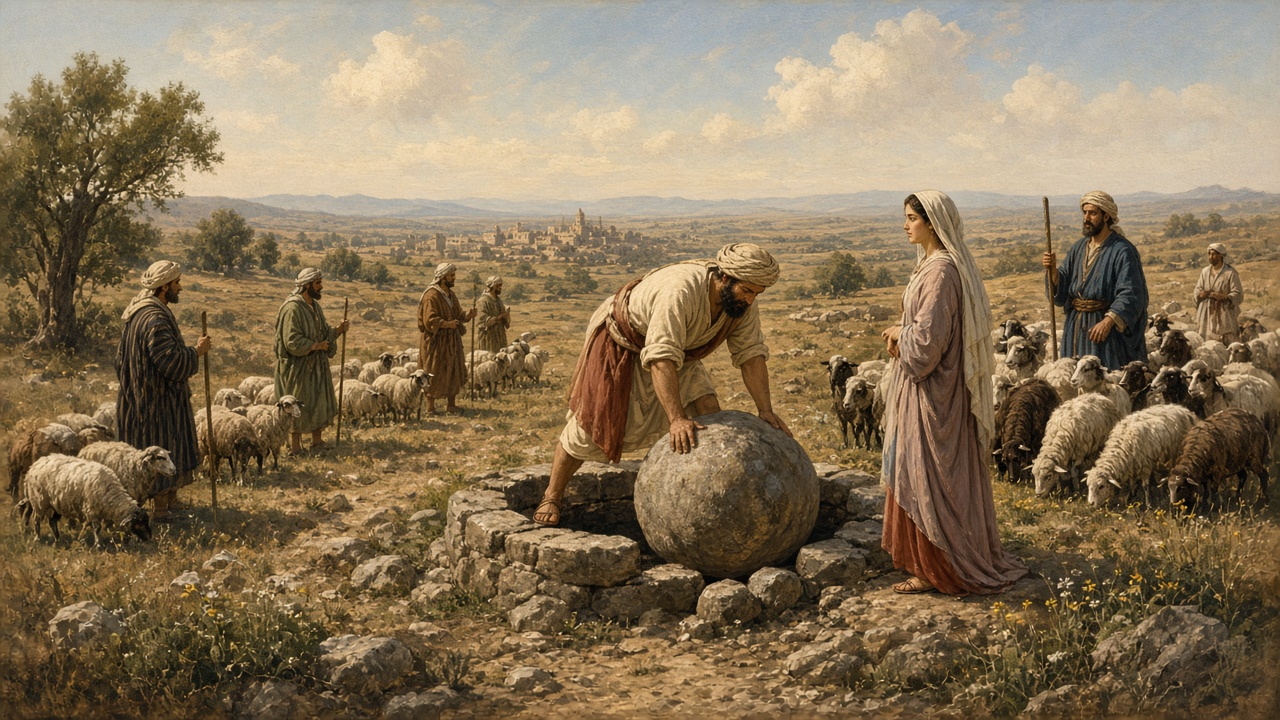
1Therfor Jacob passide forth, and cam in to the eest lond; 2and seiy a pit in the feeld, and thre flockis of scheep restynge bisidis it, for whi scheep weren watrid therof, and the mouth therof was closid with a greet stoon. 3And the custom was that whanne alle scheep weren gaderid togidere, thei schulden turne awei the stoon, and whanne the flockis weren fillid thei schulden put it eft on the mouth of the pit. 4And Jacob seide to the scheepherdis, Brithren, of whennus ben ye? Whiche answeriden, Of Aran. 5And he axide hem and seide, Wher ye knowen Laban, the sone of Nachor? Thei seiden, We knowen. 6Jacob seide, Is he hool? Thei seiden, He is in good staat; and lo! Rachel, his douytir, cometh with his flok. 7And Jacob seide, Yit myche of the dai is to come, and it is not tyme that the flockis be led ayen to the fooldis; sotheli yyue ye drynk to the scheep, and so lede ye hem ayen to mete. 8Whiche answeriden, We moun not til alle scheep be gederid to gidere, and til we remouen the stoon fro the mouth of the pit to watir the flockis. 9Yit thei spaken, and lo! Rachel cam with the scheep of hir fadir. 10And whanne Jacob seiy hir, and knewe the douytir of his modris brothir, and the scheep of Laban his vncle, he remeuyde the stoon with which the pit was closid; 11and whanne the flok was watrid, he kisside hir, and he wepte with `vois reisid. 12And he schewide to hir that he was the brothir of hir fadir, and the sone of Rebecca; and sche hastide, and telde to hir fadir. 13And whanne he hadde herd, that Jacob, the sone of his sistir, cam, he ran ayens hym, and he biclippide Jacob and kisside hym, and ledde in to his hows. Forsothe whanne the causis of the iurney weren herd,
Jacob Marries Leah and Rachel
14Laban answeride, Thou art my boon and my fleisch. And aftir that the daies of o moneth weren fillid, Laban seide to him, 15`Whethir for thou art my brothir, thou schalt serue me frely? seie thou what mede thou schalt take. 16Forsothe Laban hadde twei douytris, the name of the more was Lya, sotheli the lesse was clepid Rachel; 17but Lya was blere iyed, Rachel was of fair face, and semeli in siyt. 18And Jacob louede Rachel, and seide, Y schal serue thee seuene yeer for Rachel thi lesse douytir. 19Laban answeride, It is betere that Y yyue hir to thee than to anothir man; dwelle thou at me. 20Therfor Jacob seruyde seuene yeer for Rachel; and the daies semyden fewe to hym for the greetnesse of loue. 21And he seide to Laban, Yyue thou my wijf to me, for the tyme is fillid that Y entre to hir. 22And whanne many cumpenyes of freendis weren clepid to the feeste, he made weddyngis, 23and in the euentid Laban brouyte in to hym Lya his douytir, 24and yaf an handmaide, Selfa bi name, to the douyter. And whanne Jacob hadde entrid to hir bi custom, whanne the morewtid was maad, he seiy Lya, 25and seide to his wyues fadir, What is it that thou woldist do? wher Y seruede not thee for Rachel? whi hast thou disseyued me? 26Laban answerde, It is not custom in oure place that we yyue first the `lesse douytris to weddyngis; 27fille thou the wouke of daies of this couplyng, and Y schal yyue to thee also this Rachel, for the werk in which thou schalt serue me bi othere seuene yeer. 28Jacob assentide to the couenaunt, and whanne the wouke was passid, 29he weddide Rachel, to whom the fadir hadde youe Bala seruauntesse. 30And at the laste he vside the weddyngis desirid, and settide the loue of the `wijf suynge bifore the former; and he seruede at Laban seuene othere yeer.
Reuben, Simeon, Levi, and Judah
31Forsothe the Lord seiy that he dispiside Lya, and openyde hir wombe while the sistir dwellide bareyn. 32And Lia childide a sone conseyued, and clepide his name Ruben, and seide, The Lord seiy my mekenesse; now myn hosebonde schal loue me. 33And eft sche conseyuede, `and childide a sone, and seide, For the Lord seiy that Y was dispisid, he yaf also this sone to me; and sche clepide his name Symeon. 34And sche conseyuede the thridde tyme, and childide anothir sone, and she seide also, Now myn hosebonde schal be couplid to me, for Y childide thre sones to him; and therfor sche clepide his name Leuy. 35The fourthe tyme sche conseyuede, and childide a sone, and seide, Now I schal knouleche to the Lord; and herfor she clepide his name Judas; and ceesside to childe.
Did you know?
Jacob’s Marriages in Haran
- Jacob fled to Haran, where his uncle Laban lived, in the land of the people of the east. The city, also called the city of Nahor and identified with Harran, stood on the Belik, a tributary of the Euphrates, about seventy miles above the Belik’s junction with that river, in Upper Mesopotamia. Laban was the son of Bethuel and the grandson of Nahor, Abraham’s brother; Laban’s sister Rebekah was Isaac’s wife.Sources: Haran · Laban · Nahor (brother of Abraham) · the Bible text itself
- The well was closed by a large stone that the shepherds rolled away only after all the flocks had gathered, then put back in place. Rachel, whose name is given as “ewe,” was a shepherdess bringing her father’s sheep, and Jacob, who had himself lived as a shepherd, moved the stone and watered his uncle’s flock.Sources: Rachel · Jacob (Israel) · the Bible text itself
- Leah, the elder sister, is called “weary,” and she is described as weak-eyed, or tender-eyed; Rachel, the younger, was shapely and beautiful. Jacob served seven years for Rachel, but at the evening feast Laban gave him Leah, saying it was not the custom there to give the younger daughter in marriage before the older, and then gave him Rachel for another seven years—fourteen in all. Leah’s first sons were Reuben, whose name is given as “Behold a son,” and then Simeon, Levi, and Judah; in naming them she spoke of the LORD seeing her affliction, hearing that she was unloved, her husband becoming attached to her, and her praise of the LORD.Sources: Leah · Rachel · Reuben · the Bible text itself
Notes written with AI assistance from open sources (Theographic Bible Metadata, CC BY-SA 4.0; Easton’s Bible Dictionary, public domain) and reviewed before publishing.
Places in this chapter
- East · Today: region around Amman · 31.955, 35.934 · verse 1
- Haran · Today: Harran · 36.864, 39.033 · verse 4
Only places identified with high confidence are shown (90% or more according to the scholarly sources compiled by OpenBible). Period map: DARE (Digital Atlas of the Roman Empire), CC BY 4.0; modern map: © OpenStreetMap contributors; places: OpenBible.info (CC BY 4.0).
Credits and license for this translation
Wycliffe Bible
This is the Pentateuch and Gospels from The Holy Bible, containing the Old and New Testaments, with the apocryphal books, in the earliest English version made from the latin Vulgate by John Wycliffe and his followers. c.1395
Public Domain
Language: Middle English (English)
Dialect: Middle
Translation by: John Wycliffe
2016-11-08
Section headings adapted from the Berean Standard Bible (public domain); they are not part of this translation’s text.
Source: http://ebible.org/engWycliffe/ · eBible.org