Genesis 2
Wycliffe Bible · Tap a verse to see its cross-references.
The Seventh Day
1Therfor heuenes and erthe ben maad perfit, and al the ournement of tho. 2And God fillide in the seuenthe dai his werk which he made; and he restide in the seuenthe dai fro al his werk which he hadde maad; 3and he blesside the seuenthe dai, and halewide it; for in that dai God ceesside of al his werk which he made of nouyt, that he schulde make.
Man and Woman in the Garden
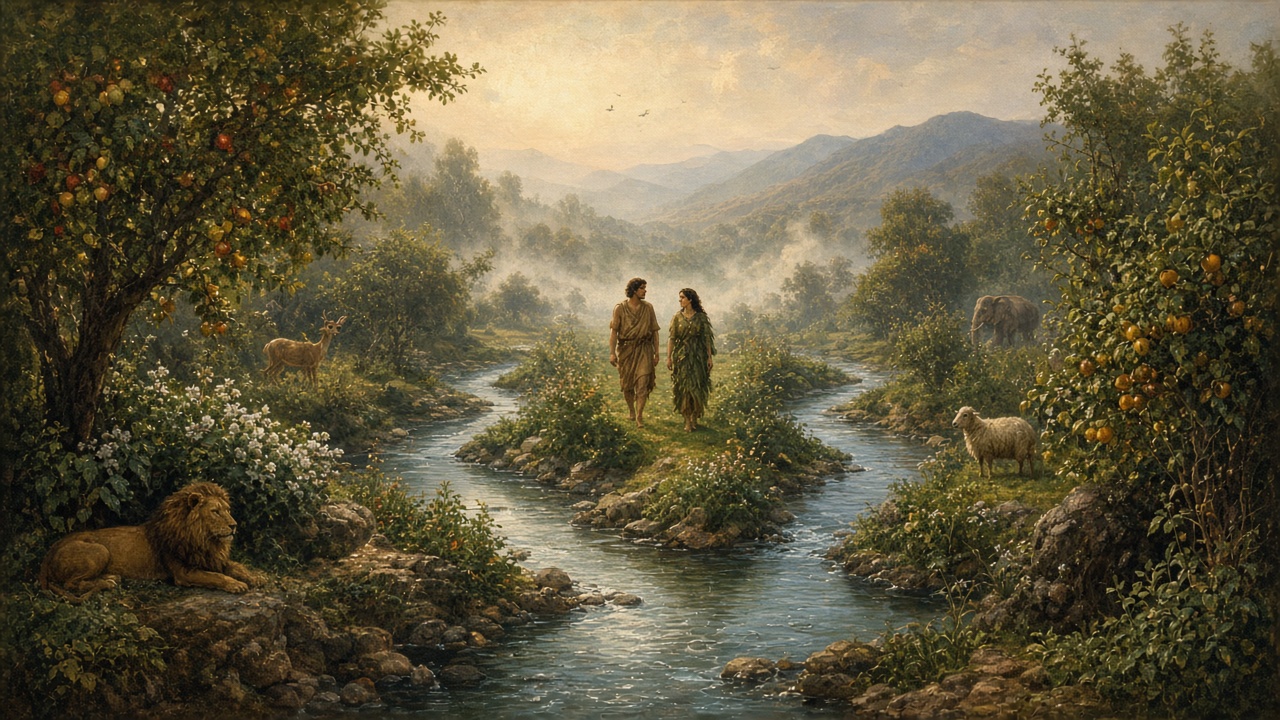
4These ben the generaciouns of heuene and of erthe, in the day wherynne the Lord God made heuene and erthe, 5and ech litil tre of erthe bifore that it sprong out in erthe; and he made ech erbe of the feeld bifore that it buriownede. For the Lord God had not reyned on erthe, and no man was that wrouyte erthe; 6but a welle stiede out of the erthe, and moistide al the hiyere part of erthe. 7Therfor the Lord God formede man of the sliym of erthe, and brethide in to his face the brething of lijf; and man was maad in to a lyuynge soule. 8Forsothe the Lord God plauntide at the bigynnyng paradis of likyng, wherynne he settide man whom he hadde formed. 9And the Lord God brouyte forth of the erthe ech tre fair in siyt, and swete to ete; also he brouyte forth the tre of lijf in the middis of paradis, and the tre of kunnyng of good and of yuel. 10And a ryuer yede out fro the place of likyng to moyste paradis, which ryuer is departid fro thennus in to foure heedis. 11The name of the o ryuer is Fyson, thilke it is that cumpassith al the lond of Euilath, where gold cometh forth, 12and the gold of that lond is the beste, and there is foundun delium, that is, a tree of spicerie, and the stoon onychyn; 13and the name to the secounde ryuer is Gyon, thilke it is that cumpassith al the loond of Ethiopie; 14forsothe the name of the thridde ryuer is Tigris, thilke goith ayens Assiriens; sotheli the fourthe ryuer is thilke Eufrates. 15Therfor the Lord God took man, and settide hym in paradis of likyng, that he schulde worche and kepe it. 16And God comaundide to hym and seide, Ete thou of ech tre of paradis; 17forsothe ete thou not of the tre of kunnyng of good and of yuel; for in what euere dai thou schalt ete therof, thou schalt die bi deeth. 18And the Lord God seide, It is not good that a man be aloone, make we to hym an help lijk to hym silf. 19Therfor whanne alle lyuynge beestis of erthe, and alle the volatils of heuene weren formed of erthe, the Lord God brouyte tho to Adam, that he schulde se what he schulde clepe tho; for al thing that Adam clepide of lyuynge soule, thilke is the name therof. 20And Adam clepide bi her names alle lyuynge thingis, and alle volatils, and alle vnresonable beestis of erthe. Forsothe to Adam was not foundun an helpere lijk hym. 21Therfore the Lord God sente sleep in to Adam, and whanne he slepte, God took oon of hise ribbis, and fillide fleisch for it. 22And the Lord God bildide the rib which he hadde take fro Adam in to a womman, and brouyte hir to Adam. 23And Adam seide, This is now a boon of my boonys, and fleisch of my fleisch; this schal be clepid virago, `for she is takun of man. 24Wherfor a man schal forsake fadir and modir, and schal cleue to his wijf, and thei schulen be tweyne in o fleisch. 25Forsothe euer eithir was nakid, that is, Adam and his wijf, and thei weren not aschamed.
Did you know?
Adam, Eden, and the Four Rivers
- Adam, meaning “red,” is a Babylonian word and the ordinary name for a human being, with the same sense in Hebrew and in Assyrian. It was given to the first man. He was formed from the dust of the ground—hence the name—and God breathed into his nostrils the breath of life.Sources: Adam · the Bible text itself
- A river flowed out of Eden and divided into four headwaters: the Pishon, the Gihon, the Hiddekel, and the Euphrates. Some identify the Pishon with the Phasis or the Halys, others with the Indus, the Ganges, or still other rivers; the Gihon has been identified with the Nile, and others regard it as the Oxus, the Araxes, or the Ganges. The Hiddekel is the Tigris, called by the Accadians the river of Idikla; Gesenius understood the name as “the rapid Tigris.”Sources: the Bible text itself · Pison · Gihon · Hiddekel
- The site of Eden, the garden in which the first parents lived, has been discussed more than almost any other geographical question. It has been placed in Armenia, in the region west of the Caspian Sea, in Media, near Damascus, in Palestine, in southern Arabia, and in Babylonia. Easton's Bible Dictionary (1897) seeks it along the Tigris and the Euphrates of western Asia, in the land of Shinar, or Babylonia.Sources: Eden
Notes written with AI assistance from open sources (Theographic Bible Metadata, CC BY-SA 4.0; Easton’s Bible Dictionary, public domain) and reviewed before publishing.
Places in this chapter
- Assyria · 36.359, 43.153 · verse 14
- Euphrates · Today: Euphrates River · 31.004, 47.442 · verse 14
- Tigris · Today: Tigris River · 31.004, 47.442 · verse 14
Only places identified with high confidence are shown (90% or more according to the scholarly sources compiled by OpenBible). Period map: DARE (Digital Atlas of the Roman Empire), CC BY 4.0; modern map: © OpenStreetMap contributors; places: OpenBible.info (CC BY 4.0).
Credits and license for this translation
Wycliffe Bible
This is the Pentateuch and Gospels from The Holy Bible, containing the Old and New Testaments, with the apocryphal books, in the earliest English version made from the latin Vulgate by John Wycliffe and his followers. c.1395
Public Domain
Language: Middle English (English)
Dialect: Middle
Translation by: John Wycliffe
2016-11-08
Section headings adapted from the Berean Standard Bible (public domain); they are not part of this translation’s text.
Source: http://ebible.org/engWycliffe/ · eBible.org