Genesis 16
Wycliffe Bible · Tap a verse to see its cross-references.
Hagar and Ishmael
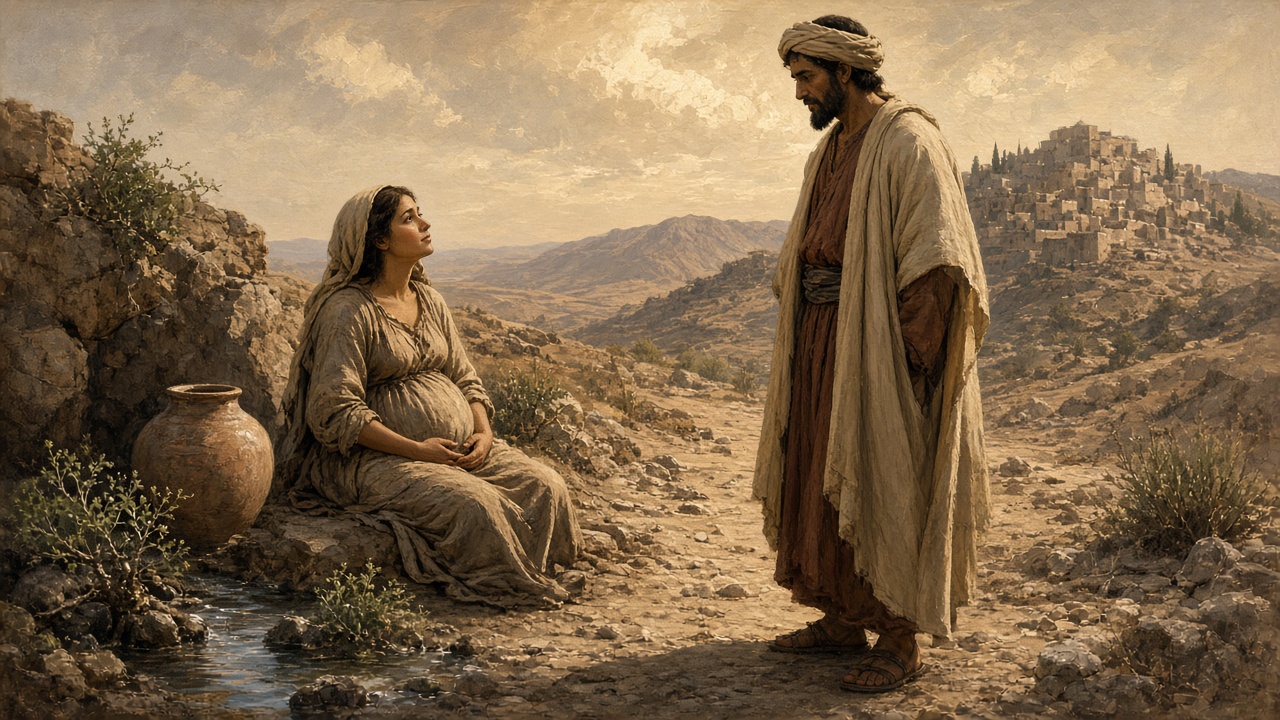
1Therfor Sarai, wijf of Abram, hadde not gendrid fre children; but sche hadde a seruauntesse of Egipt, Agar bi name, and seide to hir hosebonde, Lo! 2the Lord hath closid me, that Y schulde not bere child; entre thou to my seruauntesse, if in hap Y schal take children, nameli of hir. And whanne he assentide to hir preiynge, sche took Agar Egipcian, 3hir seruauntesse, after ten yeer aftir that thei begunne to enhabite in the lond of Chanaan, and sche yaf Agar wiif to hir hosebonde. 4And Abram entride to Agar; and Agar seiy that sche hadde conseyued, and sche dispiside hir ladi. 5And Saray seide to Abram, Thou doist wickidli ayens me; I yaf my seruauntesse in to thi bosum, which seeth, that sche conseyuede, and dispisith me; the Lord deme betwixe me and thee. 6And Abram answerde and seide to hir, Lo! thi seruauntesse is in thin hond; vse thou hir as `it likith. Therfor for Sarai turmentide hir, sche fledde awei. 7And whanne the aungel of the Lord hadde founde hir bisidis a welle of watir in wildernesse, which welle is in the weie of Sur in deseert, 8he seide to hir, Fro whennus comest thou Agar, the seruauntesse of Sarai, and whidur goist thou? Which answerde, Y fle fro the face of Sarai my ladi. 9And the aungel of the Lord seide to hir, Turne thou ayen to thi ladi, and be thou mekid vndur hir hondis. 10And eft he seide, Y multipliynge schal multiplie thi seed, and it schal not be noumbrid for multitude. 11And aftirward he seide, Lo! thou hast conseyued, and thou schalt bere a sone, and thou schalt clepe his name Ismael, for the Lord hath herd thi turment; 12this schal be a wielde man; his hond schal be ayens alle men, and the hondis of alle men schulen be ayens him; and he schal sette tabernaclis euene ayens alle his britheren. 13Forsothe Agar clepide the name of the Lord that spak to hir, Thou God that seiyest me; for sche seide, Forsothe here Y seiy the hynderere thingis of him that siy me. 14Therfor sche clepide thilke pit, the pit of hym that lyueth and seeth me; thilk pit is bitwixe Cades and Barad. 15And Agar childide a sone to Abram, which clepide his name Ismael. 16Abram was of `eiyti yeere and sixe, whanne Agar childide Ysmael to hym.
Did you know?
Hagar’s Flight and the Birth of Ishmael
- Hagar, an Egyptian maidservant of Sarai, bears a name understood to mean “flight,” or, according to others, “stranger.” After Abram had lived in Canaan for ten years, Sarai gave her to him as a secondary wife, hoping to build a family through her.Sources: Hagar · the Bible text itself
- When Sarai treated her harshly, Hagar fled along the road to Shur, through the desert that lay between her and Egypt, apparently intending to return to her relatives. The angel of the LORD found her by a spring of water there. Shur, meaning “wall,” was a wilderness on Egypt’s north-eastern border, probably named for frontier fortifications running from Pelusium to Heliopolis.Sources: the Bible text itself · Hagar · Shur
- Hagar called the LORD who spoke to her “the God who sees me,” and the well was named Beer-lahai-roi, “the well of the visible God,” between Kadesh and Bered, a town in the south of Palestine in the desert of Shur. She returned to Abram’s tent, and his eldest son, Ishmael, was born at Mamre when Abram was eighty-six; Abram gave him the name the angel had announced, because the LORD had heard her affliction.Sources: the Bible text itself · Hagar · Bered · Ishmael (Son of Hagar)
Notes written with AI assistance from open sources (Theographic Bible Metadata, CC BY-SA 4.0; Easton’s Bible Dictionary, public domain) and reviewed before publishing.
Places in this chapter
- Canaan · 32.767, 35.333 · verse 3
Only places identified with high confidence are shown (90% or more according to the scholarly sources compiled by OpenBible). Period map: DARE (Digital Atlas of the Roman Empire), CC BY 4.0; modern map: © OpenStreetMap contributors; places: OpenBible.info (CC BY 4.0).
Credits and license for this translation
Wycliffe Bible
This is the Pentateuch and Gospels from The Holy Bible, containing the Old and New Testaments, with the apocryphal books, in the earliest English version made from the latin Vulgate by John Wycliffe and his followers. c.1395
Public Domain
Language: Middle English (English)
Dialect: Middle
Translation by: John Wycliffe
2016-11-08
Section headings adapted from the Berean Standard Bible (public domain); they are not part of this translation’s text.
Source: http://ebible.org/engWycliffe/ · eBible.org