Genesis 13
Wycliffe Bible · Tap a verse to see its cross-references.
Abram and Lot Part Ways
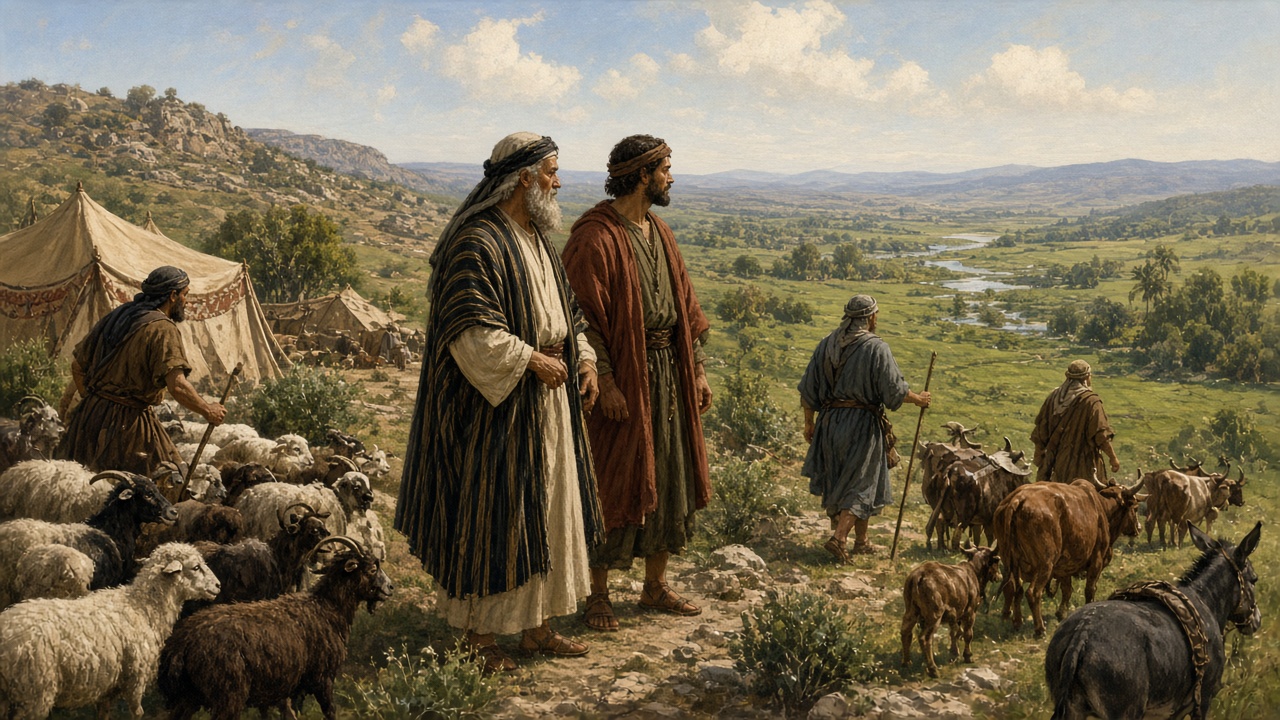
1Therfore Abram stiede fro Egipt, he, and his wijf, and alle thingis that he hadde; and Loth stiede with hym, to the south coost. 2Forsothe he was ful riche in possessyoun of siluer and of gold. 3And he turnede ayen bi the weye in which he cam fro the south in to Bethel, `til to the place, in which bifore he hadde sett tabernacle, bitwixe Bethel and Hay, 4in the place of the auter which he made bifore, and inwardli clepide there the name of the Lord. 5But also flockis of scheep, and droues of oxun, and tabernaclis weren to Loth, that was with Abram; 6and the lond miyte not take hem, that thei schulden dwelle togidre, for the catel of hem was myche, and thei miyten not dwelle in comyn. 7Wherfor also strijf was maad bitwixe the keperis of flockis of Abram and of Loth. Forsothe Chananei and Feresei dwelliden in that lond in that tyme. 8Therfor Abram seide to Loth, Y biseche, that no strijf be bitwixe me and thee, and bitwixe my scheepherdis and thi scheepherdis; for we ben britheren. 9Lo! al the lond is bifore thee, Y biseche, departe thou fro me; if thou go to the left side, Y schal holde the riyt side; if thou chese the riyt side, Y schal go to the left side.
Lot Proceeds toward Sodom
10And so Loth reiside hise iyen, and seiy aboute al the cuntrei of Jordan, which was al moistid, bifor that the Lord distriede Sodom and Gomorre, as paradis of the Lord, and as Egipt, as men comen in to Segor. 11And Loth chees to him the cuntre aboute Jordan, and departide fro the eest; and thei weren departid ech fro his brother. 12Abram dwellide in the lond of Chanaan; sotheli Loth dwellide in townes aboute Jordan, and wonide in Sodom. 13Forsothe men of Sodom weren ful wickid, and synneris greetly bifore the Lord.
God Renews the Promise to Abram
14And the Lord seide to Abram, aftir that Loth was departid fro him, Reise thin iyen forth riyt, and se fro the place in which thou art now, to the north and south, to the eest and west; 15Y schal yyue al the lond which thou seest to thee and to thi seed, til in to with outen ende. 16And Y schal make thi seed as the dust of erthe; if ony man may noumbre the dust of erthe, also he schal mowe noumbre thi seed. 17Therfor rise thou, and passe thorou the lond in his lengthe and breede, for Y schal yyue it to thee. 18Therfor Abram, mouynge his tabernacle, cam and dwellide bisidis the valei of Mambre, which is in Ebron; and he bildide there an auter to the Lord.
Did you know?
Abram and Lot Separate
- Abram came up from Egypt into the Negev, the arid district south of Palestine through which the caravan route ran from central Palestine to Egypt, and traveled from place to place toward Bethel.Sources: Negeb · the Bible text itself
- He returned to the place between Bethel and Ai where his tent had stood and where he had built an altar, and there he called on the name of the LORD. Easton's Bible Dictionary (1897) describes Bethel, about ten miles north of Jerusalem, as originally the royal Canaanite city of Luz, and holds that the name Bethel was first given to a nearby sanctuary rather than to the city itself until the tribe of Ephraim conquered it. Ai was one of the royal Canaanite cities and lay to the east of Bethel.Sources: Bethel (of Palestine) · Ai · the Bible text itself
- Lot looked out and saw the plain of the Jordan, well watered all the way to Zoar like the garden of the LORD and like the land of Egypt. Easton's Bible Dictionary (1897) calls this the first historical notice of the Jordan, in the account of Abraham and Lot's separation, and places Sodom, toward which Lot pitched his tent, in the vale of Siddim. The chapter notes that the LORD had not yet destroyed Sodom and Gomorrah, a destruction the dictionary attributes to fire from heaven because of the city's wickedness.Sources: Plain of Jordan · Sodom · the Bible text itself
Notes written with AI assistance from open sources (Theographic Bible Metadata, CC BY-SA 4.0; Easton’s Bible Dictionary, public domain) and reviewed before publishing.
Places in this chapter
- Egypt · 30.129, 31.308 · verses 1, 10
- Negeb · 31.245, 34.841 · verses 1, 3
- Jordan Valley · 32.317, 35.570 · verses 10, 11, 12
- Canaan · 32.767, 35.333 · verse 12
- Hebron · Today: Tel Rumeida · 31.525, 35.102 · verse 18
Only places identified with high confidence are shown (90% or more according to the scholarly sources compiled by OpenBible). Period map: DARE (Digital Atlas of the Roman Empire), CC BY 4.0; modern map: © OpenStreetMap contributors; places: OpenBible.info (CC BY 4.0).
Credits and license for this translation
Wycliffe Bible
This is the Pentateuch and Gospels from The Holy Bible, containing the Old and New Testaments, with the apocryphal books, in the earliest English version made from the latin Vulgate by John Wycliffe and his followers. c.1395
Public Domain
Language: Middle English (English)
Dialect: Middle
Translation by: John Wycliffe
2016-11-08
Section headings adapted from the Berean Standard Bible (public domain); they are not part of this translation’s text.
Source: http://ebible.org/engWycliffe/ · eBible.org