Exodus 27
Wycliffe Bible · Tap a verse to see its cross-references.
The Bronze Altar
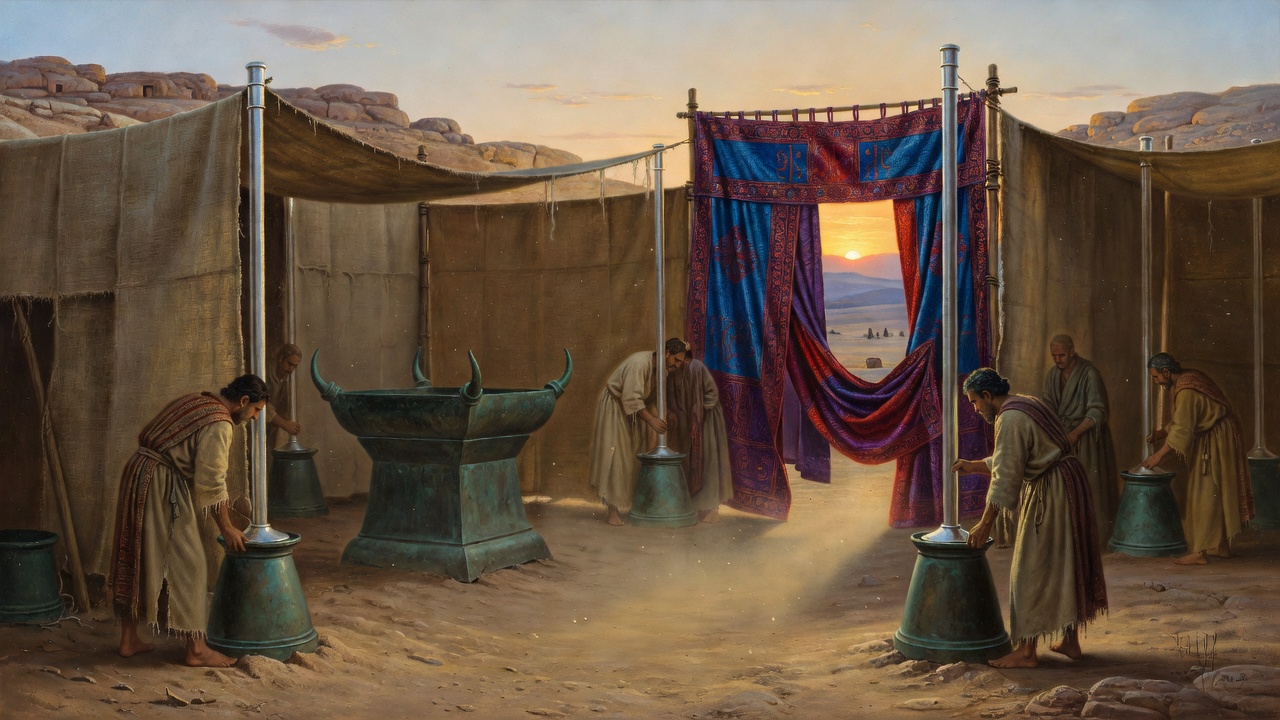
1Also thou schalt make an auter of the trees of Sechym, which schal haue fyue cubitis in lengthe, and so many in brede, that is, sqware, and thre cubitis in heiythe. 2Forsothe hornes schulen be bi foure corneris therof; and thou schalt hile it with bras. 3And thou schalt make in to the vsis of the auter pannes, to resseyue aischis, and tongis, and fleisch hookis, and resettis of fyris; thou schalt make alle vessilis of bras. 4And thou schalt make a brasun gridele in the maner of a net, and bi four corneris therof schulen be foure brasun ryngis, 5whiche thou schalt putte vndur the yrun panne of the auter; and the gridele schal be til to the myddis of the auter. 6And thou schalt make twey barris of the auter, of the trees of Sechym, whiche barris thou schalt hile with platis of bras; 7and thou schalt lede yn `the barris bi the cerclis, and tho schulen be on euer eithir side of the auter, to bere. 8Thou schalt make that auter not massif, but voide, and holowe with ynne, as it was schewid to thee in the hil.
The Courtyard
9Also thou schalt make a large street of the tabernacle, `in the maner of a chirche yeerd, in whos mydday coost ayens the south schulen be tentis of bijs foldid ayen; o side schal holde an hundrid cubitis in lengthe, 10and twenti pileris, with so many brasun foundementis, whiche pileris schulen haue silueren heedis with her grauyngis. 11In lijk maner in the north side, bi the lengthe, schulen be tentis of an hundrid cubitis, twenti pileris, and brasun foundementis of the same noumbre; and the heedis of tho pileris with her grauyngis schulen be of siluer. 12Forsothe in the breede of the large street, that biholdith to the west, schulen be tentis bi fifti cubitis, and ten pileris schulen be, and so many foundementis. 13In that breede of the large street, that biholdith to the eest, schulen be fifti cubitis, 14in whiche the tentis of fiftene cubitis schulen be assigned to o side, and thre pileris, and so many foundementis; 15and in the tother side schulen be tentis holdynge fiftene cubitis, and thre pileris, and so many foundementis. 16Forsothe in the entryng of the `greet strete schal be maad a tente of twenti cubitis, of iacynt, and purpur, and of reed selk twies died, and of bijs foldid ayen bi broideri werk; it schal haue four pileris, with so many foundementis. 17Alle the pileris of the grete street bi cumpas schulen be clothid with platis of siluer, with hedis of siluer, and with foundementis of bras. 18The greet street schal ocupie an hundrid cubitis in lengthe, fifti in breede; the hiyenesse of the tente schal be of fiue cubitis; and it schal be maad of bijs foldid ayen; and it schal haue brasun foundementis. 19Thou schalt make of bras alle the vesselis of the tabernacle, in to alle vsis and cerymonyes, as wel stakis therof, as of the greet street.
The Oil for the Lamps
20Comaunde thou to the sones of Israel, that thei brynge to thee the clenneste oile of `the trees of olyues, and powned with a pestel, that a lanterne 21brenne euere in the tabernacle of witnessyng with out the veil, which is hangid in the tabernacle of witnessyng; and Aaron and hise sones schulen sette it, that it schyne bifore the Lord til the morewtid; it schal be euerlastynge worschiping bi her successiouns of the sones of Israel.
Did you know?
The bronze altar, the courtyard, and the lamps
- This chapter calls for a square altar of acacia wood, five cubits long, five cubits wide, and three cubits high, with a horn on each of its four corners, the horns of one piece, and the altar overlaid with bronze. It was to be built hollow, of boards, with a bronze-mesh grate set beneath a ledge so that the mesh came halfway up, and with poles of acacia wood overlaid with bronze, inserted into rings so the altar could be carried. All its utensils—pots for removing ashes, shovels, sprinkling bowls, meat forks, and firepans—were to be bronze, and the altar was to be made just as shown on the mountain.Sources: the Bible text itself
- The courtyard of the tabernacle was to be a hundred cubits long and fifty cubits wide, with curtains of finely spun linen five cubits high. The south and north sides, each a hundred cubits long, were to have twenty posts and twenty bronze bases, with silver hooks and bands; the west side, fifty cubits wide, was to have ten posts and ten bases. The east side, toward the sunrise, was also fifty cubits wide, with a twenty-cubit gate curtain embroidered with blue, purple, and scarlet yarn and finely spun linen, on four posts, and with curtains of fifteen cubits on either side.Sources: the Bible text itself
- The Israelites were to bring pure oil of pressed olives for the light, so that the lamps would keep burning continually. In the Tent of Meeting, outside the veil in front of the Testimony, Aaron and his sons were to tend the lamps before the LORD from evening until morning, a permanent statute for the Israelites for the generations to come. Aaron, eldest son of Amram and Jochebed, was born in Egypt three years before his brother Moses, and by Elisheba, daughter of Amminadab of the house of Judah, whom he married, he had four sons: Nadab, Abihu, Eleazar, and Ithamar.Sources: the Bible text itself · Aaron
Notes written with AI assistance from open sources (Theographic Bible Metadata, CC BY-SA 4.0; Easton’s Bible Dictionary, public domain) and reviewed before publishing.
Credits and license for this translation
Wycliffe Bible
This is the Pentateuch and Gospels from The Holy Bible, containing the Old and New Testaments, with the apocryphal books, in the earliest English version made from the latin Vulgate by John Wycliffe and his followers. c.1395
Public Domain
Language: Middle English (English)
Dialect: Middle
Translation by: John Wycliffe
2016-11-08
Section headings adapted from the Berean Standard Bible (public domain); they are not part of this translation’s text.
Source: http://ebible.org/engWycliffe/ · eBible.org