Exodus 24
Wycliffe Bible · Tap a verse to see its cross-references.
The Covenant Sealed
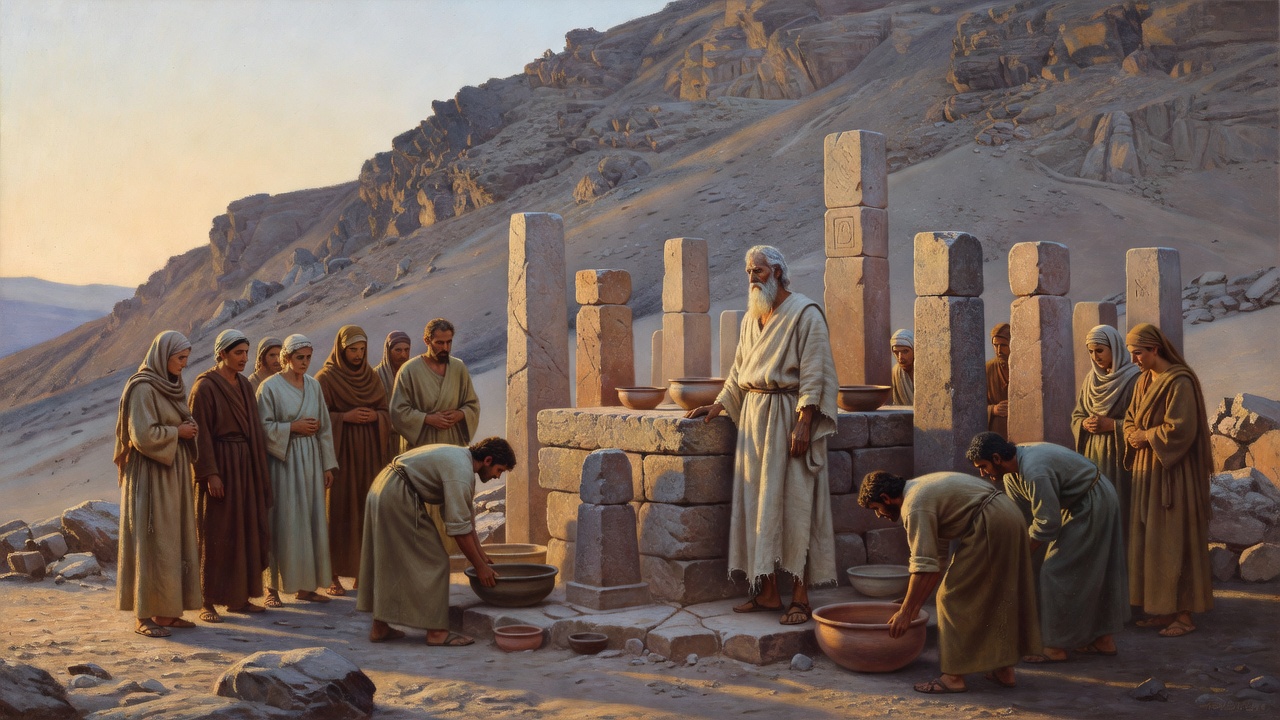
1Also he seide to Moises, `Stie thou to the Lord, thou, and Aaron, and Nadab, and Abyu, and seuenti eldere men of Israel; and ye schulen worschipe afer, 2and Moises aloone stie to the Lord, and thei schulen not neiye, nether the puple schal stie with hym. 3Therfore Moises cam, and telde to the puple alle the wordis and domes of the Lord; and al the puple answeride with o vois, We schulen do alle the wordis of the Lord, whiche he spak. 4Forsothe Moises wroot alle the wordis of the Lord; and he roos eerli, and bildide an auter to the Lord at the rootis of the hil, and he bildide twelue titlis bi twelue lynagis of Israel. 5And he sente yonge men of the sones of Israel, and thei offriden brent sacrifices, and `thei offriden pesible sacrifices `to the Lord, twelue calues. 6And so Moises took half the part of the blood, and sente in to grete cuppis; forsothe he schedde the residue part on the auter. 7And he took the book of the boond of pees, and redde, while the puple herde; whiche seiden, We schulen do alle thingis which the Lord spak, and we schulen be obedient. 8Forsothe he took, and sprengide `the blood on the puple, and seide, This is the blood of the boond of pees, which the Lord couenauntide with yow on alle these wordis. 9And Moises, and Aaron, and Nadab, and Abyu, and seuenti of the eldere men of Israel stieden, 10and seiyen God of Israel, vndur hise feet, as the werk of safire stoon, and as heuene whanne it is cleer. 11And he sente not his hond on hem of the sones of Israel, that hadden go fer awei; and thei sien God, and eeten and drunkun.
Moses on the Mountain
12Forsothe the Lord seide to Moises, `Stie thou to me in to the hil, and be thou there, and Y schal yyue to thee tablis of stoon, and the lawe, and comaundementis, whiche Y haue write, that thou teche the children of Israel. 13Moises and Josue his mynystre risen, and Moises stiede in to the hil of God, 14and seide to the eldere men, Abide ye here, til we turnen ayen to you; ye han Aaron and Hur with you, if ony thing of questioun is maad, ye schulen telle to hem. 15And whanne Moises hadde stied, 16a cloude hilide the hil, and the glorie of the Lord dwellide on Synai, and kyueride it with a cloude sixe daies; forsothe in the seuenthe dai the Lord clepide hym fro the myddis of the cloude; forsothe the licnesse of glorie of the Lord 17was as fier brennynge on the cop of the hil in the siyt of the sones of Israel. 18And Moises entride into the myddis of the cloude, and stiede in to the hil, and he was there fourti daies and fourti nyytis.
Did you know?
The Covenant at Mount Sinai
- Easton's Bible Dictionary (1897) says Mount Sinai, also called Horeb, was the mountain district the Hebrews reached in the third month after the Exodus, where they remained encamped for about a year. It notes that the last twenty-two chapters of Exodus, all of Leviticus, and Numbers 1–11 record what took place during that stay.Sources: Mount Sinai
- The LORD tells Moses to come up with Aaron, Nadab and Abihu, and seventy of Israel's elders, yet Moses alone is to approach, while the others worship at a distance and the people do not go up. Nadab was Aaron's eldest son and Abihu his second; Easton's Bible Dictionary (1897) notes that the two brothers went with their father and the elders only part of the way up the mountain.Sources: the Bible text itself · Aaron · Nadab · Abihu
- Moses then climbs farther with Joshua, his attendant, and leaves Aaron and Hur with the elders so that anyone with a dispute can go to them. Easton's Bible Dictionary (1897) calls Joshua Moses' servant, who accompanied him part of the way up Sinai, and identifies Hur, the husband of Miriam, as the man associated with Aaron in charge of the people while Moses was absent on the mountain.Sources: the Bible text itself · Joshua · Hur
Notes written with AI assistance from open sources (Theographic Bible Metadata, CC BY-SA 4.0; Easton’s Bible Dictionary, public domain) and reviewed before publishing.
Credits and license for this translation
Wycliffe Bible
This is the Pentateuch and Gospels from The Holy Bible, containing the Old and New Testaments, with the apocryphal books, in the earliest English version made from the latin Vulgate by John Wycliffe and his followers. c.1395
Public Domain
Language: Middle English (English)
Dialect: Middle
Translation by: John Wycliffe
2016-11-08
Section headings adapted from the Berean Standard Bible (public domain); they are not part of this translation’s text.
Source: http://ebible.org/engWycliffe/ · eBible.org