Exodus 11
Wycliffe Bible · Tap a verse to see its cross-references.
The Plague on the Firstborn Foretold
1And the Lord seide to Moises, Yit Y schal touche Farao and Egipt with o veniaunce, and after these thingis he schal delyuere you, and schal constreyne you to go out. 2Therfor thou schalt seie to al the puple, that a man axe of his freend, and a womman of hir neiyboresse, silueren vessels and goldun, and clothis; 3forsothe the Lord schal yyue grace to his puple bifor Egipcians. And Moises was a ful greet man in the lond of Egipt, bifore the seruauntis of Farao and al the puple; 4and he seide, The Lord seith these thingis, At mydnyyt Y schal entre in to Egipt; 5and ech firste gendrid thing in the lond of Egipcians schal die, fro the firste gendrid of Farao, that sittith in the trone of hym, til to the firste gendrid of the handmayde, which is at the querne; and alle the firste gendrid of beestis schulen die; 6and greet cry schal be in al the lond of Egipt, which maner cry was not bifore, nether schal be aftirward. 7Forsothe at alle the children of Israel a dogge schal not make priuy noise, fro man til to beeste; that ye wite bi how greet myracle the Lord departith Egipcians and Israel. 8And alle these thi seruauntis schulen come doun to me, and thei schulen preye me, and schulen seie, Go out thou, and al the puple which is suget to thee; aftir these thingis we schulen go out. 9And Moyses was ful wrooth, and yede out fro Farao. Forsothe the Lord seide to Moises, Farao schal not here you, that many signes be maad in the lond of Egipt. 10Sotheli Moises and Aaron maden alle signes and wondris, that ben writun, bifor Farao; and the Lord made hard the herte of Farao, nether he delyuerede the sones of Israel fro his lond.
Did you know?
One More Plague before the Exodus
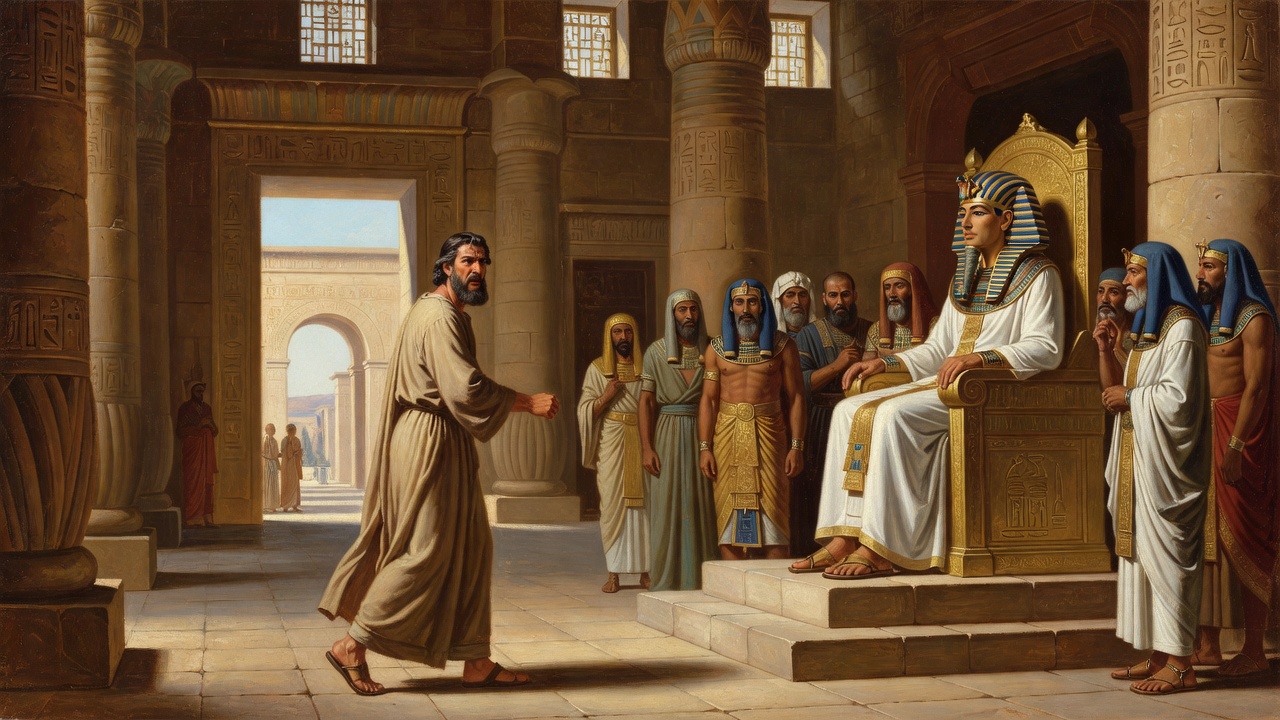
- Easton's Bible Dictionary (1897) says the pharaoh of the Exodus was probably Menephtah I, the fourteenth son of Rameses II and the eldest of the sons who survived, but it also says it is still a question whether he or Seti II was that king; some favor Seti II. The same entry says that pharaoh lived at Zoan, where his interviews with Moses and Aaron took place. This chapter ends as Moses, hot with anger, leaves Pharaoh's presence.Sources: Pharaoh (of the Exodus) · the Bible text itself
- Easton's Bible Dictionary (1897) says Jacob and his sons went down to Egypt probably about 350 years before Moses was born, and that the king gave them the best of the land, Goshen, to live in. In this chapter Israelite men and women alike are told to ask their neighbors for articles of silver and gold, and the account says the LORD gave the people favor in the sight of the Egyptians.Sources: Moses · the Bible text itself
- An event listing dates the start of the Exodus from Egypt to 1490 BC. In this chapter the LORD tells Moses that after one more plague Pharaoh will let the people leave and will drive them out completely.Sources: Exodus from Egypt · the Bible text itself
Notes written with AI assistance from open sources (Theographic Bible Metadata, CC BY-SA 4.0; Easton’s Bible Dictionary, public domain) and reviewed before publishing.
Places in this chapter
Only places identified with high confidence are shown (90% or more according to the scholarly sources compiled by OpenBible). Period map: DARE (Digital Atlas of the Roman Empire), CC BY 4.0; modern map: © OpenStreetMap contributors; places: OpenBible.info (CC BY 4.0).
Credits and license for this translation
Wycliffe Bible
This is the Pentateuch and Gospels from The Holy Bible, containing the Old and New Testaments, with the apocryphal books, in the earliest English version made from the latin Vulgate by John Wycliffe and his followers. c.1395
Public Domain
Language: Middle English (English)
Dialect: Middle
Translation by: John Wycliffe
2016-11-08
Section headings adapted from the Berean Standard Bible (public domain); they are not part of this translation’s text.
Source: http://ebible.org/engWycliffe/ · eBible.org