Deuteronomy 9
Wycliffe Bible · Tap a verse to see its cross-references.
Assurance of Victory
1Here thou, Israel; thou schalt passe Jordan to dai, that thou welde mooste naciouns, and strengere than thou; grete citees, and wallid `til to heuene; 2a greet puple, and hiy; the sones of Enachym, whiche thi silf `siest, and herdist, whiche no man may ayenstonde in the contrarie part. 3Therfor thou schalt wite to dai, that thi Lord God hym silf schal passe bifor thee; he is a fier deuourynge and wastynge, that schal al to breke hem, and schal do awei, and destrie bifor thi face swiftli, as he spak to thee. 4Seie thou not in thin herte, whanne thi Lord God hath do hem awey in thi siyt, For my riytfulnesse the Lord brouyte me yn, that Y schulde welde this lond; sithen these naciouns ben doon awey for her wickidnessis. 5For not for thi riytfulnessis, and equyte of thin herte thou schalt entre that thou welde the lond `of hem; but for thei diden wickidli, thei weren doon awey, whanne thou entridist, and that the Lord schulde fille his word which he bihiyte vndur an ooth to thi fadris, to Abraham, Isaac, and Jacob. 6Therfor wite thou that not for thi riytfulnesses thi Lord God yaf to thee this beste lond in to possessioun, sithen thou art a puple of hardeste nol.
The Golden Calf
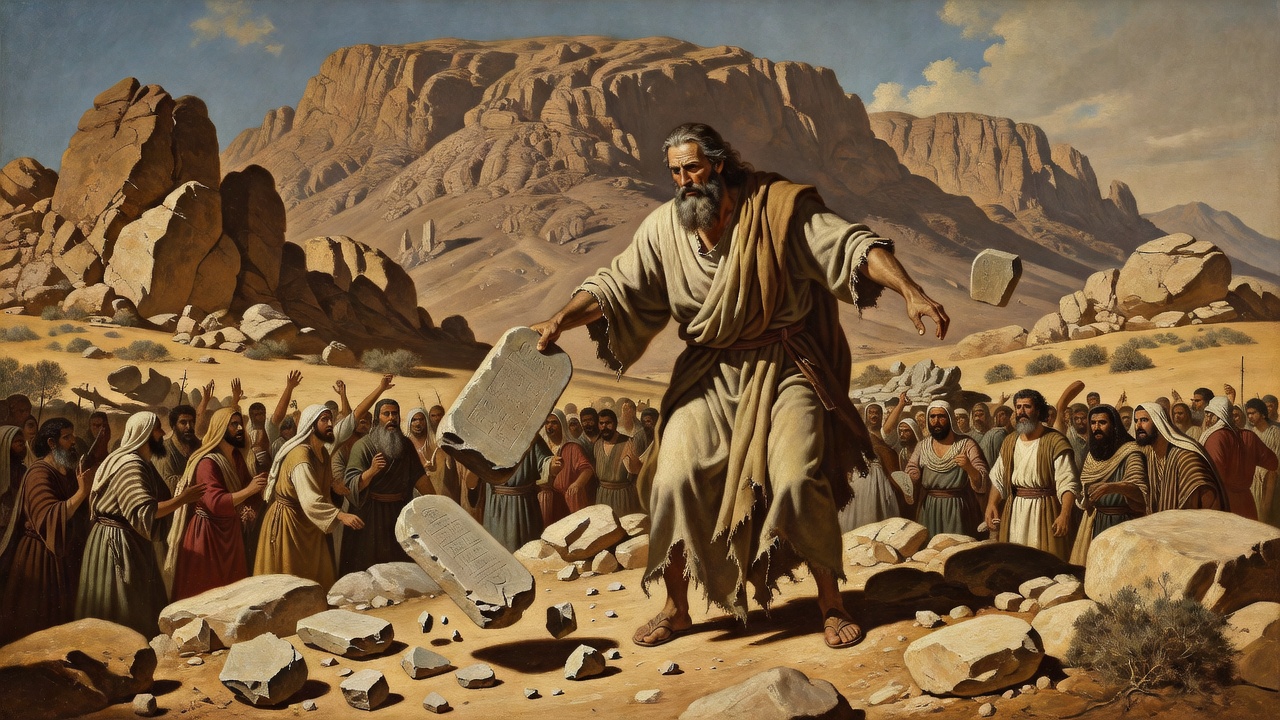
7Haue thou mynde, and foryete not, hou in the wildirnesse thou terridist thi Lord God to greet wraththe; fro that dai in which thou yedist out of Egipt `til to this place, thou striuedist euere ayens the Lord. 8For whi also in Oreb thou terridist hym, and he was wrooth, and wolde do thee awei, whanne Y stiede in to the hil, 9that Y schulde take two tablis of stoon, the tablis of couenaunt which the Lord made with you, and Y continuede in the hil fourti daies and nyytis, and Y eet not breed, and Y drank not watir. 10And the Lord yaf to me, twey tablis of stoon, euer either wrytun with Goddis fyngur, and conteynynge alle the wordis whiche he spak to you in the hil, fro the myddis of the fier, whanne the cumpany of puple was gaderid togidere. 11And whanne fourti daies and so many nyytis hadden passid, the Lord yaf to me twei tablis of stoon, tablis of boond of pees; 12and he seide to me, Rise thou, and go doun for hennys soone, for thi puple, which thou leddist out of Egipt, han forsake swiftli the weie which thou schewidist to hem, and thei han maad to hem a yotun calf. 13And eft the Lord seide to me, `Y se that this puple is of hard nol; 14suffre thou me, that I alto breke hym, and do awey the name `of hym fro vndur heuene; and Y schal ordeyne thee on a folk which is grettere and strongere than this folk. 15And whanne Y cam doun fro the hil brennynge, and helde with euer either hond twei tablis of boond of pees, and Y seiy, 16that ye hadde synned to youre Lord God, and hadden maad to you a yotun calf, and hadden forsake swiftli the weie of God which he schewide to you, 17Y castide doun the tablis fro myn hondis, and brak tho tablis in youre siyt. 18And Y felde doun bifor the Lord as `biforto, in fourti daies and fourti nyytis, and Y eet not breed, `and drank not watir, for alle youre synnes whiche ye diden ayens the Lord, and terriden hym to `greet wraththe; 19for Y dredde the indignacioun and yre of hym, by which he was stirid ayens you, and wolde do you awey. And the Lord herde me also in this tyme. 20Also the Lord was wrooth greteli ayens Aaron, and wolde alto breke hym, and Y preiede in lijk maner for hym. 21`Forsothe Y took youre synne which ye maden, that is, the calf, and brente it in fier, and Y alto brak in gobetis, and droof outerli in to dust, and castide forth in to the stronde, that cam doun fro the hil. 22Also in the brennyng, and in the temptacioun at the watris of ayenseiyng, and in the Sepulcris of Coueytise, ye terriden the Lord; 23and whanne Y sente you fro Cades Barne, and seide, `Stye ye, and welde the lond which Y yaf to you, and ye dispisiden the comaundement of youre Lord God, and ye bileueden not to him, nether ye wolden here his vois; 24but euere ye weren rebel, fro the day in which Y bigan to knowe you. 25And Y lay byfore the Lord fourti daies and fourti nyytis, in whiche Y bisouyte hym mekeli, that he schulde not `do awey you, as he manaasside. 26And Y preiede, and seide, Lord God, distrye not thi puple, and thin eritage, which thou `ayen bouytist in thi greetnesse, which thou leddist out of Egipt in strong hond. 27Haue thou mynde of thi seruauntis, of Abraham, Isaac, and Jacob; biholde thou not the hardnesse of this puple, and the wickidnesse, and the synne therof, 28lest perauenture the dwelleris of the lond, out of which thou leddist vs, seien, The Lord myyte not bryng hem in to the lond which he bihiyte to hem, and he hatide hem; therfor he ledde hem out that he schulde sle hem in wildirnesse; 29and thei ben thi puple and thin eritage, which thou leddist out in thi greet strengthe, and in thin arm holdun forth.
Did you know?
Not by Israel's Righteousness
- Moses warns Israel that their entry into Canaan is not earned through moral uprightness, directly calling them a stubborn or stiff-necked people. Instead, their conquest is attributed to the moral corruption of the resident nations and God's faithfulness to the covenant sworn to Abraham, Isaac, and Jacob.Sources: the Bible text itself · Abraham · Isaac · Jacob (Israel)
- The passage refers to the Anakim, descendants of Anak renowned for their great height and strength, who occupied heavily fortified cities in Canaan. Their reputation had previously intimidated the Israelites from attempting to enter the land.Sources: the Bible text itself · Anak
- To emphasize Israel's history of rebellion, Moses recounts the golden calf at Horeb where he shattered the two stone tablets and interceded for the people and Aaron. He also highlights repeated crises during the wilderness journey, including incidents at Taberah, Massah, and Kibroth-hattaavah.Sources: the Bible text itself · Horeb · Aaron · Taberah
Notes written with AI assistance from open sources (Theographic Bible Metadata, CC BY-SA 4.0; Easton’s Bible Dictionary, public domain) and reviewed before publishing.
Places in this chapter
- Jordan · Today: Jordan River · 31.761, 35.558 · verse 1
- Egypt · 30.129, 31.308 · verses 7, 12, 26, 29
- Mount Horeb · Today: Jebel Musa · 28.540, 33.973 · verse 8
Only places identified with high confidence are shown (90% or more according to the scholarly sources compiled by OpenBible). Period map: DARE (Digital Atlas of the Roman Empire), CC BY 4.0; modern map: © OpenStreetMap contributors; places: OpenBible.info (CC BY 4.0).
Credits and license for this translation
Wycliffe Bible
This is the Pentateuch and Gospels from The Holy Bible, containing the Old and New Testaments, with the apocryphal books, in the earliest English version made from the latin Vulgate by John Wycliffe and his followers. c.1395
Public Domain
Language: Middle English (English)
Dialect: Middle
Translation by: John Wycliffe
2016-11-08
Section headings adapted from the Berean Standard Bible (public domain); they are not part of this translation’s text.
Source: http://ebible.org/engWycliffe/ · eBible.org