Numbers 6
Unlocked Literal Bible · Tap a verse to see its cross-references.
The Nazirite Vow
1Yahweh spoke to Moses. He said, 2“Speak to the people of Israel. Say to them, 'When a man or a woman separates himself to Yahweh with a special vow of a Nazirite, 3he must keep himself from wine and strong drink. He must not drink vinegar made from wine or from strong drink. He must not drink any grape juice or eat fresh grapes or raisins. 4In all the days that he is separate to me, he must eat nothing that is made from grapes, including everything made from the seeds to their skins.
5During all the time of his vow of separation, no razor is to be used on his head until the days of his separation to Yahweh are fulfilled. He must be set apart to Yahweh. He must let the hair grow long on his head.
6During all the time that he separates himself to Yahweh, he must not come near a dead body. 7He must not make himself unclean even for his father, mother, brother, or sister, if they die. This is because he is separated to God, as everyone can see by his long hair. 8During all the time of his separation he is holy, reserved for Yahweh.
9If someone very suddenly dies beside him and defiles his consecrated head, then he must shave his head on the day of his purification—on the seventh day he must shave it. 10On the eighth day he must bring two doves or two young pigeons to the priest at the entrance to the tent of meeting. 11The priest must offer one bird as a sin offering and the other as a burnt offering. These will atone for him because he sinned by being near the dead body. He must consecrate his head again on that day. 12He must set himself apart to Yahweh for the days of his consecration. He must bring a male lamb one year old as a guilt offering. The days before he defiled himself must not be counted, because his consecration was defiled.
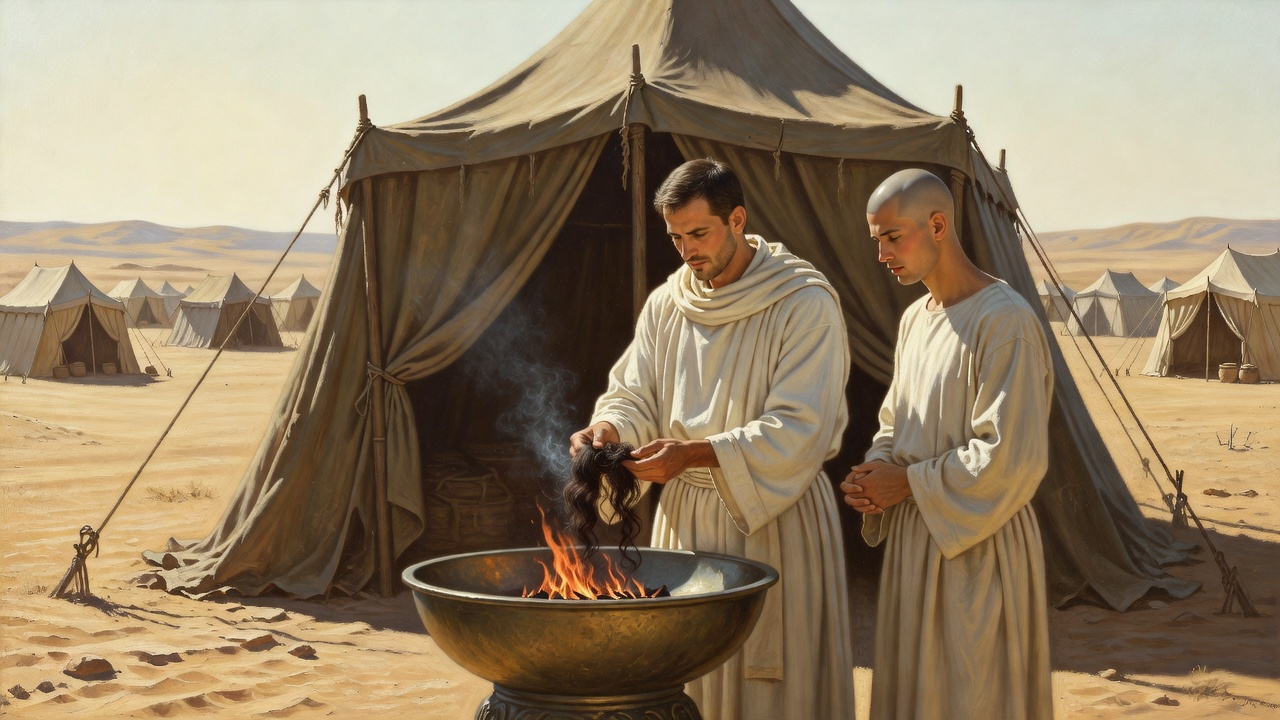
13This is the law about the Nazirite for when the time of his separation is complete. He must be brought to the entrance of the tent of meeting. 14He must present his offering to Yahweh. He must offer as a burnt offering a male lamb one year old and without blemish. He must bring as a sin offering a female lamb one year old and without blemish. He must bring a ram as a fellowship offering that is without blemish. 15He must also bring a basket of bread made without yeast, loaves of fine flour mixed with oil, wafers without yeast rubbed with oil, together with their grain offering and drink offerings. 16The priest must present them before Yahweh. He must offer his sin offering and burnt offering. 17With the basket of unleavened bread, he must present the ram as a sacrifice, the fellowship offering to Yahweh. The priest must present also the grain offering and the drink offering. 18The Nazirite must shave his head indicating his separation to God at the entrance to the tent of meeting. He must take the hair from his head and put it on the fire that is under the sacrifice of fellowship offerings. 19The priest must take the boiled shoulder of the ram, one loaf of bread without yeast out of the basket, and one wafer without yeast. He must place them into the hands of the Nazirite after he has shaved his head indicating separation. 20The priest must wave them as an offering before Yahweh, a holy portion for the priest, together with the breast that was waved and the thigh that was presented for the priest. After that, the Nazirite may drink wine.
21This is the law for the Nazirite who vows his offering to Yahweh for his separation. Whatever else he may give, he must keep the obligations of the vow he has taken, to keep the promise indicated by the law for the Nazirite.'”
Aaron’s Blessing
22Again Yahweh spoke to Moses. He said, 23“Speak to Aaron and to his sons. Say, 'You must bless the people of Israel in this way. You must say to them,
24“May Yahweh bless you and keep you.
25May Yahweh make his face shine on you and be gracious to you.
26May Yahweh look on you with favor and give you peace.”'
27It is in this way that they must give my name to the people of Israel. Then I will bless them.”
Did you know?
The Nazirite Vow and the Priestly Blessing
- The Nazirite vow was a voluntary period of special consecration to God available to both men and women. During this time, the person had to abstain completely from grape products and fermented drinks, leave their hair uncut, and avoid ritual defilement from any dead body, even that of an immediate family member.Sources: the Bible text itself
- When the period of separation ended, the Nazirite brought sacrifices to the entrance of the Tent of Meeting, shaved their head of hair, and burned the hair in the fire beneath the peace offering sacrifice. After the priest offered the required portions before God, the vow concluded and the person was allowed to drink wine again.Sources: the Bible text itself
- The chapter concludes with the priestly blessing that God instructed Moses to give to Aaron and his sons. By invoking God's protection, shining face, grace, and peace, the priests placed the divine name upon the people of Israel.Sources: the Bible text itself · Moses · Aaron
Notes written with AI assistance from open sources (Theographic Bible Metadata, CC BY-SA 4.0; Easton’s Bible Dictionary, public domain) and reviewed before publishing.
Credits and license for this translation
Unlocked Literal Bible
The Holy Bible in English, Unlocked Literal Bible translation
copyright © 2017 Door43 World Missions Community
Language: English
Translation by: Door43 World Missions Community
Contributor: 'Alrick G. Headley, M.Div., Th.M.', 'Adam W. Nagelvoort, M.Div. Academic
Ministries, Columbia International University', 'Dave Statezni, BA Orig langs.,
M.Div. Fuller Theological Seminary', 'Bram van den Heuvel, M.A.', 'C. Harry
Harriss, M.Div.', 'David Trombold, M. Div.', 'Elizabeth Oakes, BA in Religious
Studies, Linguistics', 'George "Drew" Curley, M.Div., PhD, Professor of Biblical
Languages', Hendrik "Henry" de Vries, 'Henry Whitney, BA Linguistics', 'Jesse
Griffin, BA Biblical Studies, MA Biblical Languages', 'James N. Pohlig, M.Div.,
MA in Linguistics, D. Litt. in Biblical Languages', 'Larry T Brooks, M.Div.,
Assemblies of God Theological Seminary', 'Larry Sallee, D.Min.', 'Paul M Fahnestock,
M.Div. Reformed Theological Seminary, D. Min. Pittsburgh Theological Seminary',
'Perry Oakes, PhD in Old Testament, MA in Linguistics', 'Peter Smircich, BA Philosophy',
'Susan Quigley, MA in Linguistics', 'Thomas Warren, M.Div., Trinity Evangelical
Divinity School, D.Min, Reformed Theological Seminary', 'Timothy Neu, Ph.D.
Biblical Studies', 'Ward Pyles, M.Div., Western Baptist Theological Seminary',
David Trombold, Dean Ropp, Gene Mullen, James Vigen, Leonard Smith, Nicholas Alsop,
Michael Francis
This is an open-licensed update of the ASV, intended to provide a 'form-centric' understanding of the Bible. It increases the translator's understanding of the lexical and grammatical composition of the underlying text by adhering closely to the word order and structure of the originals.
This translation is made available to you under the terms of the
Creative Commons Attribution Share-Alike license 4.0.
You have permission to share and redistribute this Bible translation in any format and to make reasonable revisions and adaptations of this translation, provided that:
You include the above copyright and source information.
If you make any changes to the text, you must indicate that you did so in a way that makes it clear that the original licensor is not necessarily endorsing your changes.
If you redistribute this text, you must distribute your contributions under the same license as the original.
Pictures included with Scriptures and other documents on this site are licensed just for use with those Scriptures and documents.
For other uses, please contact the respective copyright owners.
Note that in addition to the rules above, revising and adapting God's Word involves a great responsibility to be true to God's Word. See Revelation 22:18-19.
2020-12-04
Section headings adapted from the Berean Standard Bible (public domain); they are not part of this translation’s text.
Source: http://ebible.org/engULB/ · eBible.org