Numbers 21
Unlocked Literal Bible · Tap a verse to see its cross-references.
The Defeat of Arad
1When the Canaanite king of Arad, who lived in the Negev, heard that Israel was traveling by the road to Atharim, he fought against Israel and took some of them captive. 2Israel vowed to Yahweh and said, “If you give us victory over these people, then we will completely destroy their cities.” 3Yahweh listened to Israel's voice and he gave them victory over the Canaanites. They completely destroyed them and their cities. That place was called Hormah.
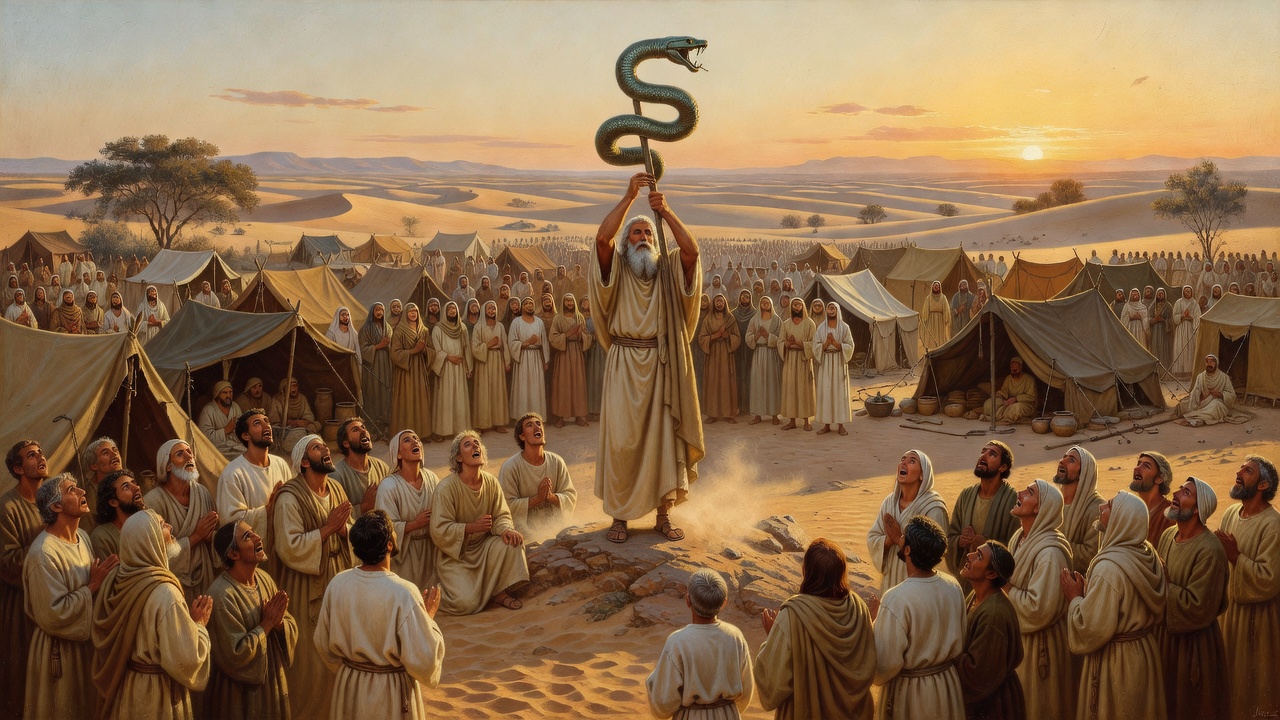
The Bronze Serpent
4They traveled from Mount Hor by the road to the Sea of Reeds to go around the land of Edom. The people became very discouraged on the way. 5The people spoke against God and Moses: “Why have you brought us up out of Egypt to die in the wilderness? There is no bread, no water, and we hate this miserable food.” 6Then Yahweh sent poisonous snakes among the people. The snakes bit the people; many people died. 7The people came to Moses and said, “We have sinned because we have spoken against Yahweh and you. Pray to Yahweh for him to take the snakes away from us.” So Moses prayed for the people. 8Yahweh said to Moses, “Make a snake and attach it to a pole. It will happen that everyone who is bitten will survive, if he looks at it.” 9So Moses made a bronze snake and attached it to a pole. When a snake bit any person, if he looked at the bronze snake, he survived.
The Journey to Moab
10Then the people of Israel traveled on and camped at Oboth. 11They traveled from Oboth and camped at Iye Abarim in the wilderness that faces Moab toward the east. 12From there they traveled on and camped in the Valley of Zered. 13From there they traveled on and camped on the other side of the Arnon River, which is in the wilderness that extends from the border of the Amorites. The Arnon River forms the border of Moab, between Moab and the Amorites. 14That is why it says in the scroll of the Wars of Yahweh,
“... Waheb in Suphah, and the valleys of the Arnon,
15the slope of the valleys that lead toward the town of Ar
and lie along the border of Moab.”
16From there they traveled to Beer, the well where Yahweh said to Moses, “Gather the people together for me to give them water.”
17Then Israel sang this song:
“Spring up, well!
Sing about it,
18about the well that our leaders dug,
the well the nobles of the people dug,
with the scepter and their staffs.”
Then from the wilderness they traveled to Mattanah. 19From Mattanah they traveled to Nahaliel, and from Nahaliel to Bamoth, 20and from Bamoth to a valley in the land of Moab. That is where the top of Mount Pisgah looks down on the wilderness.
The Defeat of Sihon
21Then Israel sent messengers to Sihon king of the Amorites saying, 22“Let us pass through your land. We will not turn into any field or vineyard. We will not drink the water from your wells. We will travel by the king's highway until we have crossed your border.” 23But King Sihon would not allow Israel to pass through their border. Instead, Sihon gathered all his army together and attacked Israel in the wilderness. He came to Jahaz, where he fought against Israel. 24Israel attacked the army of Sihon with the edge of the sword and took their land from the Arnon to the Jabbok river, as far as the land of the people of Ammon. Now the border of the people of Ammon was fortified. 25Israel took all the Amorite cities and lived in all of them, including Heshbon and all of its villages. 26Heshbon was the city of Sihon king of the Amorites, who had fought against the former king of Moab. Sihon had taken all his land from his territory to the Arnon River. 27That is why those who speak in proverbs say,
“Come to Heshbon.
Let the city of Sihon be rebuilt and established again.
28A fire blazed from Heshbon,
a flame from the city of Sihon
that devoured Ar of Moab,
and the owners of the high places of Arnon.
29Woe to you, Moab!
You have perished, people of Chemosh.
He has made his sons to be fugitives
and his daughters to be prisoners
of Sihon king of the Amorites.
30But we have conquered Sihon. Heshbon is devastated all the way to Dibon.
We have defeated them all the way to Nophah,
which reaches to Medeba.”
The Defeat of Og
31So Israel began to live in the Amorites' land. 32Then Moses sent men to look at Jazer. They took its villages and drove out the Amorites who were there.
33Then they turned and went up by the road of Bashan. Og king of Bashan went out against them, he and all his army, to fight them at Edrei. 34Then Yahweh said to Moses, “Do not fear him, because I have given you victory over him, all his army, and his land. Do to him as you did to Sihon king of the Amorites, who lived at Heshbon.” 35So they killed him, his sons, and all his army, until none of his people were left alive. Then they took over his land.
Did you know?
The Bronze Serpent and the March Beyond the Arnon
- When the Israelites grew impatient during their journey around Edom and complained about the lack of food and water, venomous snakes appeared in the camp. Moses was instructed to craft a bronze serpent and mount it on a pole so that anyone bitten could look at it and live.Sources: the Bible text itself
- This chapter cites an otherwise unknown ancient Hebrew text called the Book of the Wars of the LORD to delineate the boundary along the Arnon river, which separated the Moabites from the Amorites.Sources: the Bible text itself · Arnon
- The passage includes an ancient poem mentioning Chemosh, the deity worshipped by the Moabites. The poem recounts how Sihon king of the Amorites had previously conquered Moabite lands from Heshbon down to the Arnon before Israel defeated him in battle.Sources: the Bible text itself · Chemosh · Sihon · Heshbon
Notes written with AI assistance from open sources (Theographic Bible Metadata, CC BY-SA 4.0; Easton’s Bible Dictionary, public domain) and reviewed before publishing.
Places in this chapter
- Negeb · 31.245, 34.841 · verse 1
- Edom · 30.746, 35.604 · verse 4
- Way of the Red Sea · Today: road between the Dead Sea and the Gulf of Aqaba · 29.727, 34.998 · verse 4
- Egypt · 30.129, 31.308 · verse 5
- Moab · Today: Moab 1 · 31.181, 35.701 · verses 11, 13, 15, 20, 26, 28, 29
- Valley of Zered · Today: Wadi al Hasa · 31.027, 35.485 · verse 12
- Arnon · Today: Wadi Mujib · 31.466, 35.573 · verses 13, 14, 24, 26, 28
- Waheb · Today: within 50 km of Sufeh · 31.666, 35.817 · verse 14
- Jeshimon · 31.470, 35.223 · verse 20
- King’s Highway · 31.955, 35.934 · verse 22
- Ammon · 31.955, 35.934 · verse 24
- Jabbok · Today: Zarqa River · 32.115, 35.543 · verse 24
- Dibon · Today: Tall Dhiban · 31.502, 35.777 · verse 30
- Medeba · Today: Madaba · 31.716, 35.795 · verse 30
- Bashan · 32.781, 35.935 · verse 33
Only places identified with high confidence are shown (90% or more according to the scholarly sources compiled by OpenBible). Period map: DARE (Digital Atlas of the Roman Empire), CC BY 4.0; modern map: © OpenStreetMap contributors; places: OpenBible.info (CC BY 4.0).
Credits and license for this translation
Unlocked Literal Bible
The Holy Bible in English, Unlocked Literal Bible translation
copyright © 2017 Door43 World Missions Community
Language: English
Translation by: Door43 World Missions Community
Contributor: 'Alrick G. Headley, M.Div., Th.M.', 'Adam W. Nagelvoort, M.Div. Academic
Ministries, Columbia International University', 'Dave Statezni, BA Orig langs.,
M.Div. Fuller Theological Seminary', 'Bram van den Heuvel, M.A.', 'C. Harry
Harriss, M.Div.', 'David Trombold, M. Div.', 'Elizabeth Oakes, BA in Religious
Studies, Linguistics', 'George "Drew" Curley, M.Div., PhD, Professor of Biblical
Languages', Hendrik "Henry" de Vries, 'Henry Whitney, BA Linguistics', 'Jesse
Griffin, BA Biblical Studies, MA Biblical Languages', 'James N. Pohlig, M.Div.,
MA in Linguistics, D. Litt. in Biblical Languages', 'Larry T Brooks, M.Div.,
Assemblies of God Theological Seminary', 'Larry Sallee, D.Min.', 'Paul M Fahnestock,
M.Div. Reformed Theological Seminary, D. Min. Pittsburgh Theological Seminary',
'Perry Oakes, PhD in Old Testament, MA in Linguistics', 'Peter Smircich, BA Philosophy',
'Susan Quigley, MA in Linguistics', 'Thomas Warren, M.Div., Trinity Evangelical
Divinity School, D.Min, Reformed Theological Seminary', 'Timothy Neu, Ph.D.
Biblical Studies', 'Ward Pyles, M.Div., Western Baptist Theological Seminary',
David Trombold, Dean Ropp, Gene Mullen, James Vigen, Leonard Smith, Nicholas Alsop,
Michael Francis
This is an open-licensed update of the ASV, intended to provide a 'form-centric' understanding of the Bible. It increases the translator's understanding of the lexical and grammatical composition of the underlying text by adhering closely to the word order and structure of the originals.
This translation is made available to you under the terms of the
Creative Commons Attribution Share-Alike license 4.0.
You have permission to share and redistribute this Bible translation in any format and to make reasonable revisions and adaptations of this translation, provided that:
You include the above copyright and source information.
If you make any changes to the text, you must indicate that you did so in a way that makes it clear that the original licensor is not necessarily endorsing your changes.
If you redistribute this text, you must distribute your contributions under the same license as the original.
Pictures included with Scriptures and other documents on this site are licensed just for use with those Scriptures and documents.
For other uses, please contact the respective copyright owners.
Note that in addition to the rules above, revising and adapting God's Word involves a great responsibility to be true to God's Word. See Revelation 22:18-19.
2020-12-04
Section headings adapted from the Berean Standard Bible (public domain); they are not part of this translation’s text.
Source: http://ebible.org/engULB/ · eBible.org