Numbers 15
Unlocked Literal Bible · Tap a verse to see its cross-references.
Laws about Offerings
1Then Yahweh spoke to Moses. He said, 2“Speak to the people of Israel and say to them, 'When you go into the land where you will live, which Yahweh will give to you, 3you are to prepare an offering by fire to Yahweh, either a burnt offering or a sacrifice to fulfill a vow or a freewill offering, or an offering at your feasts, to produce a pleasing aroma for Yahweh from the herd or the flock. 4You must offer to Yahweh a burnt offering as well as a grain offering of a tenth of an ephah of fine flour mixed with one-fourth of a hin of oil. 5You must also offer with the burnt offering, or for the sacrifice, one-fourth of a hin of wine for the drink offering for each lamb. 6If you are offering a ram, you must prepare as a grain offering two-tenths of an ephah of fine flour mixed with a third of a hin of oil. 7For the drink offering, you must offer a third of a hin of wine. It will produce a sweet aroma for Yahweh. 8When you prepare a bull as a burnt offering or as a sacrifice to fulfill a vow, or as a fellowship offering to Yahweh, 9then you must offer with the bull a grain offering of three-tenths of an ephah of fine flour mixed with half a hin of oil. 10You must offer as the drink offering half a hin of wine, as an offering made by fire, to produce a sweet aroma for Yahweh.
11It must be done this way for each bull, for each ram, and for each of the male lambs or young goats. 12Every sacrifice that you prepare and offer must be done as described here. 13All who are native-born Israelites must do these things in this way, when anyone brings an offering made by fire, to produce an aroma that is pleasing to Yahweh. 14If a foreigner is staying with you, or whoever may live among you throughout your people's generations, he must make an offering made by fire, to produce a sweet aroma for Yahweh. He must act as you act. 15There must be the same law for the community and for the foreigner who stays with you, a permanent law throughout your people's generations. As you are, so also must be the traveler staying with you. He must act as you act before Yahweh. 16The same law and decree must apply to you and to the foreigner who is staying with you.'”
17Again Yahweh spoke to Moses. He said, 18“Speak to the people of Israel and say to them, 'When you come into the land where I will take you, 19when you eat the food produced in the land, you must offer an offering and present it to me. 20From the first of your dough you must offer a loaf to raise it up as a raised offering from the threshing floor. You must raise it up in this way. 21You must give to me a raised offering throughout your people's generations from the first of your dough.
Offerings for Unintentional Sins
22You will sometimes sin without intending to do so, when you do not obey all these commands that I have spoken to Moses— 23everything that I have commanded you through Moses from the day that I began to give you commands and onward throughout your people's generations. 24In the case of unintentional sin without the community's knowledge, then all the community must offer one young bull as a burnt offering to produce a sweet aroma for Yahweh. Along with this must be made a grain offering and drink offering, as commanded by the decree, and one male goat as a sin offering. 25The priest must make atonement for all the community of the people of Israel. They will be forgiven because the sin was an error. They have brought their sacrifice, an offering made by fire to me. They have brought their sin offering before me for their error. 26Then all the community of the people of Israel will be forgiven, and also the foreigners who are staying with them, because all the people committed the sin unintentionally.
27If a person sins unintentionally, then he must offer a female goat a year old as a sin offering. 28The priest must make atonement before Yahweh for the person who sins unintentionally. That person will be forgiven when atonement has been made. 29You must have the same law for the one who does anything unintentionally, the same law for the one who is native born among the people of Israel and for the foreigners who are staying among them. 30But the person who does anything in defiance, whether he is native born or a foreigner, blasphemes me. That person must be cut off from among his people. 31Because he has despised my word and has broken my commandment, that person must be cut off completely. His sin will be on him.'”
A Sabbath-Breaker Stoned
32While the people of Israel were in the wilderness, they found a man gathering wood on the Sabbath day. 33Those who found him brought him to Moses, Aaron, and all the community. 34They kept him in custody because it had not been declared what should be done with him. 35Then Yahweh said to Moses, “The man must surely be put to death. All the community must stone him with stones outside the camp.” 36So all the community brought him outside the camp and stoned him to death as Yahweh had commanded Moses.
The Law of Tassels
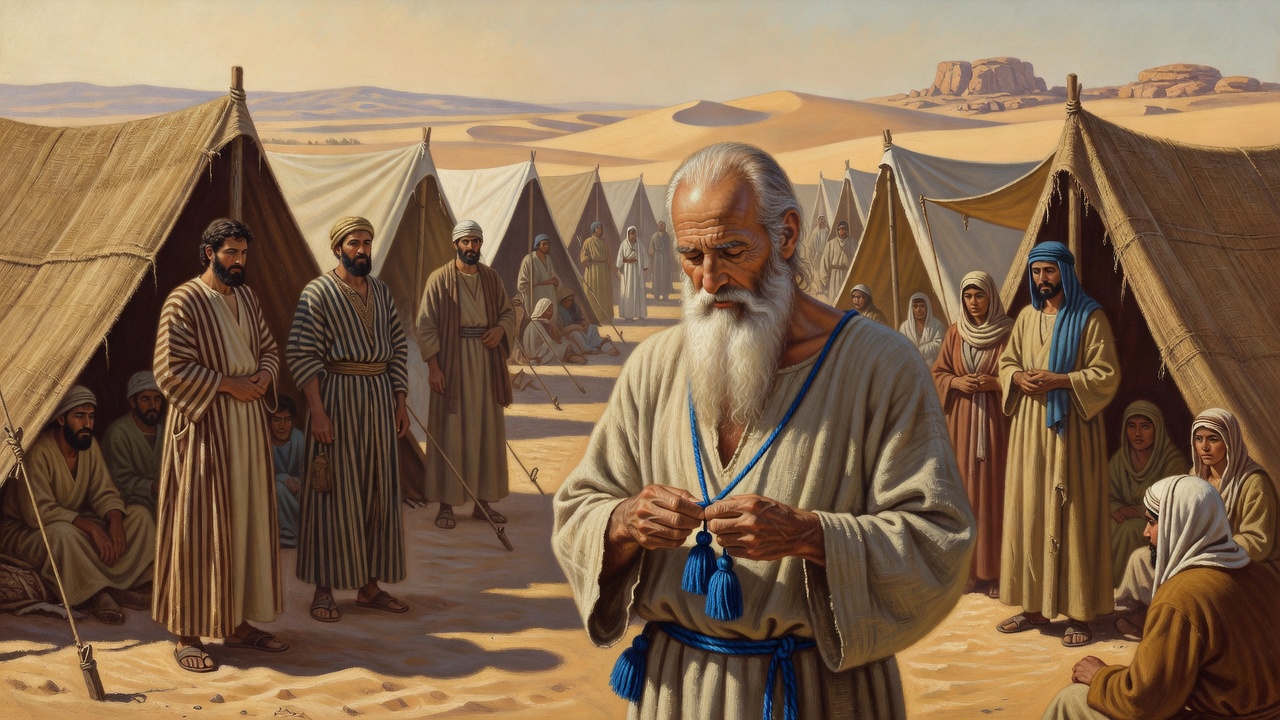
37Again Yahweh spoke to Moses. He said, 38“Speak to the descendants of Israel and command them to make for themselves tassels to hang from the borders of their garments, to hang them from each border by a blue cord. They must do this throughout their people's generations. 39It will be a special reminder to you, when you may look at it, of all my commandments, to carry them out so that you do not look to your own heart and your own eyes and prostitute yourselves to them. 40Do this so that you may call to mind and obey all my commandments, and so that you may be holy, reserved for me, your God. 41I am Yahweh your God, who brought you out of the land of Egypt, to become your God. I am Yahweh your God.”
Did you know?
Offerings, Obedience, and Reminders
- The regulations given for grain offerings, drink offerings, and unintentional sins applied equally to native-born Israelites and to foreigners residing among them. The law explicitly established a single standard and permanent statute for both groups before the LORD.Sources: the Bible text itself
- The law made a clear distinction between sins committed unintentionally, for which sacrificial atonement was provided, and defiant sins. Anyone who sinned deliberately was described as blaspheming the LORD and despising His word, bringing severe guilt and separation from the community.Sources: the Bible text itself
- To help the people remember all the divine commandments, the Israelites were instructed to attach tassels with a blue cord to the corners of their garments. Looking at these tassels was intended to keep them from being led astray by their own hearts and eyes.Sources: the Bible text itself
Notes written with AI assistance from open sources (Theographic Bible Metadata, CC BY-SA 4.0; Easton’s Bible Dictionary, public domain) and reviewed before publishing.
Places in this chapter
- Egypt · 30.129, 31.308 · verse 41
Only places identified with high confidence are shown (90% or more according to the scholarly sources compiled by OpenBible). Period map: DARE (Digital Atlas of the Roman Empire), CC BY 4.0; modern map: © OpenStreetMap contributors; places: OpenBible.info (CC BY 4.0).
Credits and license for this translation
Unlocked Literal Bible
The Holy Bible in English, Unlocked Literal Bible translation
copyright © 2017 Door43 World Missions Community
Language: English
Translation by: Door43 World Missions Community
Contributor: 'Alrick G. Headley, M.Div., Th.M.', 'Adam W. Nagelvoort, M.Div. Academic
Ministries, Columbia International University', 'Dave Statezni, BA Orig langs.,
M.Div. Fuller Theological Seminary', 'Bram van den Heuvel, M.A.', 'C. Harry
Harriss, M.Div.', 'David Trombold, M. Div.', 'Elizabeth Oakes, BA in Religious
Studies, Linguistics', 'George "Drew" Curley, M.Div., PhD, Professor of Biblical
Languages', Hendrik "Henry" de Vries, 'Henry Whitney, BA Linguistics', 'Jesse
Griffin, BA Biblical Studies, MA Biblical Languages', 'James N. Pohlig, M.Div.,
MA in Linguistics, D. Litt. in Biblical Languages', 'Larry T Brooks, M.Div.,
Assemblies of God Theological Seminary', 'Larry Sallee, D.Min.', 'Paul M Fahnestock,
M.Div. Reformed Theological Seminary, D. Min. Pittsburgh Theological Seminary',
'Perry Oakes, PhD in Old Testament, MA in Linguistics', 'Peter Smircich, BA Philosophy',
'Susan Quigley, MA in Linguistics', 'Thomas Warren, M.Div., Trinity Evangelical
Divinity School, D.Min, Reformed Theological Seminary', 'Timothy Neu, Ph.D.
Biblical Studies', 'Ward Pyles, M.Div., Western Baptist Theological Seminary',
David Trombold, Dean Ropp, Gene Mullen, James Vigen, Leonard Smith, Nicholas Alsop,
Michael Francis
This is an open-licensed update of the ASV, intended to provide a 'form-centric' understanding of the Bible. It increases the translator's understanding of the lexical and grammatical composition of the underlying text by adhering closely to the word order and structure of the originals.
This translation is made available to you under the terms of the
Creative Commons Attribution Share-Alike license 4.0.
You have permission to share and redistribute this Bible translation in any format and to make reasonable revisions and adaptations of this translation, provided that:
You include the above copyright and source information.
If you make any changes to the text, you must indicate that you did so in a way that makes it clear that the original licensor is not necessarily endorsing your changes.
If you redistribute this text, you must distribute your contributions under the same license as the original.
Pictures included with Scriptures and other documents on this site are licensed just for use with those Scriptures and documents.
For other uses, please contact the respective copyright owners.
Note that in addition to the rules above, revising and adapting God's Word involves a great responsibility to be true to God's Word. See Revelation 22:18-19.
2020-12-04
Section headings adapted from the Berean Standard Bible (public domain); they are not part of this translation’s text.
Source: http://ebible.org/engULB/ · eBible.org