Luke 6
Unlocked Literal Bible · Tap a verse to see its cross-references.
The Lord of the Sabbath
1Now it happened on a Sabbath that Jesus was going through the grainfields, and his disciples were picking the heads of grain, rubbing them between their hands, and eating the grain. 2But some of the Pharisees said, “Why are you doing something that is not lawful to do on the Sabbath day?” 3Answering them, Jesus said, “Have you not even read what David did when he was hungry, he and the men who were with him? 4He went into the house of God, and took the bread of the presence and ate some of it, and also gave some to the men who were with him to eat, even though it was only lawful for the priests to eat it.” 5Then he said to them, “The Son of Man is Lord of the Sabbath.”
Jesus Heals on the Sabbath
6It happened on another Sabbath that he went into the synagogue and taught the people there. A man was there whose right hand was withered. 7The scribes and the Pharisees were watching him closely to see whether he would heal someone on the Sabbath, so that they might find a reason to accuse him. 8But he knew what they were thinking and he said to the man whose hand was withered, “Get up, and stand here in the middle of everyone.” So the man got up and stood there. 9Jesus said to them, “I ask you, is it lawful on the Sabbath to do good or to do harm, to save a life or to destroy it?” 10Then he looked around at them all and said to the man, “Stretch out your hand.” He did so, and his hand was restored. 11But they were filled with anger and they talked to each other about what they might do to Jesus.
The Twelve Apostles
12It happened in those days that he went out to the mountain to pray. He continued all night in prayer to God. 13When it was day, he called his disciples to him, and he chose twelve of them, whom he also named apostles. 14The names of the apostles were Simon (whom he also named Peter) and his brother Andrew, James, John, Philip, Bartholomew, 15Matthew, Thomas, James son of Alphaeus, Simon who was called the Zealot, 16Judas son of James, and Judas Iscariot, who became a traitor.
Jesus Heals the Multitudes
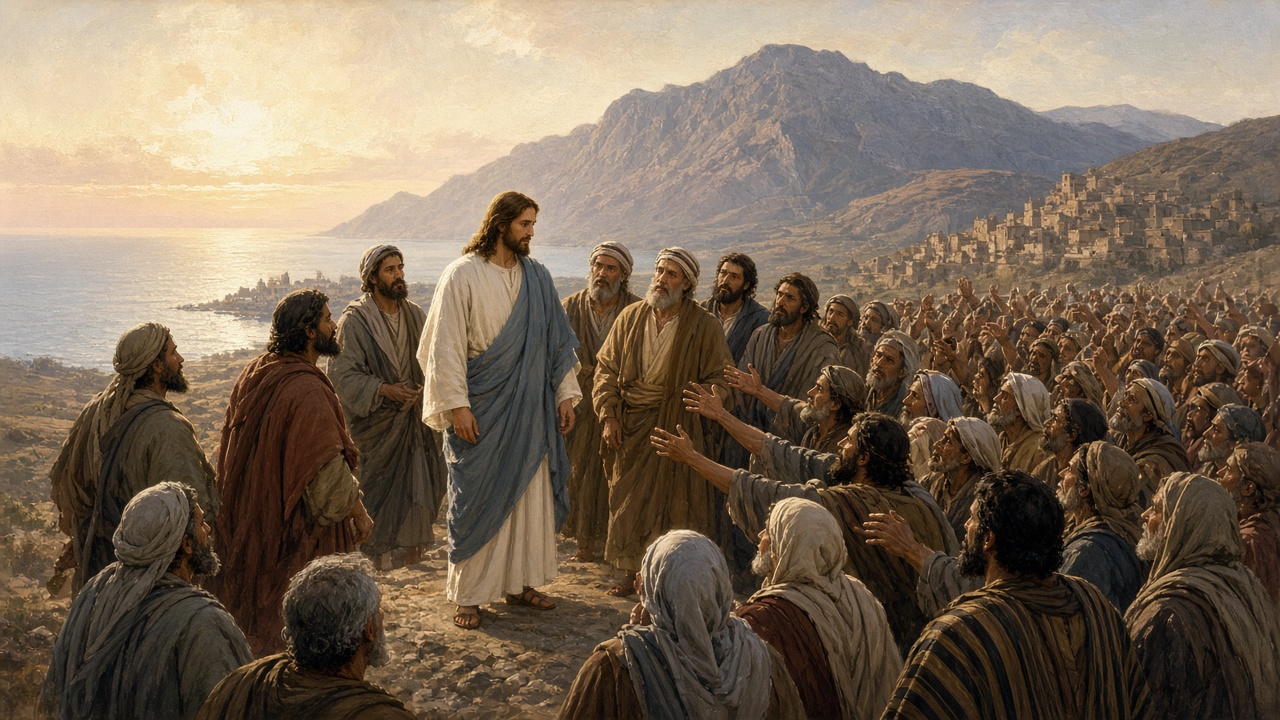
17Then Jesus came down the mountain with them and stood on a level place with a large crowd of his disciples and a large number of the people from Judea and Jerusalem and the seacoast of Tyre and Sidon. 18They had come to listen to him and to be healed of their diseases. People who were troubled with unclean spirits were also healed. 19Everyone in the crowd kept trying to touch him because power to heal was coming out from him, and he healed them all.
The Beatitudes
20Then he looked at his disciples, and said, “Blessed are you who are poor, for yours is the kingdom of God. 21Blessed are you who hunger now, for you will be filled. Blessed are you who weep now, for you will laugh. 22Blessed are you when people hate you, and when they exclude you and insult you and reject your name as evil, because of the Son of Man. 23Rejoice in that day and leap for joy, because you will surely have a great reward in heaven, for their ancestors treated the prophets in the same way.
Woes to the Satisfied
24But woe to you who are rich, for you have already received your comfort. 25Woe to you who are full now, for you will be hungry later. Woe to you who laugh now, for you will mourn and weep later. 26Woe to you when all men speak well of you, for that is how their ancestors treated the false prophets.
Love Your Enemies
27But I say to you who are listening, love your enemies and do good to those who hate you. 28Bless those who curse you and pray for those who mistreat you. 29To him who strikes you on the one cheek, offer him also the other. If someone takes away your coat, do not withhold your tunic either. 30Give to everyone who asks you. If someone takes away something that belongs to you, do not ask him to give it back to you. 31As you want people to do to you, you should do the same to them. 32If you only love people who love you, what credit is that to you? For even sinners love those who love them. 33If you do good only to people who do good to you, what credit is that to you? For even sinners do the same. 34If you only lend to people from whom you expect to be repaid, what credit is that to you? Even sinners lend to sinners, to get back the same amount. 35But love your enemies and do good to them. Lend, expecting nothing in return, and your reward will be great, and you will be sons of the Most High, for he himself is kind toward unthankful and evil people. 36Be merciful, just as your Father is merciful.
Judging Others
37Do not judge, and you will not be judged. Do not condemn, and you will not be condemned. Forgive others, and you will be forgiven. 38Give, and it will be given to you. A generous amount—pressed down, shaken together and spilling over—will pour into your lap. For with the measure you use, it will be measured back to you.”
39Then he also told them a parable. “Can a blind person guide another blind person? If he did, they would both fall into a pit, would they not? 40A disciple is not greater than his teacher, but everyone when he is fully trained will be like his teacher. 41Why do you look at the tiny piece of straw that is in your brother's eye, but you do not notice the log that is in your own eye? 42How can you say to your brother, 'Brother, let me take out the piece of straw that is in your eye,' when you yourself do not even see the log that is in your own eye? You hypocrite! First take the log out of your own eye, and then you will see clearly to take out the piece of straw that is in your brother's eye.
A Tree and Its Fruit
43For there is no good tree that produces rotten fruit, nor is there a rotten tree that produces good fruit. 44For each tree is known by the kind of fruit it produces. For people do not gather figs from a thornbush, nor do they gather grapes from a briar bush. 45The good man from the good treasure of his heart produces what is good, and the evil man from the evil treasure of his heart produces what is evil. For out of the abundance of the heart his mouth speaks.
The House on the Rock
46Why do you call me, 'Lord, Lord,' and yet you do not obey the things that I say? 47Every person who comes to me and hears my words and obeys them, I will tell you what he is like. 48He is like a man building a house, who dug down deep in the ground and built the house's foundation on solid rock. When a flood came, the torrent of water flowed against that house, but could not shake it, because it had been well built. 49But the person who hears my words and does not obey them, he is like a man who built a house on top of the ground without a foundation. When the torrent of water flowed against that house, it immediately collapsed, and the ruin of that house was complete.”
Did you know?
The Sabbath, the Twelve, and the Plain
- On a Sabbath, as Jesus passed through the grainfields, his disciples picked heads of grain, rubbed them in their hands, and ate them, and some Pharisees called this unlawful. Jesus recalled that David and his hungry companions ate consecrated bread from the house of God, bread lawful only for the priests, and said that the Son of Man is Lord of the Sabbath. On another Sabbath he restored a man’s withered right hand in the synagogue while scribes and Pharisees watched for a reason to accuse him; a chronology dates both episodes to AD 28.Sources: the Bible text itself · Corn on the Sabbath · Healing a Withered Hand
- After spending the night in prayer on the mountain, Jesus called his disciples and chose twelve, whom he designated apostles. Among them were Simon, whom he named Peter, and Peter’s brother Andrew, fishermen from Bethsaida on the western coast of the Sea of Galilee, and Matthew, a tax collector at Capernaum who had formerly been known as Levi.Sources: the Bible text itself · Simon Peter · Andrew · Matthew
- Jesus came down with them and stood on a level place, where people from Judea, Jerusalem, and the sea coast of Tyre and Sidon had gathered to hear him and to be healed. Tyre and Sidon were ancient Phoenician cities on the Mediterranean; Sidon, the older city, lay about twenty-five miles north of Tyre. A chronology dates this teaching to AD 28 and titles it the Sermon on the Mount, though the narrative places Jesus on level ground after he came down from the mountain.Sources: the Bible text itself · Tyre · Sidon · Sermon on the Mount
Notes written with AI assistance from open sources (Theographic Bible Metadata, CC BY-SA 4.0; Easton’s Bible Dictionary, public domain) and reviewed before publishing.
Places in this chapter
- Jerusalem · 31.777, 35.234 · verse 17
- Judea · Today: Judea 1 · 31.777, 35.234 · verse 17
- Sidon · Today: Sandikli archaeological site in Sidon · 33.561, 35.372 · verse 17
- Tyre · 33.271, 35.196 · verse 17
Only places identified with high confidence are shown (90% or more according to the scholarly sources compiled by OpenBible). Period map: DARE (Digital Atlas of the Roman Empire), CC BY 4.0; modern map: © OpenStreetMap contributors; places: OpenBible.info (CC BY 4.0).
Credits and license for this translation
Unlocked Literal Bible
The Holy Bible in English, Unlocked Literal Bible translation
copyright © 2017 Door43 World Missions Community
Language: English
Translation by: Door43 World Missions Community
Contributor: 'Alrick G. Headley, M.Div., Th.M.', 'Adam W. Nagelvoort, M.Div. Academic
Ministries, Columbia International University', 'Dave Statezni, BA Orig langs.,
M.Div. Fuller Theological Seminary', 'Bram van den Heuvel, M.A.', 'C. Harry
Harriss, M.Div.', 'David Trombold, M. Div.', 'Elizabeth Oakes, BA in Religious
Studies, Linguistics', 'George "Drew" Curley, M.Div., PhD, Professor of Biblical
Languages', Hendrik "Henry" de Vries, 'Henry Whitney, BA Linguistics', 'Jesse
Griffin, BA Biblical Studies, MA Biblical Languages', 'James N. Pohlig, M.Div.,
MA in Linguistics, D. Litt. in Biblical Languages', 'Larry T Brooks, M.Div.,
Assemblies of God Theological Seminary', 'Larry Sallee, D.Min.', 'Paul M Fahnestock,
M.Div. Reformed Theological Seminary, D. Min. Pittsburgh Theological Seminary',
'Perry Oakes, PhD in Old Testament, MA in Linguistics', 'Peter Smircich, BA Philosophy',
'Susan Quigley, MA in Linguistics', 'Thomas Warren, M.Div., Trinity Evangelical
Divinity School, D.Min, Reformed Theological Seminary', 'Timothy Neu, Ph.D.
Biblical Studies', 'Ward Pyles, M.Div., Western Baptist Theological Seminary',
David Trombold, Dean Ropp, Gene Mullen, James Vigen, Leonard Smith, Nicholas Alsop,
Michael Francis
This is an open-licensed update of the ASV, intended to provide a 'form-centric' understanding of the Bible. It increases the translator's understanding of the lexical and grammatical composition of the underlying text by adhering closely to the word order and structure of the originals.
This translation is made available to you under the terms of the
Creative Commons Attribution Share-Alike license 4.0.
You have permission to share and redistribute this Bible translation in any format and to make reasonable revisions and adaptations of this translation, provided that:
You include the above copyright and source information.
If you make any changes to the text, you must indicate that you did so in a way that makes it clear that the original licensor is not necessarily endorsing your changes.
If you redistribute this text, you must distribute your contributions under the same license as the original.
Pictures included with Scriptures and other documents on this site are licensed just for use with those Scriptures and documents.
For other uses, please contact the respective copyright owners.
Note that in addition to the rules above, revising and adapting God's Word involves a great responsibility to be true to God's Word. See Revelation 22:18-19.
2020-12-04
Section headings adapted from the Berean Standard Bible (public domain); they are not part of this translation’s text.
Source: http://ebible.org/engULB/ · eBible.org