Jeremiah 47
Unlocked Literal Bible · Tap a verse to see its cross-references.
Judgment on the Philistines
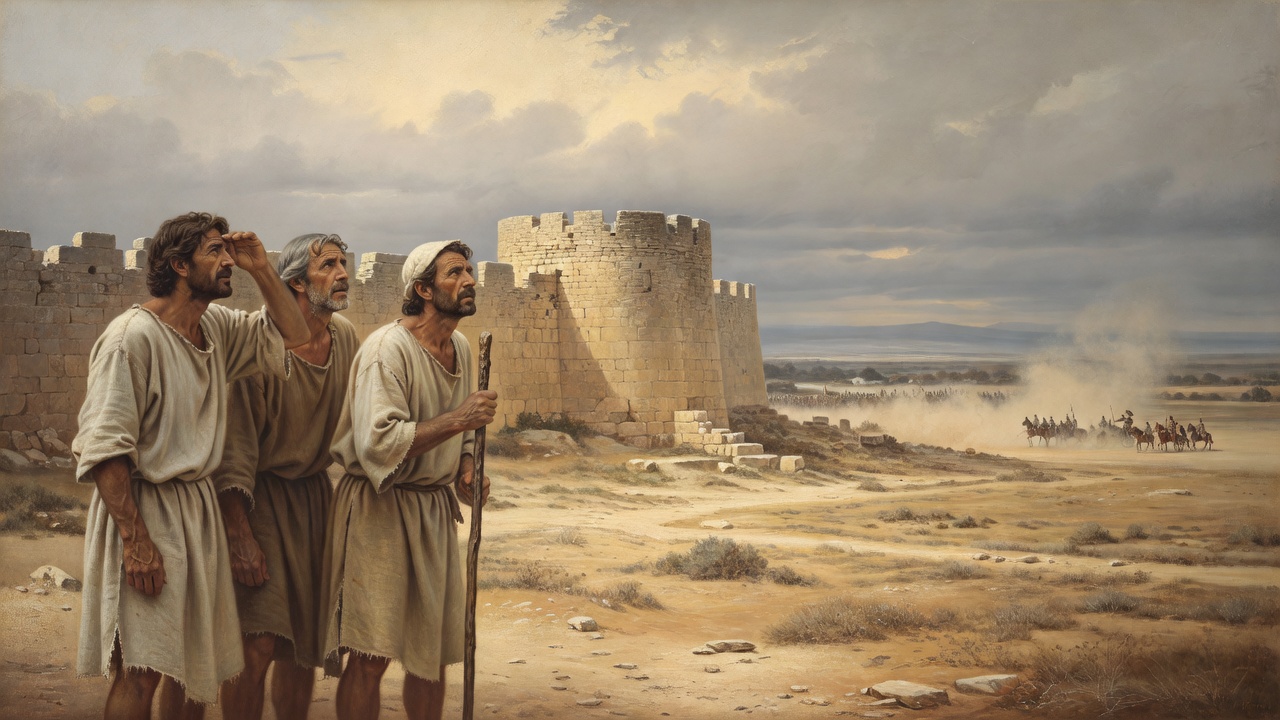
1This is the word of Yahweh that came to Jeremiah the prophet concerning the Philistines. This word came to him before Pharaoh attacked Gaza.
2“Yahweh says this: See, floods of water are rising in the north. They will be like an overflowing river!
Then they will overflow the land and everything in it, its cities and its inhabitants! So everyone will shout for help,
and all the inhabitants of the land will lament.
3At the sound of the stamping of their strong horses' hooves,
at the roar of their chariots and the noise of their wheels,
fathers will not help their children because of their own weakness.
4For the day is coming that will devastate all of the Philistines, to cut off from Tyre and Sidon
every survivor who wants to help them. For Yahweh is devastating the Philistines,
those who remain from the island of Caphtor. 5Baldness will come upon Gaza. As for Ashkelon, the people who are left in their valley will be made silent.
How long will you cut yourself in mourning?
6Woe, sword of Yahweh! How long will it be until you become silent?
Go back to your scabbard! Stop and be silent.
7How can it rest when Yahweh has commanded it,
when he has ordered it to attack Ashkelon and the coastlands along the sea?”
Did you know?
Judgment on the Philistines
- Jeremiah refers to the Philistines as the remnant from the coasts of Caphtor. Biblical traditions identify Caphtor as the place of origin of the Philistines, a location widely associated by scholars with Crete or parts of the eastern Mediterranean coast.Sources: the Bible text itself · Caphtor
- The chapter directs its warnings against Gaza and Ashkelon, two of the five prominent Philistine cities along the Mediterranean coast. Both were ancient centers known for their strategic position and trade links connecting Egypt and the surrounding regions.Sources: the Bible text itself · Gaza · Ashkelon
- The prophecy notes that the coming destruction would cut off every remaining ally from Tyre and Sidon. These two major Phoenician ports to the north were key maritime centers whose interests were closely intertwined with the coastal region.Sources: the Bible text itself · Tyre · Sidon
Notes written with AI assistance from open sources (Theographic Bible Metadata, CC BY-SA 4.0; Easton’s Bible Dictionary, public domain) and reviewed before publishing.
Places in this chapter
- Gaza · Today: Tell Harube · 31.504, 34.464 · verses 1, 5
- Sidon · Today: Sandikli archaeological site in Sidon · 33.561, 35.372 · verse 4
- Tyre · 33.271, 35.196 · verse 4
- Ashkelon · Today: Tel Ashkelon · 31.664, 34.546 · verses 5, 7
- Great Sea · Today: Mediterranean Sea · 31.805, 34.170 · verse 5
- Philistia · 31.664, 34.546 · verse 5
Only places identified with high confidence are shown (90% or more according to the scholarly sources compiled by OpenBible). Period map: DARE (Digital Atlas of the Roman Empire), CC BY 4.0; modern map: © OpenStreetMap contributors; places: OpenBible.info (CC BY 4.0).
Credits and license for this translation
Unlocked Literal Bible
The Holy Bible in English, Unlocked Literal Bible translation
copyright © 2017 Door43 World Missions Community
Language: English
Translation by: Door43 World Missions Community
Contributor: 'Alrick G. Headley, M.Div., Th.M.', 'Adam W. Nagelvoort, M.Div. Academic
Ministries, Columbia International University', 'Dave Statezni, BA Orig langs.,
M.Div. Fuller Theological Seminary', 'Bram van den Heuvel, M.A.', 'C. Harry
Harriss, M.Div.', 'David Trombold, M. Div.', 'Elizabeth Oakes, BA in Religious
Studies, Linguistics', 'George "Drew" Curley, M.Div., PhD, Professor of Biblical
Languages', Hendrik "Henry" de Vries, 'Henry Whitney, BA Linguistics', 'Jesse
Griffin, BA Biblical Studies, MA Biblical Languages', 'James N. Pohlig, M.Div.,
MA in Linguistics, D. Litt. in Biblical Languages', 'Larry T Brooks, M.Div.,
Assemblies of God Theological Seminary', 'Larry Sallee, D.Min.', 'Paul M Fahnestock,
M.Div. Reformed Theological Seminary, D. Min. Pittsburgh Theological Seminary',
'Perry Oakes, PhD in Old Testament, MA in Linguistics', 'Peter Smircich, BA Philosophy',
'Susan Quigley, MA in Linguistics', 'Thomas Warren, M.Div., Trinity Evangelical
Divinity School, D.Min, Reformed Theological Seminary', 'Timothy Neu, Ph.D.
Biblical Studies', 'Ward Pyles, M.Div., Western Baptist Theological Seminary',
David Trombold, Dean Ropp, Gene Mullen, James Vigen, Leonard Smith, Nicholas Alsop,
Michael Francis
This is an open-licensed update of the ASV, intended to provide a 'form-centric' understanding of the Bible. It increases the translator's understanding of the lexical and grammatical composition of the underlying text by adhering closely to the word order and structure of the originals.
This translation is made available to you under the terms of the
Creative Commons Attribution Share-Alike license 4.0.
You have permission to share and redistribute this Bible translation in any format and to make reasonable revisions and adaptations of this translation, provided that:
You include the above copyright and source information.
If you make any changes to the text, you must indicate that you did so in a way that makes it clear that the original licensor is not necessarily endorsing your changes.
If you redistribute this text, you must distribute your contributions under the same license as the original.
Pictures included with Scriptures and other documents on this site are licensed just for use with those Scriptures and documents.
For other uses, please contact the respective copyright owners.
Note that in addition to the rules above, revising and adapting God's Word involves a great responsibility to be true to God's Word. See Revelation 22:18-19.
2020-12-04
Section headings adapted from the Berean Standard Bible (public domain); they are not part of this translation’s text.
Source: http://ebible.org/engULB/ · eBible.org