Deuteronomy 24
Unlocked Literal Bible · Tap a verse to see its cross-references.
Marriage and Divorce Laws
1When a man takes a wife and marries her, if she finds no favor in his eyes because he has found some unsuitable thing in her, then he must write her a certificate of divorce, put it into her hand, and send her out of his house. 2When she has gone out of his house, she may go and be another man's wife. 3If the second husband hates her and writes her a certificate of divorce, puts it into her hand, and sends her out of his house; or if the second husband dies, the man who took her to be his wife— 4then her former husband, the one who had first sent her away, may not take her again to be his wife, after she has become impure; for that would be an abomination to Yahweh. You must not cause the land to become guilty, the land that Yahweh your God is giving you as an inheritance.
5When a man takes a new wife, he will not go to war with the army, neither may he be commanded to go on any forced duty; he will be free to be at home for one year and will cheer his wife whom he has taken.
Additional Laws
6No man may take a mill or an upper millstone as a pledge, for that would be taking a person's life as a pledge.
7If a man is found kidnapping any of his brothers from among the people of Israel, and treats him as a slave and sells him, that thief must die; and you will remove the evil from among you.
8Take heed regarding any plague of leprosy, so that you carefully observe and follow every instruction given to you which the priests, the Levites, teach you; as I commanded them, so you will act. 9Call to mind what Yahweh your God did to Miriam as you were coming out of Egypt.
10When you make your neighbor any kind of loan, you must not go into his house to fetch his pledge. 11You will stand outside, and the man to whom you have lent will bring the pledge outside to you. 12If he is a poor man, you must not sleep with his pledge in your possession. 13You must surely restore to him the pledge by the time the sun goes down, so that he may sleep in his cloak and bless you; it will be righteousness for you before Yahweh your God.
14You must not oppress a hired servant who is poor and needy, whether he is of your fellow Israelites, or of the foreigners who are in your land within your city gates; 15Each day you must give him his wage; the sun must not go down on this unsettled matter, for he is poor and is counting on it. Do this so that he does not cry out against you to Yahweh, and so that it not be a sin that you have committed.
16The parents must not be put to death for their children, neither must the children be put to death for their parents. Instead, everyone must be put to death for his own sin.
17You must not use force to take away the justice that is due the foreigner or the fatherless, nor take the widow's cloak as a pledge. 18Instead, you must call to mind that you were a slave in Egypt, and that Yahweh your God rescued you from there. Therefore I instruct you to obey this command.
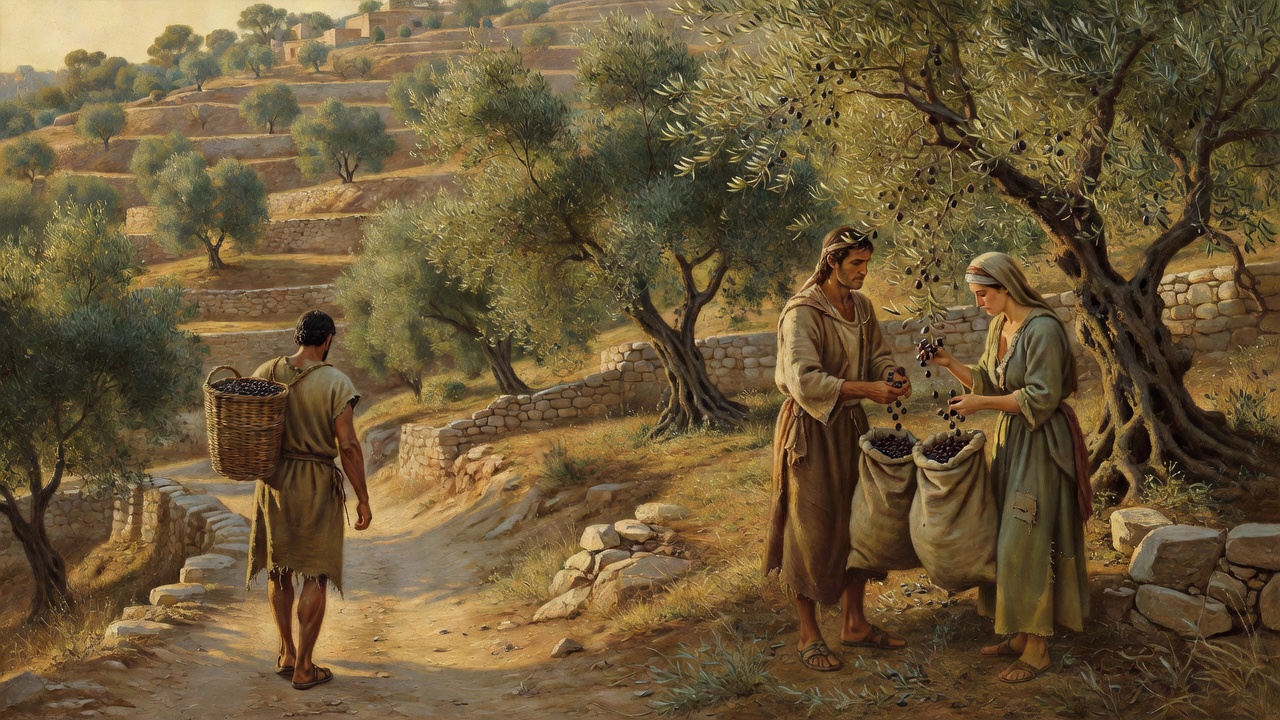
19When you reap your harvest in your field, and if you have forgotten an omer of grain in the field, you must not go back to get it; it must be for the foreigner, for the fatherless, or for the widow, so that Yahweh your God may bless you in all the work of your hands. 20When you shake your olive tree, you must not go over the branches again; it will be for the foreigner, for the fatherless, or for the widow. 21When you gather the grapes of your vineyard, you must not glean it again. What is left over will be for the foreigner, for the fatherless, and for the widow. 22You must call to mind that you were a slave in the land of Egypt; therefore I instruct you to obey this command.
Did you know?
Laws of Compassion, Justice, and Social Protection
- Israelite harvesting laws required landowners to leave behind forgotten sheaves of grain, leftover olives, and grape gleanings for vulnerable groups: the resident foreigner, the orphan, and the widow. This social welfare system was grounded in the collective memory that the Israelites had once been oppressed slaves in Egypt.Sources: the Bible text itself · Egypt
- Debtors and hired workers were protected by explicit legal limits. Creditors were forbidden from entering a debtor's house to seize a pledge, taking essential millstones that provided a household's daily bread, or keeping an impoverished person's sleeping cloak past sunset, and day laborers had to be paid before nightfall.Sources: the Bible text itself
- When giving instructions concerning infectious skin diseases and the guidance of Levitical priests, the text points back to the affliction of Miriam, the sister of Moses and Aaron, during the wilderness journey following the Exodus from Egypt.Sources: the Bible text itself · Miriam · Egypt
Notes written with AI assistance from open sources (Theographic Bible Metadata, CC BY-SA 4.0; Easton’s Bible Dictionary, public domain) and reviewed before publishing.
Places in this chapter
Only places identified with high confidence are shown (90% or more according to the scholarly sources compiled by OpenBible). Period map: DARE (Digital Atlas of the Roman Empire), CC BY 4.0; modern map: © OpenStreetMap contributors; places: OpenBible.info (CC BY 4.0).
Credits and license for this translation
Unlocked Literal Bible
The Holy Bible in English, Unlocked Literal Bible translation
copyright © 2017 Door43 World Missions Community
Language: English
Translation by: Door43 World Missions Community
Contributor: 'Alrick G. Headley, M.Div., Th.M.', 'Adam W. Nagelvoort, M.Div. Academic
Ministries, Columbia International University', 'Dave Statezni, BA Orig langs.,
M.Div. Fuller Theological Seminary', 'Bram van den Heuvel, M.A.', 'C. Harry
Harriss, M.Div.', 'David Trombold, M. Div.', 'Elizabeth Oakes, BA in Religious
Studies, Linguistics', 'George "Drew" Curley, M.Div., PhD, Professor of Biblical
Languages', Hendrik "Henry" de Vries, 'Henry Whitney, BA Linguistics', 'Jesse
Griffin, BA Biblical Studies, MA Biblical Languages', 'James N. Pohlig, M.Div.,
MA in Linguistics, D. Litt. in Biblical Languages', 'Larry T Brooks, M.Div.,
Assemblies of God Theological Seminary', 'Larry Sallee, D.Min.', 'Paul M Fahnestock,
M.Div. Reformed Theological Seminary, D. Min. Pittsburgh Theological Seminary',
'Perry Oakes, PhD in Old Testament, MA in Linguistics', 'Peter Smircich, BA Philosophy',
'Susan Quigley, MA in Linguistics', 'Thomas Warren, M.Div., Trinity Evangelical
Divinity School, D.Min, Reformed Theological Seminary', 'Timothy Neu, Ph.D.
Biblical Studies', 'Ward Pyles, M.Div., Western Baptist Theological Seminary',
David Trombold, Dean Ropp, Gene Mullen, James Vigen, Leonard Smith, Nicholas Alsop,
Michael Francis
This is an open-licensed update of the ASV, intended to provide a 'form-centric' understanding of the Bible. It increases the translator's understanding of the lexical and grammatical composition of the underlying text by adhering closely to the word order and structure of the originals.
This translation is made available to you under the terms of the
Creative Commons Attribution Share-Alike license 4.0.
You have permission to share and redistribute this Bible translation in any format and to make reasonable revisions and adaptations of this translation, provided that:
You include the above copyright and source information.
If you make any changes to the text, you must indicate that you did so in a way that makes it clear that the original licensor is not necessarily endorsing your changes.
If you redistribute this text, you must distribute your contributions under the same license as the original.
Pictures included with Scriptures and other documents on this site are licensed just for use with those Scriptures and documents.
For other uses, please contact the respective copyright owners.
Note that in addition to the rules above, revising and adapting God's Word involves a great responsibility to be true to God's Word. See Revelation 22:18-19.
2020-12-04
Section headings adapted from the Berean Standard Bible (public domain); they are not part of this translation’s text.
Source: http://ebible.org/engULB/ · eBible.org