Acts 13
Unlocked Literal Bible · Tap a verse to see its cross-references.
Paul’s First Missionary Journey Begins
1Now in the church in Antioch, there were some prophets and teachers. They were Barnabas, Simeon (who is called Niger), Lucius of Cyrene, Manaen (the foster brother of Herod the tetrarch), and Saul. 2While they were worshiping the Lord and fasting, the Holy Spirit said, “Set apart for me Barnabas and Saul, to do the work to which I have called them.” 3After they had fasted, prayed, and laid their hands on these men, they sent them off.
On Cyprus
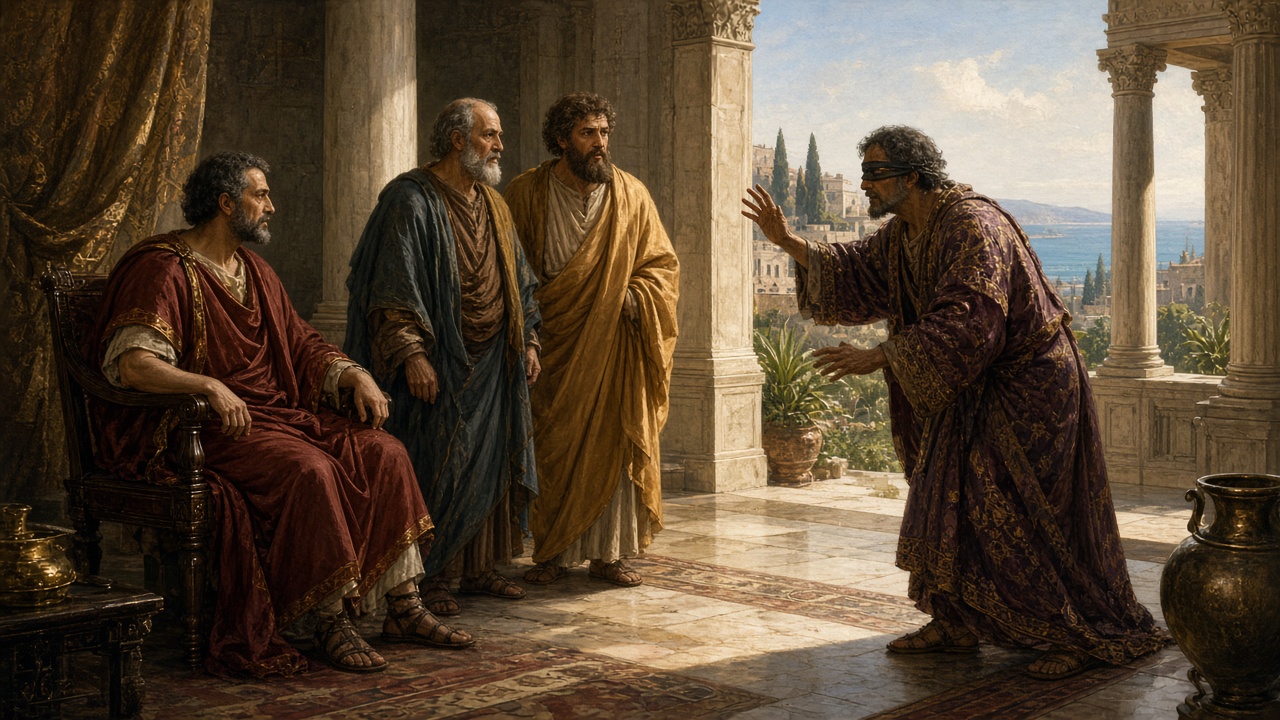
4So Barnabas and Saul obeyed the Holy Spirit and went down to Seleucia; from there they sailed to the island of Cyprus. 5When they were in the city of Salamis, they proclaimed the word of God in the synagogues of the Jews. They also had John Mark as their assistant. 6When they had gone through the whole island to Paphos, they found a certain magician, a Jewish false prophet, whose name was Bar Jesus. 7This magician associated with the proconsul, Sergius Paulus, who was an intelligent man. This man summoned Barnabas and Saul, because he wanted to hear the word of God. 8But Elymas “the magician” (that is how his name is translated) opposed them; he tried to turn the proconsul away from the faith. 9But Saul, who is also called Paul, filled with the Holy Spirit, stared at him intensely. 10and said, “You son of the devil, you are full of all kinds of deceit and wickedness. You are an enemy of every kind of righteousness. You will never stop twisting the straight paths of the Lord, will you? 11Now look, the hand of the Lord is upon you, and you will become blind. You will not see the sun for a while.” Immediately there fell on Elymas a mist and darkness; he started going around asking people to lead him by the hand. 12After the proconsul saw what had happened, he believed, because he was astonished at the teaching about the Lord.
In Pisidian Antioch
13Now Paul and his friends set sail from Paphos and came to Perga in Pamphylia. But John left them and returned to Jerusalem. 14Paul and his friends traveled from Perga and came to Antioch of Pisidia. There they went into the synagogue on the Sabbath day and sat down. 15After the reading of the law and the prophets, the leaders of the synagogue sent them a message saying, “Brothers, if you have any message of encouragement for the people here, say it.” 16So Paul stood up and motioned with his hand; he said, “Men of Israel and you who honor God, listen. 17The God of this people Israel chose our fathers and made the people numerous when they stayed in the land of Egypt, and with an uplifted arm he led them out of it. 18For about forty years he put up with them in the wilderness. 19After he had destroyed seven nations in the land of Canaan, he gave our people their land for an inheritance. 20All these events took place over four hundred and fifty years. After all these things, God gave them judges until Samuel the prophet. 21Then the people asked for a king, and God gave them Saul son of Kish, a man from the tribe of Benjamin, to be king for forty years. 22After God removed him from the kingship, he raised up David to be their king. It was about David that God said, 'I have found David son of Jesse to be a man after my heart, who does all I want him to do.' 23From this man's descendants God has brought to Israel a savior, Jesus, as he promised to do. 24This began to happen when, before Jesus came, John first announced the baptism of repentance to all the people of Israel. 25As John was finishing his work, he said, 'Who do you think I am? I am not the one. But listen, one is coming after me, the shoes of whose feet I am not worthy to untie.' 26Brothers, children of the line of Abraham, and those among you who worship God, it is to us that the message about this salvation has been sent. 27For they who live in Jerusalem, and their rulers, did not recognize him, and they fulfilled sayings of the prophets that are read every Sabbath by condemning him. 28Even though they found no good cause for death in him, they asked Pilate to kill him. 29When they had completed all the things that were written about him, they took him down from the tree and laid him in a tomb. 30But God raised him from the dead. 31He was seen for many days by those who had come up with him from Galilee to Jerusalem. These people are now his witnesses to the people. 32So we are telling you the good news that what God promised to our fathers 33he has fulfilled for us, their children, by raising up Jesus. As it is written in the second Psalm:
'You are my Son, today I have become your Father.'
34The fact that he raised him up from the dead so that his body would never decay, God has spoken in this way:
'I will give you the holy and sure blessings promised to David.'
35This is why he also says in another Psalm,
'You will not allow your Holy One to see decay.'
36For when David had served the desires of God in his own generation, he fell asleep; he was laid with his fathers and his body experienced decay. 37But he whom God raised up experienced no decay. 38So let it be known to you, brothers, that through this man is proclaimed to you forgiveness of sins. 39By him every one who believes is justified from all the things which the law of Moses could not justify you. 40So then be careful that the thing the prophets spoke about does not happen to you:
41'Look, you despisers, and be astonished and then perish;
For I am doing a work in your days,
A work that you shall never believe, even if someone announces it to you.'”
A Light for the Gentiles
42As Paul and Barnabas left, the people begged them that they might speak these same words again the next Sabbath. 43When the synagogue meeting ended, many of the Jews and devout proselytes followed Paul and Barnabas, who spoke to them and urged them to continue in the grace of God.
44On the next Sabbath, almost the whole city was gathered together to hear the word of the Lord. 45When the Jews saw the crowds, they were filled with jealousy and spoke against the things that were said by Paul and insulted him. 46But Paul and Barnabas spoke out boldly and said, “It was necessary that the word of God should first be spoken to you. Seeing you push it away from yourselves and consider yourselves unworthy of eternal life, see, we will turn to the Gentiles. 47For so has the Lord commanded us, saying,
'I have placed you as a light for the Gentiles,
that you should bring salvation to the uttermost parts of the earth.'”
48As the Gentiles heard this, they were glad and praised the word of the Lord. As many as were appointed to eternal life believed. 49The word of the Lord was spread out through the whole region. 50But the Jews urged on the devout and important women, as well as the leading men of the city. These stirred up a persecution against Paul and Barnabas and threw them out beyond the border of their city. 51But Paul and Barnabas shook off the dust from their feet against them. Then they went to the city of Iconium. 52And the disciples were filled with joy and with the Holy Spirit.
Did you know?
The mission sent from Antioch
- Easton's Bible Dictionary (1897) describes Antioch in Syria as ranking third, after Rome and Alexandria, among the cities of the Roman empire; the church there set Barnabas and Saul apart. Among its prophets and teachers were Simeon called Niger, a surname meaning black, perhaps from a dark complexion, and Lucius of Cyrene, in North Africa.Sources: Antioch (Syria) · the Bible text itself · Simeon · Lucius
- At Paphos, the capital of Cyprus and the residence of the Roman governor, a Jewish sorcerer named Bar-Jesus, also called Elymas, an Arabic name meaning magician or sorcerer, tried to turn the proconsul Sergius Paulus from the faith. It is here that Saul is also called Paul; Easton's Bible Dictionary (1897) says the name Paul was probably given to him in infancy for use in the Gentile world, while Saul was his Hebrew home-name.Sources: Paphos · Elymas · Paul · the Bible text itself
- Sent from Antioch, they went down to Seleucia, the city's seaport near the mouth of the Orontes, and sailed to Cyprus; later they landed at Perga, the capital of Pamphylia, on the river Cestrus. There John left them and returned to Jerusalem; his Roman name, Mark, gradually came to replace his Jewish name, and he was a cousin of Barnabas.Sources: Seleucia · Perga · John Mark · the Bible text itself
Notes written with AI assistance from open sources (Theographic Bible Metadata, CC BY-SA 4.0; Easton’s Bible Dictionary, public domain) and reviewed before publishing.
Places in this chapter
- Antioch · Today: Antioch on the Orontes · 36.227, 36.172 · verse 1
- Cyrene · 32.821, 21.851 · verse 1
- Cyprus · 35.000, 33.000 · verse 4
- Seleucia · Today: Seleucia Pieria · 36.124, 35.922 · verse 4
- Salamis · 35.185, 33.902 · verse 5
- Paphos · Today: New Paphos · 34.756, 32.404 · verses 6, 13
- Jerusalem · 31.777, 35.234 · verses 13, 27, 31
- Pamphylia · 37.000, 31.000 · verse 13
- Perga · 36.960, 30.854 · verses 13, 14
- Antioch · Today: Antioch in Pisidia · 38.306, 31.189 · verse 14
- Pisidia · 38.306, 31.189 · verse 14
- Egypt · 30.129, 31.308 · verse 17
- Canaan · 32.767, 35.333 · verse 19
- Galilee · 32.760, 35.527 · verse 31
- Iconium · Today: Konya · 37.872, 32.492 · verse 51
Only places identified with high confidence are shown (90% or more according to the scholarly sources compiled by OpenBible). Period map: DARE (Digital Atlas of the Roman Empire), CC BY 4.0; modern map: © OpenStreetMap contributors; places: OpenBible.info (CC BY 4.0).
Credits and license for this translation
Unlocked Literal Bible
The Holy Bible in English, Unlocked Literal Bible translation
copyright © 2017 Door43 World Missions Community
Language: English
Translation by: Door43 World Missions Community
Contributor: 'Alrick G. Headley, M.Div., Th.M.', 'Adam W. Nagelvoort, M.Div. Academic
Ministries, Columbia International University', 'Dave Statezni, BA Orig langs.,
M.Div. Fuller Theological Seminary', 'Bram van den Heuvel, M.A.', 'C. Harry
Harriss, M.Div.', 'David Trombold, M. Div.', 'Elizabeth Oakes, BA in Religious
Studies, Linguistics', 'George "Drew" Curley, M.Div., PhD, Professor of Biblical
Languages', Hendrik "Henry" de Vries, 'Henry Whitney, BA Linguistics', 'Jesse
Griffin, BA Biblical Studies, MA Biblical Languages', 'James N. Pohlig, M.Div.,
MA in Linguistics, D. Litt. in Biblical Languages', 'Larry T Brooks, M.Div.,
Assemblies of God Theological Seminary', 'Larry Sallee, D.Min.', 'Paul M Fahnestock,
M.Div. Reformed Theological Seminary, D. Min. Pittsburgh Theological Seminary',
'Perry Oakes, PhD in Old Testament, MA in Linguistics', 'Peter Smircich, BA Philosophy',
'Susan Quigley, MA in Linguistics', 'Thomas Warren, M.Div., Trinity Evangelical
Divinity School, D.Min, Reformed Theological Seminary', 'Timothy Neu, Ph.D.
Biblical Studies', 'Ward Pyles, M.Div., Western Baptist Theological Seminary',
David Trombold, Dean Ropp, Gene Mullen, James Vigen, Leonard Smith, Nicholas Alsop,
Michael Francis
This is an open-licensed update of the ASV, intended to provide a 'form-centric' understanding of the Bible. It increases the translator's understanding of the lexical and grammatical composition of the underlying text by adhering closely to the word order and structure of the originals.
This translation is made available to you under the terms of the
Creative Commons Attribution Share-Alike license 4.0.
You have permission to share and redistribute this Bible translation in any format and to make reasonable revisions and adaptations of this translation, provided that:
You include the above copyright and source information.
If you make any changes to the text, you must indicate that you did so in a way that makes it clear that the original licensor is not necessarily endorsing your changes.
If you redistribute this text, you must distribute your contributions under the same license as the original.
Pictures included with Scriptures and other documents on this site are licensed just for use with those Scriptures and documents.
For other uses, please contact the respective copyright owners.
Note that in addition to the rules above, revising and adapting God's Word involves a great responsibility to be true to God's Word. See Revelation 22:18-19.
2020-12-04
Section headings adapted from the Berean Standard Bible (public domain); they are not part of this translation’s text.
Source: http://ebible.org/engULB/ · eBible.org