1 Chronicles 7
Unlocked Literal Bible · Tap a verse to see its cross-references.
The Descendants of Issachar
1Issachar's four sons were Tola, Puah, Jashub, and Shimron. 2The sons of Tola were Uzzi, Rephaiah, Jeriel, Jahmai, Ibsam, and Samuel. They were the heads of their fathers' houses, from the descendants of Tola and they were listed as mighty warriors among their generation. They numbered 22,600 in the days of David. 3Uzzi's son was Izrahiah. His sons were Michael, Obadiah, Joel, and Ishijah, all five of them were clan leaders. 4Along with them they had thirty-six thousand troops for battle, according to the lists belonging to their ancestors' clans, for they had many wives and sons. 5Their relatives were fighting men from all the clans of Issachar, and they numbered in all, eighty-seven thousand fighting men, as listed in their genealogy.
The Descendants of Benjamin
6Benjamin's three sons were Bela, Beker, and Jediael. 7Bela's five sons were Ezbon, Uzzi, Uzziel, Jerimoth, and Iri. They were soldiers and heads of fathers' houses. Their people numbered 22,034 fighting men, according to the lists belonging to their ancestors' clans. 8Beker's sons were Zemirah, Joash, Eliezer, Elioenai, Omri, Jeremoth, Abijah, Anathoth, and Alemeth. All these were his sons. 9The lists of their clans numbered 20,200 heads of their fathers' houses and fighting men. 10The son of Jediael was Bilhan. Bilhan's sons were Jeush, Benjamin, Ehud, Kenaanah, Zethan, Tarshish, and Ahishahar. 11All these were sons of Jediael. Listed in their clan lists were 17,200 heads of houses and fighting men fit for military service. 12(The Shuppites and the Huppites were sons of Ir, and the Hushites were sons of Aher.)
The Descendants of Naphtali
13Naphtali's sons were Jahziel, Guni, Jezer, and Shillem. These were Bilhah's grandsons.
The Descendants of Manasseh
14Manasseh had a male child named Asriel, whom his Aramean concubine bore. She also gave birth to Makir, Gilead's father. 15Makir took a wife from the Huppites and Shuppites. A sister's name was Maakah. Another of Manasseh's descendants was Zelophehad, who had only daughters. 16Maakah wife of Makir, bore a son and she called him Peresh. His brother's name was Sheresh, and his sons were Ulam and Rakem. 17Ulam's son was Bedan. These were the descendants of Gilead son of Makir son of Manasseh. 18Gilead's sister Hammoleketh bore Ishhod, Abiezer, and Mahlah. 19The sons of Shemida were Ahian, Shechem, Likhi, and Aniam.
The Descendants of Ephraim
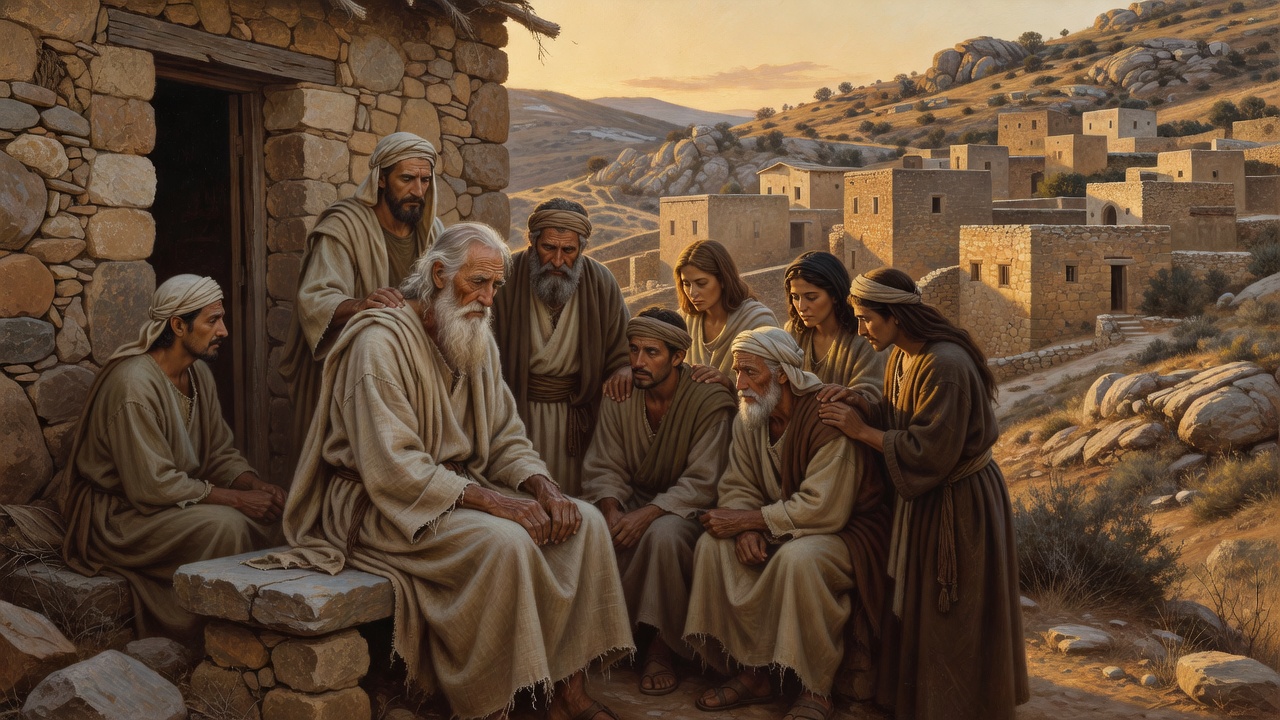
20The descendants of Ephraim were as follows: Ephraim's son was Shuthelah. Shuthelah's son was Bered. Bered's son was Tahath. Tahath's son was Eleadah. Eleadah's son was Tahath. 21Tahath's son was Zabad. Zabad's son was Shuthelah. (Ezer and Elead were killed by men of Gath, natives in the land, when they went to steal their cattle. 22Ephraim their father mourned for them many days, and his brothers came to comfort him. 23He slept with his wife. She conceived and bore a son. Ephraim called him Beriah, because tragedy had come to his family.) 24His daughter was Sheerah, who built Lower and Upper Beth Horon and Uzzen Sheerah. 25His son was Rephah. Rephah's son was Resheph. Resheph's son was Telah. Telah's son was Tahan. 26Tahan's son was Ladan. Ladan's son was Ammihud. Ammihud's son was Elishama. 27Elishama's son was Nun. Nun's son was Joshua.
28Their possessions and residences were Bethel and its surrounding villages. They extended eastward to Naaran and westward to Gezer and its villages, and to Shechem and its villages to Ayyah and its villages. 29On the border with Manasseh were Beth Shan and its villages, Taanach and its villages, Megiddo and its villages, and Dor and its villages. In these towns the descendants of Joseph son of Israel lived.
The Descendants of Asher
30Asher's sons were Imnah, Ishvah, Ishvi, and Beriah. Serah was their sister. 31Beriah's sons were Heber and Malkiel, who was the father of Birzaith. 32Heber's sons were Japhlet, Shomer, and Hotham. Shua was their sister. 33Japhlet's sons were Pasak, Bimhal, and Ashvath. These were Japhlet's children. 34Shomer, Japhlet's brother, had these sons: Rohgah, Hubbah, and Aram. 35Shemer's brother, Helem, had these sons: Zophah, Imna, Shelesh, and Amal. 36Zophah's sons were Suah, Harnepher, Shual, Beri, Imrah, 37Bezer, Hod, Shamma, Shilshah, Ithran, and Beera. 38Jether's sons were Jephunneh, Pispah, and Ara. 39Ulla's sons were Arah, Hanniel, and Rizia. 40All these were descendants of Asher. They were ancestors of the clans, heads of fathers' houses, distinguished men, fighting men, and chief among the leaders. There were twenty-six thousand men listed who were fit for military service, according to their numbered lists.
Did you know?
Genealogies of the Northern Tribes
- The genealogy of Ephraim highlights a woman named Sheerah, who is credited with building Upper and Lower Beth-horon as well as Uzzen-sheerah. These strategic settlements were situated along the mountain pass leading down toward the coastal plain.Sources: Beth-horon · Uzzen-sheerah · the Bible text itself
- A brief narrative recounts that Ephraim's sons Ezer and Elead were killed by the natives of Gath during an attempt to steal livestock. Ephraim mourned their loss for many days before his relatives came to comfort him, and his next son was named Beriah because of the tragedy.Sources: Gath · the Bible text itself
- The chapter traces the lineage of Ephraim down to Joshua the son of Nun, placing the prominent leader of the conquest within his tribal ancestry alongside figures such as Elishama and Ammihud.Sources: the Bible text itself
Notes written with AI assistance from open sources (Theographic Bible Metadata, CC BY-SA 4.0; Easton’s Bible Dictionary, public domain) and reviewed before publishing.
Places in this chapter
- Lower Beth-horon · Today: Beit Ur al Tahta · 31.895, 35.084 · verse 24
- Upper Beth-horon · Today: Beit Ur al Fauqa · 31.886, 35.114 · verse 24
- Gezer · Today: Tel Gezer · 31.859, 34.919 · verse 28
- Shechem · Today: Tell Balatah · 32.214, 35.282 · verse 28
- Megiddo · Today: Tel Megiddo · 32.585, 35.184 · verse 29
- Taanach · Today: Tell Ta’anakh · 32.522, 35.219 · verse 29
Only places identified with high confidence are shown (90% or more according to the scholarly sources compiled by OpenBible). Period map: DARE (Digital Atlas of the Roman Empire), CC BY 4.0; modern map: © OpenStreetMap contributors; places: OpenBible.info (CC BY 4.0).
Credits and license for this translation
Unlocked Literal Bible
The Holy Bible in English, Unlocked Literal Bible translation
copyright © 2017 Door43 World Missions Community
Language: English
Translation by: Door43 World Missions Community
Contributor: 'Alrick G. Headley, M.Div., Th.M.', 'Adam W. Nagelvoort, M.Div. Academic
Ministries, Columbia International University', 'Dave Statezni, BA Orig langs.,
M.Div. Fuller Theological Seminary', 'Bram van den Heuvel, M.A.', 'C. Harry
Harriss, M.Div.', 'David Trombold, M. Div.', 'Elizabeth Oakes, BA in Religious
Studies, Linguistics', 'George "Drew" Curley, M.Div., PhD, Professor of Biblical
Languages', Hendrik "Henry" de Vries, 'Henry Whitney, BA Linguistics', 'Jesse
Griffin, BA Biblical Studies, MA Biblical Languages', 'James N. Pohlig, M.Div.,
MA in Linguistics, D. Litt. in Biblical Languages', 'Larry T Brooks, M.Div.,
Assemblies of God Theological Seminary', 'Larry Sallee, D.Min.', 'Paul M Fahnestock,
M.Div. Reformed Theological Seminary, D. Min. Pittsburgh Theological Seminary',
'Perry Oakes, PhD in Old Testament, MA in Linguistics', 'Peter Smircich, BA Philosophy',
'Susan Quigley, MA in Linguistics', 'Thomas Warren, M.Div., Trinity Evangelical
Divinity School, D.Min, Reformed Theological Seminary', 'Timothy Neu, Ph.D.
Biblical Studies', 'Ward Pyles, M.Div., Western Baptist Theological Seminary',
David Trombold, Dean Ropp, Gene Mullen, James Vigen, Leonard Smith, Nicholas Alsop,
Michael Francis
This is an open-licensed update of the ASV, intended to provide a 'form-centric' understanding of the Bible. It increases the translator's understanding of the lexical and grammatical composition of the underlying text by adhering closely to the word order and structure of the originals.
This translation is made available to you under the terms of the
Creative Commons Attribution Share-Alike license 4.0.
You have permission to share and redistribute this Bible translation in any format and to make reasonable revisions and adaptations of this translation, provided that:
You include the above copyright and source information.
If you make any changes to the text, you must indicate that you did so in a way that makes it clear that the original licensor is not necessarily endorsing your changes.
If you redistribute this text, you must distribute your contributions under the same license as the original.
Pictures included with Scriptures and other documents on this site are licensed just for use with those Scriptures and documents.
For other uses, please contact the respective copyright owners.
Note that in addition to the rules above, revising and adapting God's Word involves a great responsibility to be true to God's Word. See Revelation 22:18-19.
2020-12-04
Section headings adapted from the Berean Standard Bible (public domain); they are not part of this translation’s text.
Source: http://ebible.org/engULB/ · eBible.org