Genesis 48
Plain English Version · Tap a verse to see its cross-references.
Jacob was good to Joseph’s sons
1One day, not long after that, somebody said to Joseph, “Your father is really sick. He might die soon.”
So Joseph went to see his father Jacob. And Joseph took his 2 sons with him. Their names were Manasseh and Ephraim.
2Joseph and his sons got to Jacob’s house, and somebody went and told Jacob, “Your son Joseph has come here to see you.”
Then Joseph and his sons went inside to talk to Jacob. Jacob was lying on his bed. He was really weak, so it was hard for him to move. But he really wanted to talk to Joseph, so he slowly sat up on his bed.
3Then Jacob said to Joseph, “You know, a long time ago, I saw God. He is the one that has power over everything. He came to me at the place called Luz, in Canaan country. And he promised me that he will be good to me. 4He said to me, ‘I will give you lots of kids and grand-kids, so that your family will grow into lots of different tribes. And I will give them all of this country, called Canaan. They will have this country for ever.’”
5Then Jacob kept talking to Joseph. He said, “At that time, there will be one tribe for each of my sons, and each tribe will get part of the land. And your 2 sons, Ephraim and Manasseh, they will get part of that land too. It’s like I’m adopting your 2 sons. There will be a tribe for Ephraim, and there will be a tribe for Manasseh, just like there will be a tribe for my son Reuben, and a tribe for my son Simeon, and for all my other sons. Your 2 sons, Ephraim and Manasseh, they were born here in Egypt country before I came to live here. 6But if you have any other sons, they will not have their own tribes. No, their kids and grand-kids will belong to Ephraim’s tribe and Manasseh’s tribe. And their families will have some land in the land of Ephraim or Manasseh in Canaan country.”
7Jacob also said to Joseph, “I want your 2 sons, Ephraim and Manasseh, to have their own tribes and their own land, because your mother Rachel only gave me 2 sons. She had you and your brother Benjamin. And then she died, and I was really sad. At that time, we were going from Paddan Aram country to Canaan country. Your mother died in Canaan country, on the way to the town called Efrath. And I buried her body near the road that goes to Efrath.” Another name for that town is Bethlehem.
Jacob made Ephraim more important than Manasseh
8Jacob was very old, and his eyes were weak, so he couldn’t see very well. He looked at Joseph’s 2 sons, and he said to Joseph, “Who are these 2 boys?”
Joseph said, “They are my sons, the ones that God gave me here in this country.”
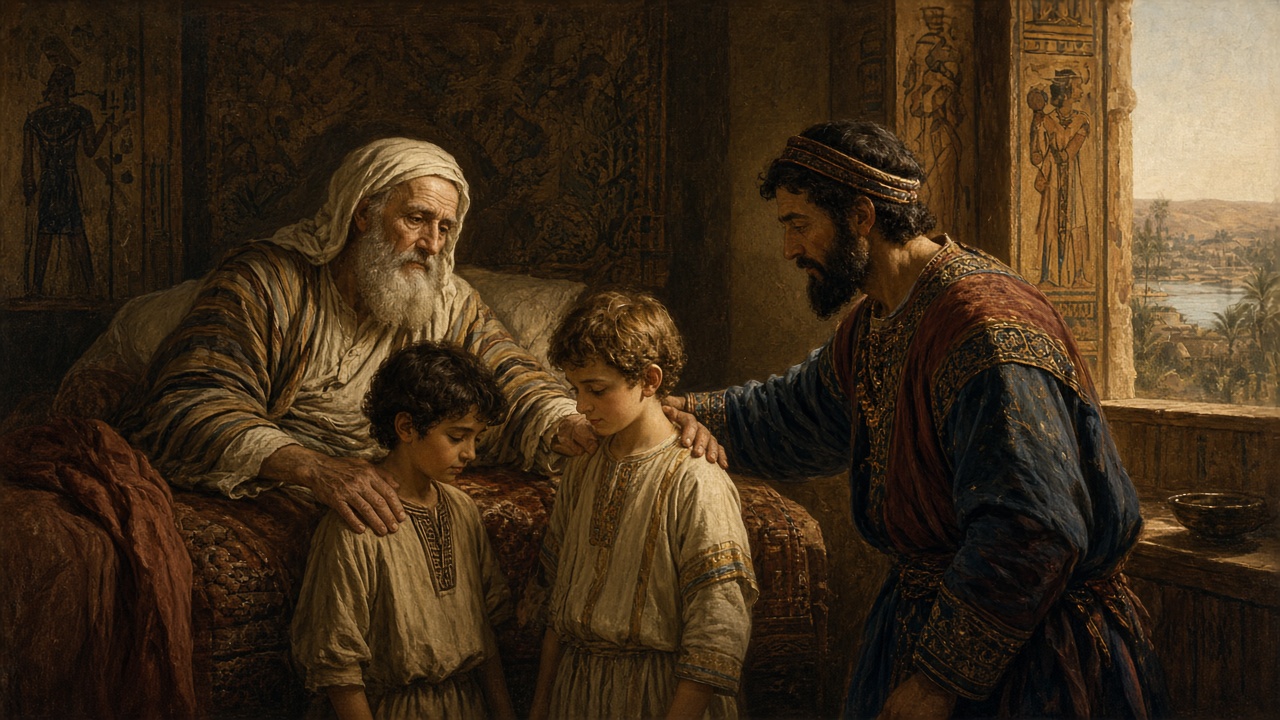
Then Jacob said, “Bring them near to me. I will put my hands on them, and I will ask God to be good to them.”
So Joseph took his 2 sons near to Jacob. And Jacob hugged those 2 boys, and he kissed them on their cheeks. 11Then Jacob said to Joseph, “You know, for a really long time, I thought you were dead. But a long time later, God let me see you again. And now, he let me see your kids too.”
12Then Joseph got his 2 sons to move away from Jacob. And Joseph got down on his knees and put his face near the ground, to show respect to his father Jacob.
13Then Joseph stood up. He put his son Ephraim on his right side, and he put his son Manasseh on his left side, and he went near to Jacob with his 2 sons, so that Jacob can ask God to be good to them. Then Joseph put his younger son Ephraim in front of Jacob’s left hand, and he put his older son Manasseh in front of Jacob’s right hand. You see, in that culture, people thought that their right hand was more important than their left hand. So Joseph wanted Jacob to put his right hand on Manasseh, because he was the older son. And he wanted Jacob to put his left hand on Ephraim, because he was the younger son.
14But Jacob didn’t do that. No, he put his right hand on Ephraim’s head, even though Ephraim was the younger son. And then he crossed his left arm over his right arm, and he put his left hand on Manasseh’s head, even though Manasseh was the older son.
15Then Jacob asked God to be good to Joseph and his sons. Jacob said,
“God, my grand-father Abraham always lived your way, and so did my father Isaac.
God, you took care of me all my life, and you still take care of me today.
16You are the one that saved me and set me free from all the bad things that happened to me.
So now, I’m asking you to be good to these 2 boys, Ephraim and Manasseh.
Let them be just like my own sons, and give them those good things that you promised to me, and to my grand-father Abraham, and to my father Isaac.
Let them have lots of kids and grand-kids, so that their families will become a really big mob here on earth.”
17While Jacob said all those things, he had his right hand on Ephraim’s head, and he had his left hand on Manasseh’s head. But Joseph wanted Jacob to put his right hand on Manasseh, because he was the older son. So Joseph got upset, and he tried to move Jacob’s right hand from Ephraim’s head to Manasseh’s head. 18And Joseph said to Jacob, “Father, don’t put your right hand on my younger son’s head. Look, here is my older son. Put your right hand on his head.”
19But Jacob didn’t move his hand. He said, “No, my son. I know for sure that I’m doing the right thing. Listen, your older son will have a big family, and they will become an important tribe. But your younger son will be more important than your older son. He will have a really big family, and later on, his tribe will be really big and really important.”
20That’s the story about the way that Jacob made Ephraim more important than Manasseh.
Then Jacob said another good thing about Ephraim and Manasseh. Jacob said to them,
“Later on, the Israel mob will always remember that God was very good to both of you. And sometimes they will say to each other,
‘I’m asking God to be good to you, just like he was good to Ephraim and Manasseh.’”
21Then Jacob said to Joseph, “Listen, I am going to die very soon. But God will be with you and your family. Later on, he will take your family back to that country where your father and grand-fathers lived, and he will give you land there.”
22Jacob also said to Joseph, “You know, a long time ago, I fought the Amor tribe with my long knife, and with my bow and arrows. And I took a bit of their land from them. Well, I’m giving you that bit of land too. I’m not giving it to your brothers, I’m only giving it to you.”
Did you know?
Adoption and Blessing of Ephraim and Manasseh
- Jacob reckons Joseph’s two sons, born to him in Egypt, as his own, on a level with Reuben and Simeon, Leah’s sons. Children born to Joseph after them were to remain Joseph’s, and were to be called by their brothers’ names in the territory they inherited.Sources: the Bible text itself · Manasseh (son of Joseph) · Reuben · Simeon
- Manasseh was the elder son and Ephraim the younger, born in Egypt. The name Ephraim means double fruitfulness, because God had made him fruitful in the land of his affliction. Though Israel could hardly see for age, he crossed his hands, laid his right hand on Ephraim, and insisted that the younger brother would be greater.Sources: the Bible text itself · Ephraim · Manasseh (son of Joseph)
- Jacob recalls that God Almighty appeared to him at Luz in the land of Canaan and blessed him there. Luz was the ancient name of a royal Canaanite city near Bethel, where Jacob halted and received a prophetic vision. He also remembers Rachel, Joseph’s mother, who died to his sorrow on the way back from Paddan—a name found only in this verse, for Padan-aram—and whom he buried beside the road to Ephrath, that is, Bethlehem.Sources: the Bible text itself · Luz · Paddan · Rachel
Notes written with AI assistance from open sources (Theographic Bible Metadata, CC BY-SA 4.0; Easton’s Bible Dictionary, public domain) and reviewed before publishing.
Places in this chapter
- Canaan · 32.767, 35.333 · verses 3, 4, 7, 21
- Luz · Today: Beitin · 31.923, 35.241 · verse 3
- Egypt · 30.129, 31.308 · verses 5, 9
- Bethlehem · 31.704, 35.208 · verse 7
- Ephrath · Today: Bethlehem · 31.704, 35.208 · verse 7
Only places identified with high confidence are shown (90% or more according to the scholarly sources compiled by OpenBible). Period map: DARE (Digital Atlas of the Roman Empire), CC BY 4.0; modern map: © OpenStreetMap contributors; places: OpenBible.info (CC BY 4.0).
Credits and license for this translation
Plain English Version
Portions of the Holy Bible in the Plain English Version translation for Australian Aboriginal people who speak English as a second language
Copyright © 2026 Wycliffe Bible Translators Australia
Language: Aboriginal English (English)
Dialect: Australian Aboriginal
Plain English Version © 2026 by Wycliffe Bible Translators Australia, licensed under Creative Commons Attribution-Share Alike 4.0 International (CC BY SA 4.0)
This licence allows you to copy and redistribute the material in any medium or format, even commercially. You may adapt, remix, transform, and build upon the material for any purpose, but if you do so, you must distribute your contributions under the same license as the original. You must always give appropriate credit, provide a link to the license, and indicate if changes were made. You may not suggest that Wycliffe Bible Translators endorses you or your use.
For full details of the licence, visit: creativecommons.org/licenses/by-sa/4.0/legalcode
This translation is made available to you under the terms of the
Creative Commons Attribution Share-Alike license 4.0.
You have permission to share and redistribute this Bible translation in any format and to make reasonable revisions and adaptations of this translation, provided that:
You include the above copyright and source information.
If you make any changes to the text, you must indicate that you did so in a way that makes it clear that the original licensor is not necessarily endorsing your changes.
If you redistribute this text, you must distribute your contributions under the same license as the original.
Pictures included with Scriptures and other documents on this site are licensed just for use with those Scriptures and documents.
For other uses, please contact the respective copyright owners.
Note that in addition to the rules above, revising and adapting God's Word involves a great responsibility to be true to God's Word. See Revelation 22:18-19.
2026-10-02
Source: http://ebible.org/engPEV/ · eBible.org