Genesis 4
Plain English Version · Tap a verse to see its cross-references.
Cain and Abel gave things to God
1Adam and Eve slept together, like a man does with his wife, and then Eve had a baby boy. Eve said, “God has helped me make another human.” So she gave him the name Cain. That name means make. 2After that, they had another son, and she gave him the name Abel.
Abel grew up, and he looked after sheep and goats all the time. Cain grew up, and he became a gardener. He dug the ground and grew plants for people to eat.
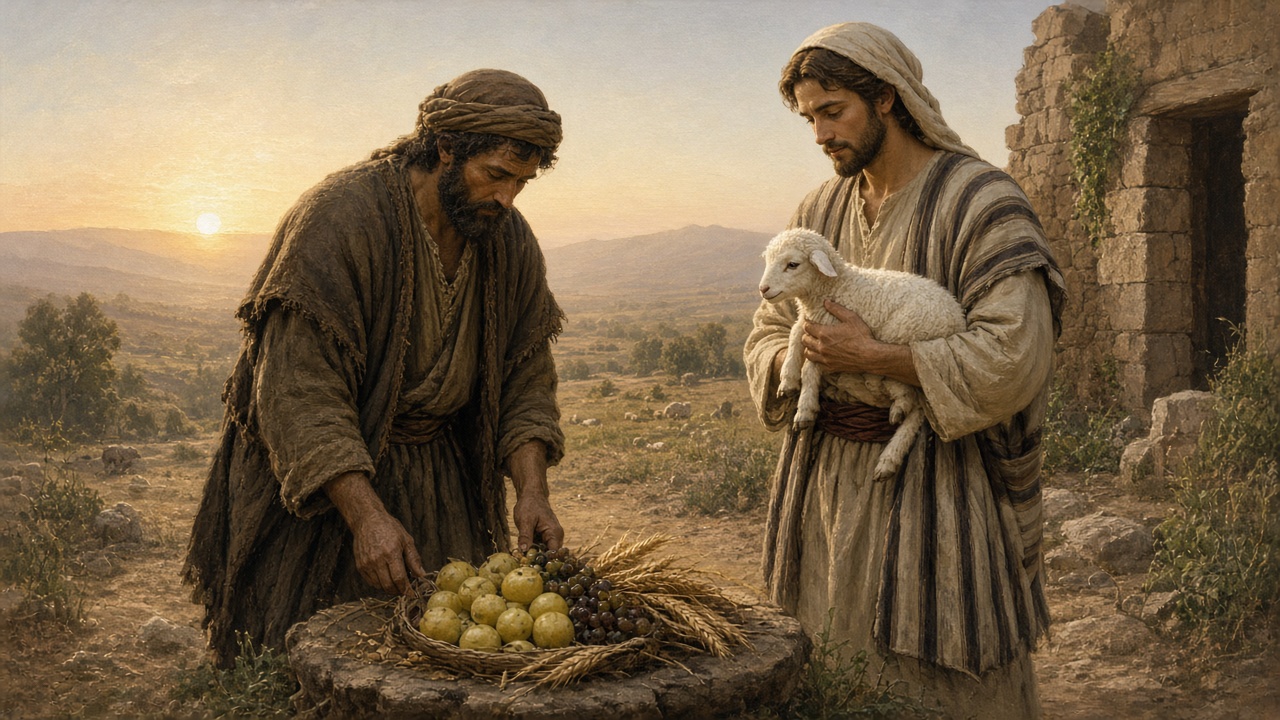
3One day, Cain brought a gift to give to God. He brought some food from his garden. 4And Abel brought a gift to give to God too. He gave God some of his young sheep and goats. They were the first ones born to their mothers. Abel brought the best bits of meat from those sheep and goats. And God was happy with Abel, and with his gift. 5But God was not happy with Cain, or with his gift. Then Cain got very angry. His face changed, and he looked very sad.
6God said to Cain, “Why are you angry? Why do you look sad? 7If you do the right thing, I will be happy with you. But, if you don’t do the right thing, look out, you will always want to do more bad things. But you have to control yourself and stop doing bad things.”
8After that, Cain went to his brother Abel, and Cain said, “Let’s go for a walk.” So Cain and Abel went out bush together. While they were there, Cain hit his brother, and killed him dead. Cain killed his brother|src="gn-05.tif" size="col" ref="4:8"
9Later, God said to Cain, “Where is your brother, Abel?”
Cain said, “I don’t know where my brother is. It’s not my job to look after him.”
10God said to Cain, “You did a really bad thing. Your brother’s blood is on the ground. It’s like his blood is calling out to me. It is telling me you killed him. 11So now I’m going to curse you. You killed your brother, and his blood is on the ground. So I will make the ground bad for you. 12If you try to grow plants in the ground, nothing will grow for you. You will go away from me. And you will walk around in lots of places, but you will not have a home.”
13Cain said to God, “God, you are too hard on me. 14If you make me leave this land where I grow my food, and if you make me go away from you, then I will have to walk around everywhere, and I will not have a home. Then somebody will find me and finish me.”
15God said, “I will not let that happen. I’ll tell everybody that if they kill you, then I will punish them properly. I will do 7 times as much payback to them.” So God put a mark on Cain’s head, so that everybody will know that they can’t kill him.
The people born into Cain’s family
16After that, Cain went away from God and went to live in a place called Nod. That country was on the east side of Eden. 17Cain slept with his wife, like married people do together, and then she had a baby boy, called Enok. Cain built a town, and he also called it Enok, after his son. 18Enok grew up, and he had a son, called Irad.
Irad grew up, and he had a son, called Mehujayel.
Mehujayel grew up, and he had a son, called Methushayel.
Methushayel grew up, and he had a son, called Lamek.
19Lamek grew up, and he married 2 women. One wife’s name was Adah, and the other wife’s name was Zillah.
20Lamek’s wife Adah had a baby boy, called Jabal. Jabal grew up, and he looked after animals. He took those animals around and camped in different places. He was the first person to do that.
21Adah had another son, called Jubal. Jubal grew up and was the first person to play musical instruments. He played a harp and a flute.
22Lamek’s other wife, Zillah, had a son called Tubal Cain. Tubal Cain grew up and made tools from iron and from a brown metal called bronze.
Zillah also had a daughter, called Namah.
23One day, Lamek said to his 2 wives, “Adah and Zillah, listen to me properly. A young man hit me and hurt me, so I killed him dead. 24God said that if anyone killed Cain, he will punish that person properly. He will do 7 times as much payback to them. I reckon I’m more important than Cain. So if somebody kills me for killing that young man, I reckon God will do 77 times as much payback to that person.”
Adam and Eve had another son
25Adam and Eve slept together again, like a man does with his wife, and they had another son, and they gave him the name Seth. That name means gave. Eve said, “God gave me another son to take the place of Abel, our son that Cain killed.”
26Seth grew up, and he had a son too, and he gave him the name Enosh. At that time people started to call God by his special name Yahweh when they showed respect to him.
Did you know?
Cain, Abel, and Life East of Eden
- Abel’s Hebrew name means “breath” or “vanity.” He kept sheep, while his brother Cain tilled the soil: Abel brought the best portions of the firstborn of his flock, and Cain brought fruit of the ground. Easton's Bible Dictionary (1897) reads the phrase “in process of time” (margin, “at the end of days”) as probably referring to the Sabbath.Sources: Abel · Cain · the Bible text itself
- After Abel’s death, Cain settled in the land of Nod, east of Eden, a name meaning exile, wandering, or unrest. There he built a city and named it after his son Enoch. Easton's Bible Dictionary notes that this is the first city mentioned in Scripture.Sources: Nod · Enoch (son of Cain) · the Bible text itself
- Lamech, fifth in descent from Cain, married two women, Adah and Zillah. Easton's Bible Dictionary calls his address to them the only extant example of antediluvian poetry, sometimes known as “Lamech’s sword-song.” Their children are tied to early ways of life: Jabal with tents and livestock, Jubal with the harp and flute, and Tubal-cain with forging bronze and iron.Sources: Lamech (descendant of Cain) · Adah (wife of Lamech) · Zillah · the Bible text itself
Notes written with AI assistance from open sources (Theographic Bible Metadata, CC BY-SA 4.0; Easton’s Bible Dictionary, public domain) and reviewed before publishing.
Credits and license for this translation
Plain English Version
Portions of the Holy Bible in the Plain English Version translation for Australian Aboriginal people who speak English as a second language
Copyright © 2026 Wycliffe Bible Translators Australia
Language: Aboriginal English (English)
Dialect: Australian Aboriginal
Plain English Version © 2026 by Wycliffe Bible Translators Australia, licensed under Creative Commons Attribution-Share Alike 4.0 International (CC BY SA 4.0)
This licence allows you to copy and redistribute the material in any medium or format, even commercially. You may adapt, remix, transform, and build upon the material for any purpose, but if you do so, you must distribute your contributions under the same license as the original. You must always give appropriate credit, provide a link to the license, and indicate if changes were made. You may not suggest that Wycliffe Bible Translators endorses you or your use.
For full details of the licence, visit: creativecommons.org/licenses/by-sa/4.0/legalcode
This translation is made available to you under the terms of the
Creative Commons Attribution Share-Alike license 4.0.
You have permission to share and redistribute this Bible translation in any format and to make reasonable revisions and adaptations of this translation, provided that:
You include the above copyright and source information.
If you make any changes to the text, you must indicate that you did so in a way that makes it clear that the original licensor is not necessarily endorsing your changes.
If you redistribute this text, you must distribute your contributions under the same license as the original.
Pictures included with Scriptures and other documents on this site are licensed just for use with those Scriptures and documents.
For other uses, please contact the respective copyright owners.
Note that in addition to the rules above, revising and adapting God's Word involves a great responsibility to be true to God's Word. See Revelation 22:18-19.
2026-10-02
Source: http://ebible.org/engPEV/ · eBible.org