Genesis 38
Plain English Version · Tap a verse to see its cross-references.
The story about Judah’s sons
1This story is about something that Jacob’s son Judah did.
Judah left his brothers, and he went to stay with a man from the town called Adullam. That man’s name was Hirah. 2While Judah was staying in that place, he saw a young woman. That woman’s father was called Shua, and he was from the Canaan tribe. Judah married that young woman, and he slept with her. 3Then that woman had a baby boy, and Judah named him Er. 4Later, that woman had another baby boy, and she named him Onan. 5And later, she had another baby boy too. She named that baby Shelah. At that time, Judah was staying in the town called Kezib.
6Judah’s oldest son Er, he grew up and became a man. And Judah found a woman for Er to marry. That woman’s name was Tamar. 7But Judah’s oldest son Er, he did really bad things, and God was angry with him. So God finished up Er, and he died.
8Then Judah talked to his 2nd son Onan. Judah said, “Your brother Er is dead, and he didn’t have any kids. So now, you have to marry Er’s wife and sleep with her, so that she will have kids. That’s the rule in our culture. And after those kids grow up, they will get everything that belonged to Er. It will be like they are his kids.”
9So Onan married Er’s wife. But Onan didn’t want to have kids with her, because he knew that those kids will not belong to him. So Onan did a bad thing. Every time they slept together, like married people do, he didn’t sleep with her properly. He always stopped early, so she didn’t get any babies growing inside her. 10But God was angry with Onan for doing that bad thing, so God finished up Onan too.
11Then Judah thought, “My sons Er and Onan, they are both dead, and they didn’t have any kids with that woman. So now, my other son Shelah has to marry that woman and have kids with her. That’s the rule in our culture. But if Shelah marries that woman, he might die too, just like Er and Onan.” So Judah got worried, and he didn’t want his son Shelah to marry that woman Tamar.
So Judah talked to Tamar, and he tried to trick her. He said to her, “My son Shelah is too young to marry you now. So go back to your father’s house, and live there. Don’t get married to anyone else. Later on, Shelah will grow up, and then you can marry him.” So Tamar went back to her father’s house, and she lived there.
Judah’s son Shelah grew up and became a man. But Judah didn’t keep that promise he made to Tamar. He didn’t let her marry his son Shelah.
Tamar tricked Judah
12Some time later, Judah’s wife died. Her father’s name was Shua. Judah missed his wife, so he felt very sad for a while. But later on, he felt all right again.
Judah’s work-men were in the place called Timnah. They were cutting the wool off Judah’s sheep. Judah wanted to visit his work-men, so he started to go towards Timnah, and his friend Hirah went with him. That man Hirah, he was from the town called Adullam.
13Then somebody told that woman Tamar, “Your dead husband’s father is going to Timnah to visit his work-men. They are cutting the wool off his sheep there.”
14Tamar thought about Judah’s son Shelah. She knew that he was grown up now, but Judah still didn’t let her marry him. So Tamar thought, “I will trick Judah and get him to sleep with me, like a man sleeps with his wife, so that I can have kids. Then those kids will belong to my dead husband Er.”
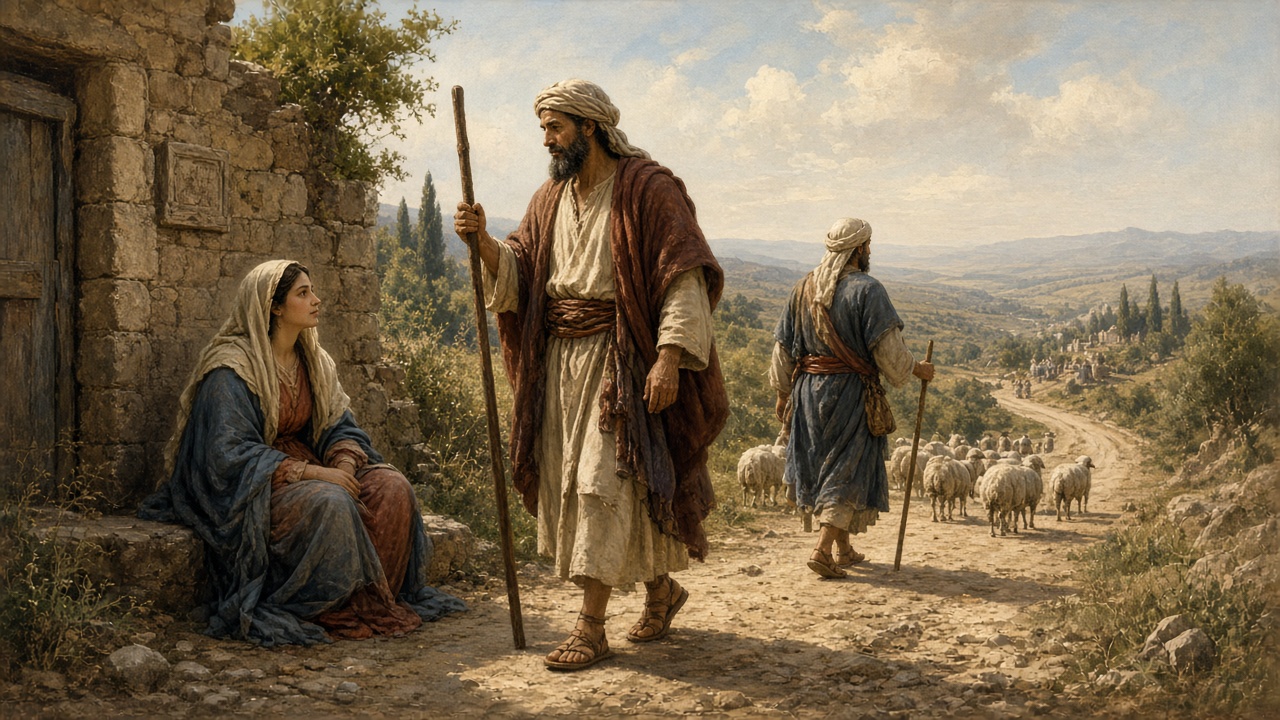
At that time, Tamar was wearing the sort of clothes that widows wear. But then, Tamar changed those clothes, and she put on some pretty clothes, and she put a scarf over her head, to cover her face. Then she went and sat outside the town called Enayim. That town is on the road that goes to Timnah.
15Later, Judah walked along that road, and he saw Tamar sitting there. She had that scarf over her head, and Judah couldn’t see her face. So Judah didn’t know that she was Tamar, his dead son’s wife. He thought she was a woman that sleeps with men for pay. So Judah went to her, and he said, “I want to sleep with you, like a man sleeps with his wife.”
Tamar said, “If I sleep with you, then you have to give me something to pay me. What will you give me?”
17Judah said, “After you sleep with me, I will send you one of my young goats.”
Tamar said, “All right. But first, you have to give me something that belongs to you, to show that you promised to send me a young goat.”
18Judah said, “All right, I will give you something to show that I made that promise. What do you want me to give you?”
Tamar said, “Give me that necklace with your special stamp on it, and your walking stick.” (Judah used that special stamp like a signature.)
So Judah gave those things to Tamar. Then he slept with Tamar, like a man sleeps with his wife, and a baby started to grow inside her. Judah gave Tamar his walking stick and the necklace with his special stamp|alt="cropped" src="Gen 38 artist Judith Knowles.tif" size="col" copy="Judith Knowles" ref="38:18" 19Then Tamar left that place, and she went home. She took off the scarf that was over her head, and she took off those pretty clothes, and she put on her widow’s clothes again.
20Judah talked to his friend Hirah, and he said, “Take one of my young goats, and give it to that woman that I slept with. Then tell her to give back my necklace with my special stamp on it, and my walking stick.”
So Hirah took that young goat, and he went to look for that woman, but he didn’t find her. 21So he talked to the men that lived in that place, and he said, “Where is that woman that sleeps with men for pay? She was sitting next to the road, near the place called Enayim.”
But those men said, “There isn’t any woman here that sleeps with men for pay.”
22So Hirah went back to Judah, and he said, “I didn’t find that woman. And the men that live in that place, they said to me, ‘There isn’t any woman here that sleeps with men for pay.’”
23Then Judah said to Hirah, “All right, that woman can keep the necklace with my stamp on it, and my walking stick. I tried to keep my promise to that woman. Yes, I gave you a young goat to take to her. But you didn’t find her. If you go and look for her again, everybody will laugh at us. So she can just keep my things.”
Judah found out that Tamar tricked him
243 months later, somebody said to Judah, “Your dead son’s wife Tamar, she did a bad thing. She slept with a man that isn’t her husband. And now there is a baby growing inside her.”
Judah wanted to punish Tamar for doing that. So he said, “Go and get her. Put her on a fire, and burn her until she dies.”
25So some people went to Tamar’s house, and they started to take her to the place to burn her. But she said to them, “Take this necklace with a special stamp on it, and this walking stick, and show them to Judah, my dead husband’s father. Say to him, ‘The man that owns these things, he is the one that slept with me and made this baby grow inside me. So please look at this necklace with the special stamp on it, and this walking stick, and say who they belong to.’”
26So they took those things to Judah, and they told him what Tamar said. And Judah looked at those things, and he knew that they belonged to him. Then Judah knew that Tamar tricked him, and he felt shame. He said, “You know, I did the wrong thing. I didn’t let Tamar marry my son Shelah. But Tamar is better than me. She wanted to have kids that will belong to her dead husband, just like our culture says. That’s the reason why she got me to sleep with her.”
So Judah didn’t punish Tamar, and he never slept with her again.
Tamar had 2 sons
27Later on, the time came for Tamar to have her baby. At that time, Tamar found out that she had 2 babies inside her. 28There was a working woman there with Tamar, and that woman helped Tamar while she had her babies.
The 1st baby started to be born. His arm came out. And that working woman, she tied a bit of red string around that baby’s arm, and she said, “This baby is first.” 29But then, that baby pulled his arm back in, and the 2nd baby came out. Then that working woman was shocked, because that 2nd baby came out before his brother. She talked to that 2nd baby, and she said, “You pushed really hard, and you came out first. It’s like you broke out through a wall.” So they named that baby Perez. That name means break out.
30Then the other baby came out, with that bit of red string tied around his arm. And they named that baby Zerah.
Did you know?
Judah and Tamar
- Soon after Joseph was sold to the Ishmaelites, Judah left his brothers and settled near Hirah, an Adullamite, and married the daughter of Shua, a Canaanite. She bore him Er, Onan, and Shelah; Shelah was born at Chezib, whose name means deceitful and is probably the same place as Achzib.Sources: Judah (patriarch) · Shuah · Chezib · the Bible text itself
- Judah took Tamar as a wife for his firstborn, Er. After Er died, he told Onan to sleep with her, fulfill a brother-in-law's duty, and raise up offspring for Er, but Onan would spill his seed on the ground so the child would not belong to him. Easton's Bible Dictionary (1897) compares that episode with Deuteronomy 25:5 and Matthew 22:24; Onan died before Jacob's family went down to Egypt, and Judah never gave Tamar to Shelah as promised.Sources: Tamar · Onan · the Bible text itself
- After the daughter of Shua died, Judah and his friend Hirah went up to his sheepshearers at Timnah, which Easton's Bible Dictionary (1897) describes as a town of Judah about twenty miles west of Jerusalem. Tamar veiled her face and waited at Enaim, on the way to Timnah—probably Enam, a city in the lowland or Shephelah—and Judah thought she was a prostitute because her face was covered. She later bore twins, and the child who broke out first was named Perez, a name that means breach.Sources: Timnah · Enaim · Pharez · the Bible text itself
Notes written with AI assistance from open sources (Theographic Bible Metadata, CC BY-SA 4.0; Easton’s Bible Dictionary, public domain) and reviewed before publishing.
Credits and license for this translation
Plain English Version
Portions of the Holy Bible in the Plain English Version translation for Australian Aboriginal people who speak English as a second language
Copyright © 2026 Wycliffe Bible Translators Australia
Language: Aboriginal English (English)
Dialect: Australian Aboriginal
Plain English Version © 2026 by Wycliffe Bible Translators Australia, licensed under Creative Commons Attribution-Share Alike 4.0 International (CC BY SA 4.0)
This licence allows you to copy and redistribute the material in any medium or format, even commercially. You may adapt, remix, transform, and build upon the material for any purpose, but if you do so, you must distribute your contributions under the same license as the original. You must always give appropriate credit, provide a link to the license, and indicate if changes were made. You may not suggest that Wycliffe Bible Translators endorses you or your use.
For full details of the licence, visit: creativecommons.org/licenses/by-sa/4.0/legalcode
This translation is made available to you under the terms of the
Creative Commons Attribution Share-Alike license 4.0.
You have permission to share and redistribute this Bible translation in any format and to make reasonable revisions and adaptations of this translation, provided that:
You include the above copyright and source information.
If you make any changes to the text, you must indicate that you did so in a way that makes it clear that the original licensor is not necessarily endorsing your changes.
If you redistribute this text, you must distribute your contributions under the same license as the original.
Pictures included with Scriptures and other documents on this site are licensed just for use with those Scriptures and documents.
For other uses, please contact the respective copyright owners.
Note that in addition to the rules above, revising and adapting God's Word involves a great responsibility to be true to God's Word. See Revelation 22:18-19.
2026-10-02
Source: http://ebible.org/engPEV/ · eBible.org