Genesis 21
Plain English Version · Tap a verse to see its cross-references.
Abraham and Sarah had a son, Isaac
1God was good to Sarah, and he kept his promise to her, 2and a baby started to grow inside her. Then that baby boy was born at the time that God said he would be born. Abraham was an old man, and that baby was a son for Abraham. 3Abraham called his son Isaac. That name means laugh.
4And when Isaac was 8 days old, Abraham did the young man operation on him, just like God told him to do, to show that Isaac belonged to God.
5Abraham was 100 years old when Isaac was born. 6Sarah said, “God is giving me something to laugh about now, and everyone that hears this story will be happy with me, and they will laugh too.” 7She also said, “Nobody reckoned that I can ever have a kid. But look, now Abraham is old, and I had a son for him.” Abraham was 100 years old and Sarah was 90 when their son Isaac was born|src="gn-08.tif" size="col" ref="21:7"
Abraham sent Hagar and Ishmael away from his camp
8When Isaac was about 3 years old, he stopped drinking Sarah’s milk, and Abraham gave him a big party. 9Then Sarah saw Ishmael laughing at Isaac. Ishmael was the son of Abraham and Hagar. Hagar was Sarah’s worker, and she was from Egypt country. 10Then Sarah said to Abraham, “When you die, my son Isaac has to get all your things. I don’t want Ishmael to get anything, he is just the son of a worker woman. So you have to tell that woman and her son to get out of our camp. Send them right away from here.”
11Abraham was really upset by what Sarah said. Ishmael was his son, so Abraham reckoned it was wrong to send him away. 12But God said to Abraham, “Don’t worry about Ishmael or his mother. You see, the family that I promised you will come from Isaac, not from Ishmael. So listen to Sarah, and do what she says. 13Don’t worry, I will give Ishmael a big family too. Later on, his family will grow into a big nation. I will do that for him, because he is your son too.”
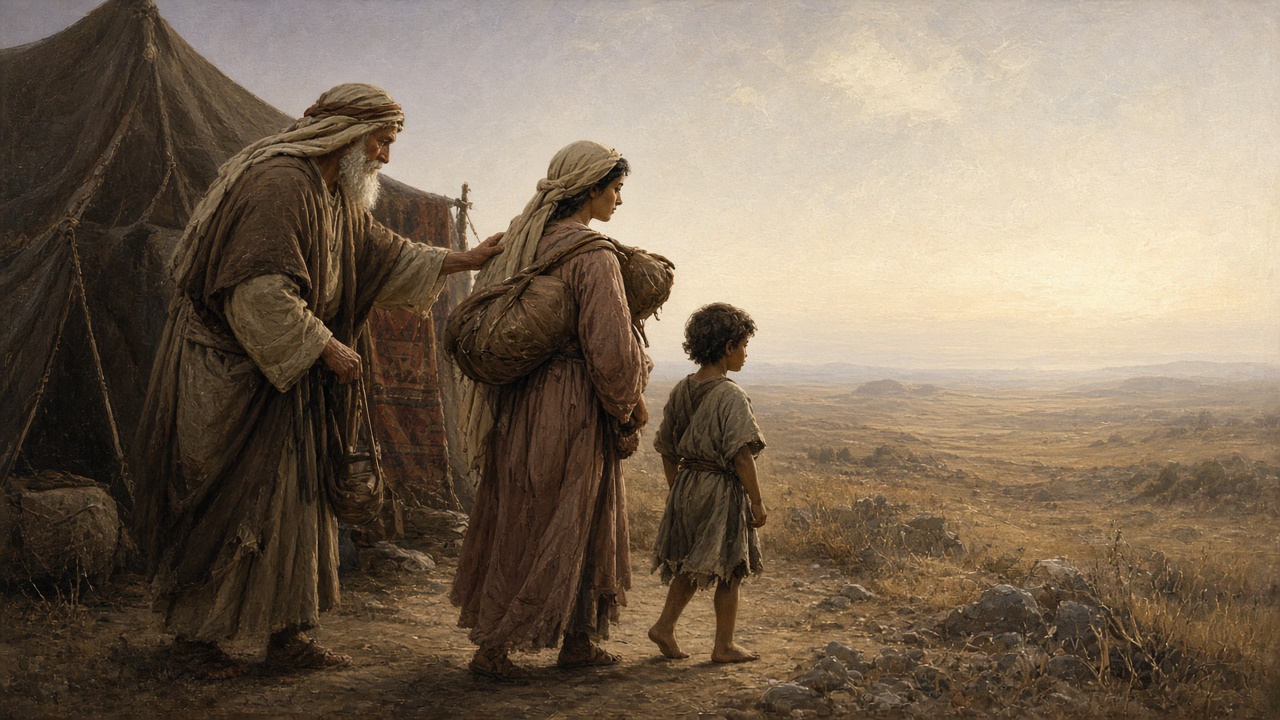
14So early the next morning, Abraham got some food, and a leather water bag. He put them on Hagar’s shoulder, and he sent her and Ishmael out of his camp. They walked around in the desert country near Beersheba. 15They kept going until there was no water left in the water bag. Then they stopped, and Hagar left Ishmael in the shade of a little tree. 16And then she went and sat by herself a little way from him, because she thought, “I don’t want to watch him die.” And she started to cry out loud.
17Ishmael was crying too, and God heard him, and he sent an angel messenger from heaven to talk to Hagar. The angel said, “Why are you upset? Don’t worry. God has heard Ishmael crying, under that tree. 18Go and take care of him. Listen, I will give him a big family, and they will become a great nation.” 19Then God showed her a water-hole. So she got up and filled her water bag, and she gave Ishmael a drink.
20God kept Ishmael safe as he grew up in the desert called Paran. He learned how to use a bow and arrows properly, so he became a good hunter. And later on, Hagar got a wife for him from Egypt country.
Abraham and Abimelek made strong promises to each other
22One day, Abimelek went to talk to Abraham. Abimelek was the big boss of the country where Abraham lived. And Ficol, the leader of Abimelek’s army, went with him. Abimelek said to Abraham, “You know, you are not one of my people. You came from another place to live here in my country. But I have been good to you, and to all your people. So I want you to promise me that you will never try to trick me, or my kids, or anyone that is born into my family. I want you to promise that you will be good to them. We know that God is very good to you, and he helps you with everything you do. So I want you to make that promise to me while God is listening. I want you to tell God to punish you if you break that promise.”
24So Abraham made that promise to Abimelek. He said those words in the way that Abimelek wanted.
25But then Abraham also complained to Abimelek. He said, “I’ve got a problem. Some of your workers took one of my water-holes, and then they stopped my workers from getting any water there.”
26Abimelek said, “I’m sorry, Abraham. I don’t know who did that. I never heard about it, and you didn’t tell me about it until now.”
27At that time, Abraham gave Abimelek some of his sheep, and goats, and cows, and the 2 men made strong promises to each other. 28Then Abraham also picked out 7 young female sheep from his animals, and he put them to one side. 29Abimelek asked him, “Why did you put these 7 sheep to one side? What do you mean by that?”
30Abraham said, “I want to give you these sheep as a special present. Take them. That’s how you can show people that you agree with me, that I dug that water-hole and that I own it.”
31From that time on, that place was called Beersheba. That name means water-hole where they made a promise. It was where Abraham and Abimelek made strong promises to each other.
32After they made those promises, Abimelek and Ficol went back to their home, in Philistia country. 33Then Abraham showed respect to God there in Beersheba. He called God by his special name Yahweh, and he planted a special tree to remember that place. Yahweh is the true God that lives for ever.
34Abraham and all his people lived for a long time in the country that belonged to the Philistia mob.
Did you know?
Isaac’s birth, Hagar’s departure, and Beersheba
- Abraham was a hundred years old when Sarah bore him Isaac, their only son together, and he circumcised the child at eight days old, as God had commanded. Sarah said that God had made her laugh, and that everyone who heard of this would laugh with her. Easton's Bible Dictionary (1897) notes that a great feast was held when Isaac was weaned, probably when he was about two years old.Sources: the Bible text itself · Isaac
- Hagar, whose name is explained as “flight” or, according to others, “stranger,” was an Egyptian and Sarah’s handmaid, whom Sarah gave to Abraham as a secondary wife. After Isaac’s birth, Abraham sent Hagar and their son Ishmael into the Wilderness of Beersheba with bread and a skin of water. Ishmael later settled in the Wilderness of Paran, a desert tract in the northeastern Sinai Peninsula between the Arabah on the east and the wilderness of Shur on the west, became a great archer, and his mother got him a wife from Egypt.Sources: the Bible text itself · Hagar · Paran
- Beersheba, “well of the oath” or “well of seven,” was named when Abraham and Abimelech swore an oath there over a well that Abraham said he had dug; he set apart seven ewe lambs as a witness, and the two made a covenant. Phicol, chief captain of the army of Abimelech, the Philistine king of Gerar, entered that alliance with Abraham. Abraham then planted a tamarisk at Beersheba and lived for a long time in the land of the Philistines.Sources: the Bible text itself · Beersheba · Phichol
Notes written with AI assistance from open sources (Theographic Bible Metadata, CC BY-SA 4.0; Easton’s Bible Dictionary, public domain) and reviewed before publishing.
Places in this chapter
Only places identified with high confidence are shown (90% or more according to the scholarly sources compiled by OpenBible). Period map: DARE (Digital Atlas of the Roman Empire), CC BY 4.0; modern map: © OpenStreetMap contributors; places: OpenBible.info (CC BY 4.0).
Credits and license for this translation
Plain English Version
Portions of the Holy Bible in the Plain English Version translation for Australian Aboriginal people who speak English as a second language
Copyright © 2026 Wycliffe Bible Translators Australia
Language: Aboriginal English (English)
Dialect: Australian Aboriginal
Plain English Version © 2026 by Wycliffe Bible Translators Australia, licensed under Creative Commons Attribution-Share Alike 4.0 International (CC BY SA 4.0)
This licence allows you to copy and redistribute the material in any medium or format, even commercially. You may adapt, remix, transform, and build upon the material for any purpose, but if you do so, you must distribute your contributions under the same license as the original. You must always give appropriate credit, provide a link to the license, and indicate if changes were made. You may not suggest that Wycliffe Bible Translators endorses you or your use.
For full details of the licence, visit: creativecommons.org/licenses/by-sa/4.0/legalcode
This translation is made available to you under the terms of the
Creative Commons Attribution Share-Alike license 4.0.
You have permission to share and redistribute this Bible translation in any format and to make reasonable revisions and adaptations of this translation, provided that:
You include the above copyright and source information.
If you make any changes to the text, you must indicate that you did so in a way that makes it clear that the original licensor is not necessarily endorsing your changes.
If you redistribute this text, you must distribute your contributions under the same license as the original.
Pictures included with Scriptures and other documents on this site are licensed just for use with those Scriptures and documents.
For other uses, please contact the respective copyright owners.
Note that in addition to the rules above, revising and adapting God's Word involves a great responsibility to be true to God's Word. See Revelation 22:18-19.
2026-10-02
Source: http://ebible.org/engPEV/ · eBible.org