Genesis 13
Plain English Version · Tap a verse to see its cross-references.
Abram and his nephew Lot split up
1So Abram, Sarai, and Lot left Egypt and went back to the dry desert country. They took everything they owned, and all their workers. 2Abram was a very rich man. He had a lot of silver and gold, and a big mob of animals.
3They were in that dry desert country for a while, then they went north from place to place until they got back to the town called Bethel. They camped in the same place that they camped at before. It was between Bethel and the town called Ayi. 4That was the place where Abram built a special stone table to burn animals, to show respect to God. After Abram got back there, he prayed to God, and he called God by his special name Yahweh.
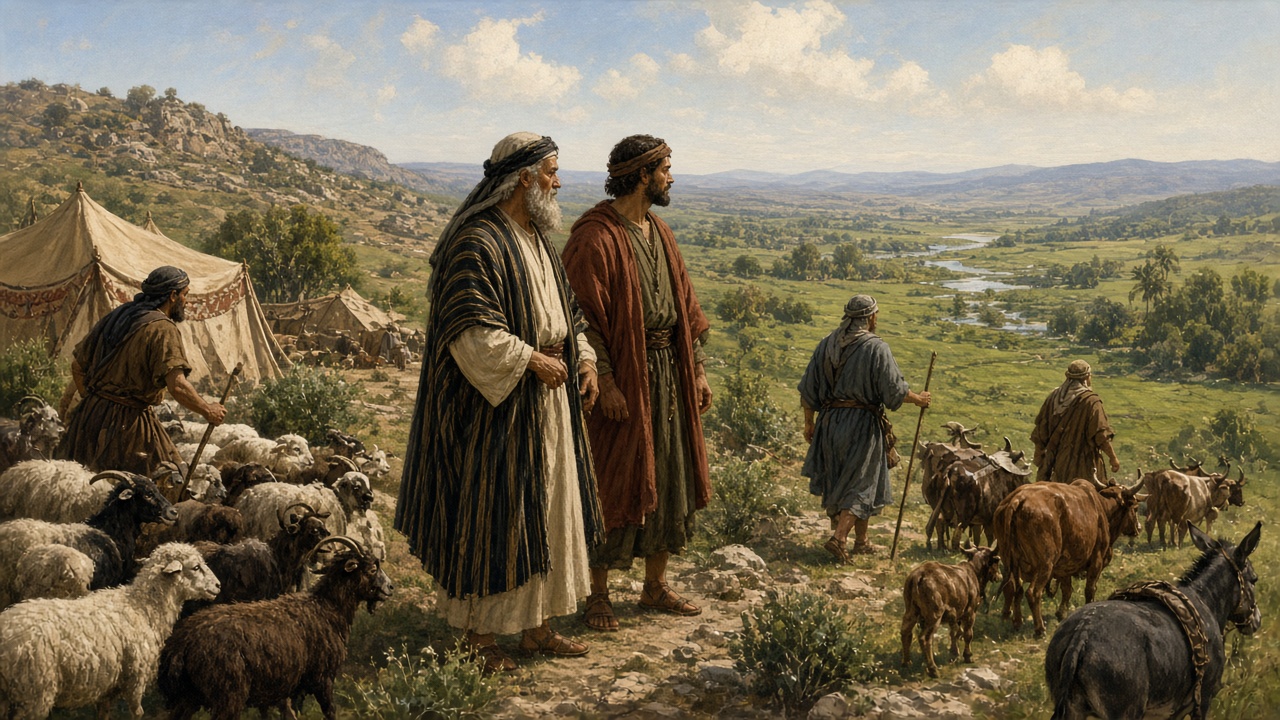
5Abram and his nephew Lot were still together. And Lot also had a big mob of sheep, and goats, and cows, and bulls. And he had a lot of tents for all his workers too. 6But there was a problem. There were other people already living in that country. They were called the Canaan mob, and the Periz mob. And they had animals too, and all those animals needed grass and water, as well as Abram’s animals, and Lot’s animals too. But there wasn’t enough grass and water in that place for all those animals. So Abram’s work-men and Lot’s work-men started to argue and fight with each other about whose animals got the grass and water. 8Then Abram said to Lot, “I don’t like this trouble. You and me, we are family, and I don’t want trouble between us. And I don’t want our work-men to argue and fight with each other. 9Look, there is a lot of country here. Just look around, and you will see that there’s plenty of country for both of us. So I reckon we have to split up. I want you to pick the part of the country you want, and then I will go somewhere else. If you pick the country to the east, then I will go to the country to the west, but if you pick the west country, then I will go to the east country.” Abram told Lot to pick the part of the country he wanted|src="1g Abraham&Lot.tif" size="col" ref="13:9"
10Lot looked to the east, towards a town called Zoar, in the flat country around the Jordan River. He saw that the flat country had plenty of grass and water. It looked just like God’s garden, and like the country in Egypt. (That was before God burned up the towns in the flat country called Sodom and Gomorrah.) 11So Lot picked the flat country around the Jordan River, to the east.
Then Abram did what he promised, and he went to the country called Canaan.
In that way, Lot’s mob and Abram’s mob went to different places, and there was no more trouble between their work-men.
Lot went to the flat country around the Jordan River. There were some towns there, and Lot camped near the town called Sodom. 13The people that lived in Sodom were very bad. They were always going against God, and they did bad things all the time.
God made a promise to Abram
14Then, after Lot left, God said to Abram, “Look at all the country around you. Look to the north, and to the south, and to the east, and to the west. 15I will give you all the country that you can see. Later on, you will have a son, and lots of people will be born into his family, and they will own all this country, for ever. 16Look at the ground you are standing on, it has lots of little bits of dirt. Nobody can count all those little bits of dirt on the ground, and just like that, nobody will be able to count all the people that will be in your family later on. 17All right, Abram, I want you to get up and walk all around the country that I’m giving you, and look at it all properly.”
18So Abram went to the big trees that belonged to a man called Mamreh, near a town called Hebron, and he camped there. He piled up stones there and made another special table with a flat top, so that he could burn animals to show respect to God.
Did you know?
Abram and Lot Separate
- Abram came up from Egypt into the Negev, the arid district south of Palestine through which the caravan route ran from central Palestine to Egypt, and traveled from place to place toward Bethel.Sources: Negeb · the Bible text itself
- He returned to the place between Bethel and Ai where his tent had stood and where he had built an altar, and there he called on the name of the LORD. Easton's Bible Dictionary (1897) describes Bethel, about ten miles north of Jerusalem, as originally the royal Canaanite city of Luz, and holds that the name Bethel was first given to a nearby sanctuary rather than to the city itself until the tribe of Ephraim conquered it. Ai was one of the royal Canaanite cities and lay to the east of Bethel.Sources: Bethel (of Palestine) · Ai · the Bible text itself
- Lot looked out and saw the plain of the Jordan, well watered all the way to Zoar like the garden of the LORD and like the land of Egypt. Easton's Bible Dictionary (1897) calls this the first historical notice of the Jordan, in the account of Abraham and Lot's separation, and places Sodom, toward which Lot pitched his tent, in the vale of Siddim. The chapter notes that the LORD had not yet destroyed Sodom and Gomorrah, a destruction the dictionary attributes to fire from heaven because of the city's wickedness.Sources: Plain of Jordan · Sodom · the Bible text itself
Notes written with AI assistance from open sources (Theographic Bible Metadata, CC BY-SA 4.0; Easton’s Bible Dictionary, public domain) and reviewed before publishing.
Places in this chapter
- Egypt · 30.129, 31.308 · verses 1, 10
- Negeb · 31.245, 34.841 · verses 1, 3
- Jordan Valley · 32.317, 35.570 · verses 10, 11, 12
- Canaan · 32.767, 35.333 · verse 12
- Hebron · Today: Tel Rumeida · 31.525, 35.102 · verse 18
Only places identified with high confidence are shown (90% or more according to the scholarly sources compiled by OpenBible). Period map: DARE (Digital Atlas of the Roman Empire), CC BY 4.0; modern map: © OpenStreetMap contributors; places: OpenBible.info (CC BY 4.0).
Credits and license for this translation
Plain English Version
Portions of the Holy Bible in the Plain English Version translation for Australian Aboriginal people who speak English as a second language
Copyright © 2026 Wycliffe Bible Translators Australia
Language: Aboriginal English (English)
Dialect: Australian Aboriginal
Plain English Version © 2026 by Wycliffe Bible Translators Australia, licensed under Creative Commons Attribution-Share Alike 4.0 International (CC BY SA 4.0)
This licence allows you to copy and redistribute the material in any medium or format, even commercially. You may adapt, remix, transform, and build upon the material for any purpose, but if you do so, you must distribute your contributions under the same license as the original. You must always give appropriate credit, provide a link to the license, and indicate if changes were made. You may not suggest that Wycliffe Bible Translators endorses you or your use.
For full details of the licence, visit: creativecommons.org/licenses/by-sa/4.0/legalcode
This translation is made available to you under the terms of the
Creative Commons Attribution Share-Alike license 4.0.
You have permission to share and redistribute this Bible translation in any format and to make reasonable revisions and adaptations of this translation, provided that:
You include the above copyright and source information.
If you make any changes to the text, you must indicate that you did so in a way that makes it clear that the original licensor is not necessarily endorsing your changes.
If you redistribute this text, you must distribute your contributions under the same license as the original.
Pictures included with Scriptures and other documents on this site are licensed just for use with those Scriptures and documents.
For other uses, please contact the respective copyright owners.
Note that in addition to the rules above, revising and adapting God's Word involves a great responsibility to be true to God's Word. See Revelation 22:18-19.
2026-10-02
Source: http://ebible.org/engPEV/ · eBible.org