Song of Songs 6
Douay-Rheims 1899 · Tap a verse to see its cross-references.
Together in the Garden
The Friends
1My beloved is gone down into his garden, to the bed of aromatical spices, to feed in the gardens, and to gather lilies.
The Bride
2I to my beloved, and my beloved to me, who feedeth among the lilies. 3Thou art beautiful, O my love, sweet and comely as Jerusalem: terrible as an army set in array.
The Bridegroom
4Turn away thy eyes from me, for they have made me flee away. Thy hair is as a flock of goats, that appear from Galaad. 5Thy teeth as a flock of sheep, which come up from the washing, all with twins, and there is none barren among them. 6Thy cheeks are as the bark of a pomegranate, beside what is hidden within thee. 7There are threescore queens, and fourscore concubines, and young maidens without number. 8One is my dove, my perfect one is but one, she is the only one of her mother, the chosen of her that bore her. The daughters saw her, and declared her most blessed: the queens and concubines, and they praised her. 9Who is she that cometh forth as the morning rising, fair as the moon, bright as the sun, terrible as an army set in array?
The Friends
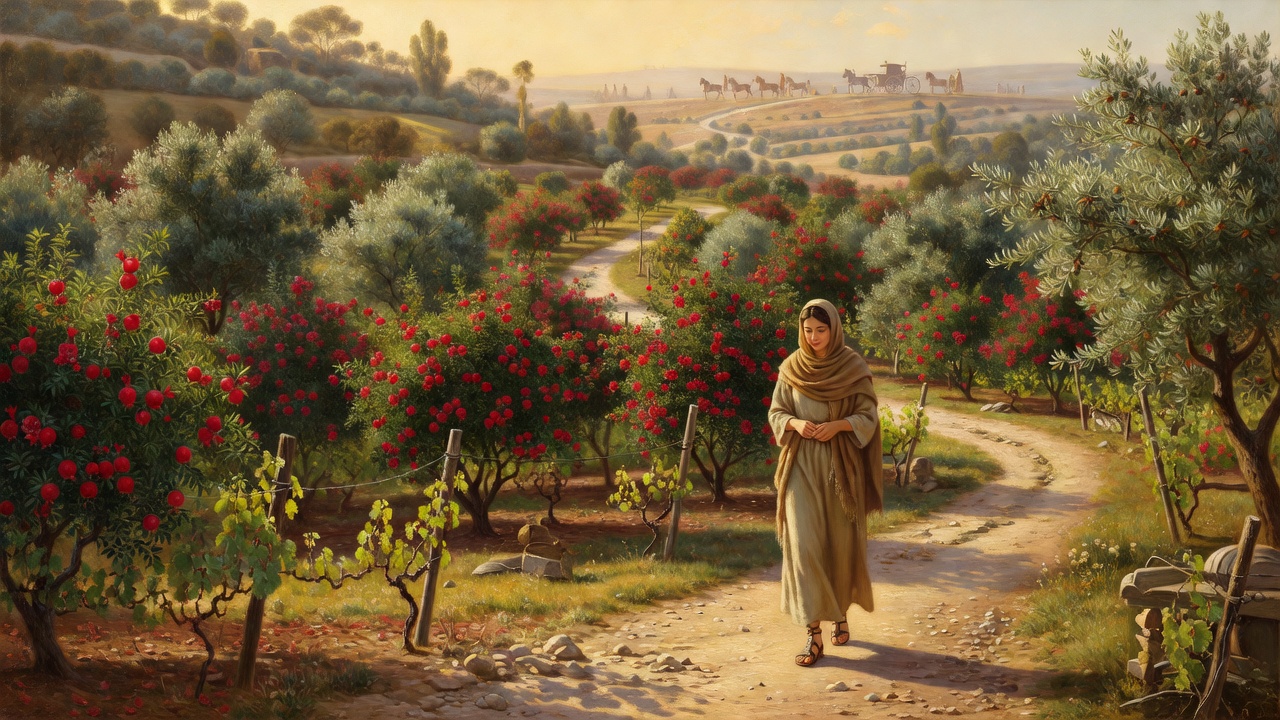
10I went down into the garden of nuts, to see the fruits of the valleys, and to look if the vineyard had flourished, and the pomegranates budded.
The Bridegroom
11I knew not: my soul troubled me for the chariots of Aminadab. 12Return, return, O Sulamitess: return, return that we may behold thee.
Did you know?
Beauty and Royal Splendor
- The poem praises the woman's beauty by comparing her to Tirzah and Jerusalem, two prominent royal centers. Tirzah was an ancient Canaanite city celebrated for its charm that later served as an early capital of the northern kingdom of Israel, while Jerusalem stood as the mountain capital of Judah.Sources: Tirzah · Jerusalem · the Bible text itself
- The description of hair streaming down like a flock of goats from Gilead evokes the rugged, mountainous territory east of the Jordan River, where herds grazed along the steep slopes.Sources: Gilead · the Bible text itself
Notes written with AI assistance from open sources (Theographic Bible Metadata, CC BY-SA 4.0; Easton’s Bible Dictionary, public domain) and reviewed before publishing.
Places in this chapter
Only places identified with high confidence are shown (90% or more according to the scholarly sources compiled by OpenBible). Period map: DARE (Digital Atlas of the Roman Empire), CC BY 4.0; modern map: © OpenStreetMap contributors; places: OpenBible.info (CC BY 4.0).
Credits and license for this translation
Douay-Rheims 1899
The Holy Bible in English, Douay-Rheims American Edition of 1899, translated from the Latin Vulgate
Public Domain
Language: English
Dialect: archaic American
Translation by: English College, Douai
This Public Domain Bible text is brought to you courtesy of eBible.org.
Help support free Bible access at https://eBible.org/give.php .
2022-11-03
Section headings adapted from the Berean Standard Bible (public domain); they are not part of this translation’s text.
Source: http://ebible.org/engDRA/ · eBible.org