Psalms 80
Douay-Rheims 1899 · Tap a verse to see its cross-references.
Hear Us, O Shepherd of Israel
1Unto the end, for the winepresses, a psalm for Asaph himself.
2Rejoice to God our helper: sing aloud to the God of Jacob.
3Take a psalm, and bring hither the timbrel: the pleasant psaltery with the harp.
4Blow up the trumpet on the new moon, on the noted day of your solemnity.
5For it is a commandment in Israel, and a judgment to the God of Jacob.
6He ordained it for a testimony in Joseph, when he came out of the land of Egypt: he heard a tongue which he knew not.
7He removed his back from the burdens: his hands had served in baskets.
8Thou calledst upon me in affliction, and I delivered thee: I heard thee in the secret place of tempest: I proved thee at the waters of contradiction.
9Hear, O my people, and I will testify to thee: O Israel, if thou wilt hearken to me,
10There shall be no new god in thee: neither shalt thou adore a strange god.
11For I am the Lord thy God, who brought thee out of the land of Egypt: open thy mouth wide, and I will fill it.
12But my people heard not my voice: and Israel hearkened not to me.
13So I let them go according to the desires of their heart: they shall walk in their own inventions.
14If my people had heard me: if Israel had walked in my ways:
15I should soon have humbled their enemies, and laid my hand on them that troubled them.
16The enemies of the Lord have lied to him: and their time shall be for ever.
17And he fed them with the fat of wheat, and filled them with honey out of the rock.
Did you know?
A Prayer for the Uprooted Vine
- The psalm specifically mentions Ephraim, Benjamin, and Manasseh, tribes closely linked by descent from Rachel through Joseph and Benjamin. During Israel's wilderness wanderings, these three tribes were assigned to camp and march together on the western side of the tabernacle.Sources: Benjamin (patriarch) · Manasseh (son of Joseph) · the Bible text itself
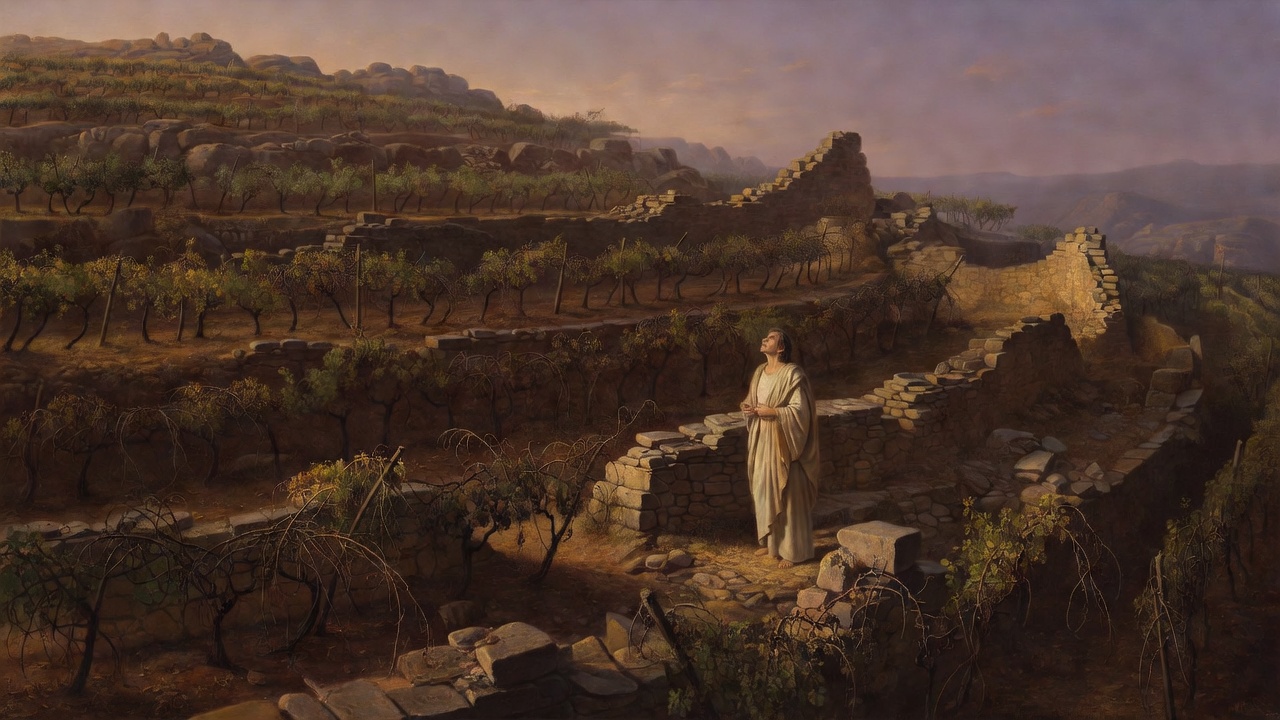
- The author uses an extended allegory comparing the nation of Israel to a grapevine brought out of Egypt and replanted in Canaan. The song laments that God had torn down the protective vineyard walls, leaving the fruitful vine exposed to wild beasts and passersby.Sources: Egypt · the Bible text itself
- This poem is part of a distinct collection spanning Psalms 73 through 83 attributed to Asaph. The biblical record describes Asaph as a leading Levite musician in the time of King David whose musical guild or descendants continued his tradition in temple worship.Sources: Asaph (Levite) · the Bible text itself
Notes written with AI assistance from open sources (Theographic Bible Metadata, CC BY-SA 4.0; Easton’s Bible Dictionary, public domain) and reviewed before publishing.
Places in this chapter
- Egypt · 30.129, 31.308 · verse 8
- Euphrates · Today: Euphrates River · 31.004, 47.442 · verse 11
- Great Sea · Today: Mediterranean Sea · 31.805, 34.170 · verse 11
Only places identified with high confidence are shown (90% or more according to the scholarly sources compiled by OpenBible). Period map: DARE (Digital Atlas of the Roman Empire), CC BY 4.0; modern map: © OpenStreetMap contributors; places: OpenBible.info (CC BY 4.0).
Credits and license for this translation
Douay-Rheims 1899
The Holy Bible in English, Douay-Rheims American Edition of 1899, translated from the Latin Vulgate
Public Domain
Language: English
Dialect: archaic American
Translation by: English College, Douai
This Public Domain Bible text is brought to you courtesy of eBible.org.
Help support free Bible access at https://eBible.org/give.php .
2022-11-03
Section headings adapted from the Berean Standard Bible (public domain); they are not part of this translation’s text.
Source: http://ebible.org/engDRA/ · eBible.org