Job 5
Douay-Rheims 1899 · Tap a verse to see its cross-references.
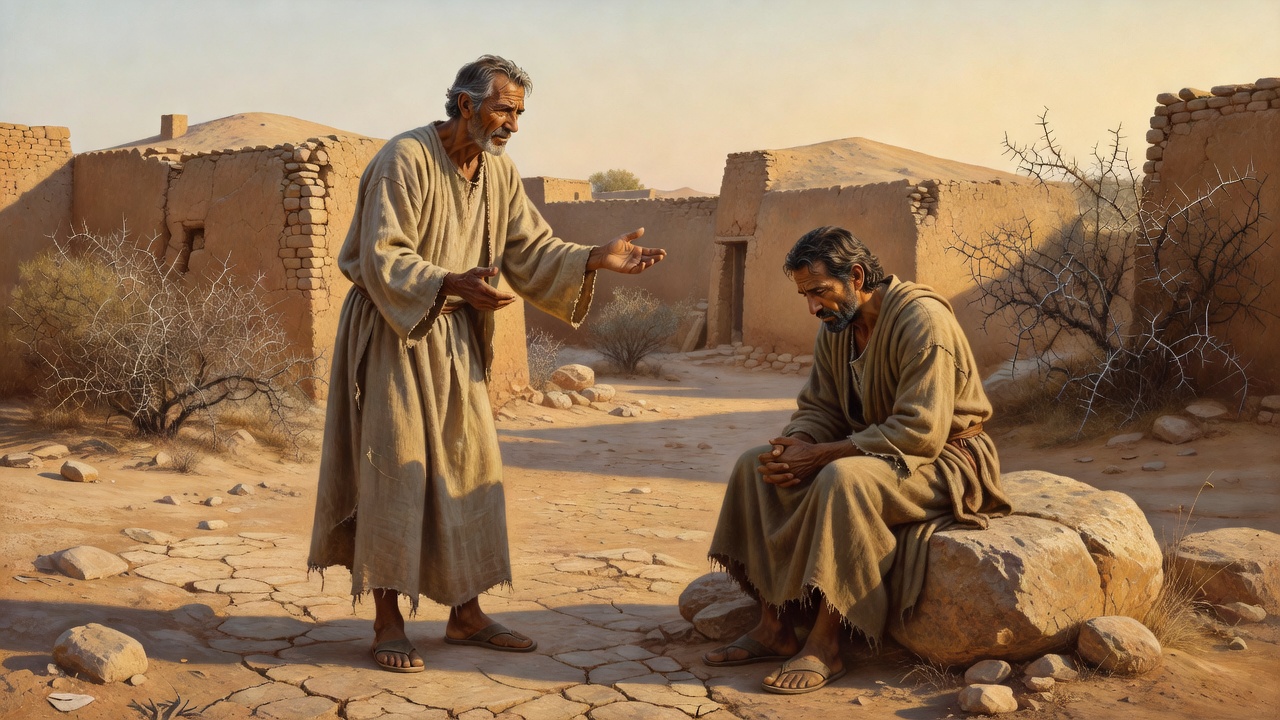
Eliphaz Continues: God Blesses those Who Seek Him
1Call now if there be any that will answer thee, and turn to some of the saints. 2Anger indeed killeth the foolish, and envy slayeth the little one. 3I have seen a fool with a strong root, and I cursed his beauty immediately. 4His children shall be far from safety, and shall be destroyed in the gate, and there shall be none to deliver them. 5Whose harvest the hungry shall eat, and the armed man shall take him by violence, and the thirsty shall drink up his riches. 6Nothing upon earth is done without a voice cause, and sorrow doth not spring out of the ground. 7Man is born to labour and the bird to fly. 8Wherefore I will pray to the Lord, and address my speech to God: 9Who doth great things and unsearchable and wonderful things without number: 10Who giveth rain upon the face of the earth, and watereth all things with waters: 11Who setteth up the humble on high, and comforteth with health those that mourn. 12Who bringeth to nought the designs of the malignant, so that their hands cannot accomplish what they had begun: 13Who catcheth the wise in their craftiness, and disappointeth the counsel of the wicked: 14They shall meet with darkness in the day, and grope at noonday as in the night. 15But he shall save the needy from the sword of their mouth, and the poor from the hand of the violent. 16And to the needy there shall he hope, but iniquity shall draw in her mouth. 17Blessed is the mall whom God correcteth: refuse not therefore the chastising of the lord: 18For he woundeth, and cureth: he striketh, and his hands shall heal. 19In six troubles he shall deliver thee, and in the seventh, evil shall not touch thee. 20In famine he shall deliver thee from death: and in battle, from the hand of the sword. 21Thou shalt he hidden from the scourge of the tongue: and thou shalt not fear calamity when it cometh. 22In destruction and famine then shalt laugh: and thou shalt not be afraid of the beasts of the earth. 23But thou shalt have a covenant with the stones of the lands, and the beasts of the earth shall be at pence with thee. 24And thou shalt know that thy tabernacle is in peace, and visiting thy beauty thou shalt not sin. 25Thou shalt know also that thy seed shall be multiplied, and thy offspring like the grass of the earth. 26Thou shalt enter into the grave in abundance, as a heap of wheat is brought in its season. 27Behold, this is even so, as we have searched out: which thou having heard, consider it thoroughly in thy mind.
Did you know?
Eliphaz's Counsel on Suffering and Divine Correction
- Eliphaz portrays suffering as purposeful divine discipline rather than arbitrary misfortune, asserting that trouble does not arise without cause from the soil. He urges Job not to despise the correction of the Almighty, who wounds only to heal and restore.Sources: the Bible text itself
- In promising deliverance from six calamities and even seven, Eliphaz employs a traditional poetic formula known as graded numerical parallelism. This rhetorical pattern, common in ancient Near Eastern wisdom poetry, builds emphasis to express comprehensive and complete protection.Sources: the Bible text itself
- Eliphaz describes ultimate restoration in vivid agricultural and pastoral terms, depicting a life where wild beasts and stony soil cease to be hostile. He envisions a peaceful death occurring in full vigor, likened to a sheaf of grain harvested at the proper season.Sources: the Bible text itself
Notes written with AI assistance from open sources (Theographic Bible Metadata, CC BY-SA 4.0; Easton’s Bible Dictionary, public domain) and reviewed before publishing.
Credits and license for this translation
Douay-Rheims 1899
The Holy Bible in English, Douay-Rheims American Edition of 1899, translated from the Latin Vulgate
Public Domain
Language: English
Dialect: archaic American
Translation by: English College, Douai
This Public Domain Bible text is brought to you courtesy of eBible.org.
Help support free Bible access at https://eBible.org/give.php .
2022-11-03
Section headings adapted from the Berean Standard Bible (public domain); they are not part of this translation’s text.
Source: http://ebible.org/engDRA/ · eBible.org