Job 2
Douay-Rheims 1899 · Tap a verse to see its cross-references.
Job Loses His Health
1And it came to pass, when on a certain day the sons of God came, and stood before the Lord, and Satan came among them, and stood in his sight, 2That the Lord said to Satan: Whence comest thou? And he answered and said: I have gone round about the earth, and walked through it. 3And the Lord said to Satan: Hast thou considered my servant Job, that there is none like him in the earth, a man simple, and upright, and fearing God, and avoiding evil, and still keeping his innocence? But thou hast moved me against him, that I should afflict him without cause. 4And Satan answered, and said: Skin for skin, and all that a man hath he will give for his life: 5But put forth thy hand, and touch his bone and his flesh, and then thou shalt gee that he will bless thee to thy face. 6And the Lord said to Satan: Behold be is in thy hand, but yet save his life. 7So Satan went forth from the presence Of the Lord, and struck Job with a very grievous ulcer, from the sole of the foot even to the top of his head: 8And he took a potsherd and scraped the corrupt matter, sitting on a dunghill. 9And his wife said to him: Dost thou still continue in thy simplicity? bless God and die. 10And he said to her: Thou hast; spoken like one of the foolish women: if we have received good things at the hand of God, why should we not receive evil? In all these things Job did not sin with his lips.
Job’s Three Friends
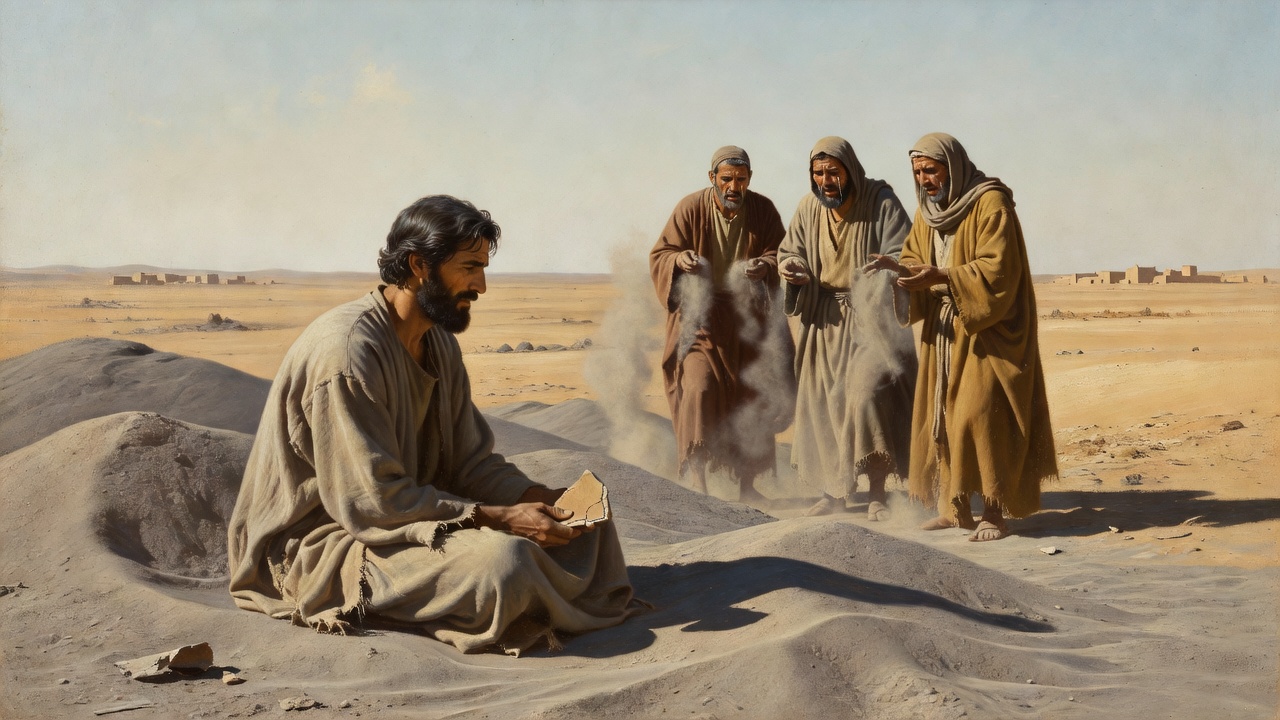
11Now when Job’s three friends heard all the evil that had befallen him, they came every one from his own place, Alphas the Themanite, and Baldad the Suhite, and Sophar the Naamathite. For they had made an appointment to come together and visit him, and comfort him. 12And when they had lifted up their eyes afar off, they knew him not, and crying out they wept, and rending their garments they sprinkled dust upon their heads towards heaven. 13And they sat with him on the ground seven days and seven nights, and no man spoke to him a word: for they saw that his grief was very great.
Did you know?
Job’s Affliction and the Arrival of His Friends
- In the Hebrew text of Job, the term translated as Satan appears with the definite article as the adversary or accuser. In this second heavenly council, the adversary argues that while Job endured the loss of his wealth and family, striking his physical flesh and bones would cause him to abandon his integrity.Sources: Satan · the Bible text itself
- Job’s companions—Eliphaz the Temanite, Bildad the Shuhite, and Zophar the Naamathite—came from distant regions associated with Arabia. Bildad's background is linked to Shuah, a son of Abraham by Keturah, while the ancient Greek Septuagint translation connects Zophar to the Mineans of southern Arabia.Sources: Bildad · Zophar · the Bible text itself
- Upon seeing Job's severe suffering, his three friends tore their garments, threw dust into the air over their heads, and sat with him on the ground in complete silence for seven days and seven nights. This shared vigil reflected ancient customs of deep mourning when sorrow was too profound for words.Sources: the Bible text itself
Notes written with AI assistance from open sources (Theographic Bible Metadata, CC BY-SA 4.0; Easton’s Bible Dictionary, public domain) and reviewed before publishing.
Credits and license for this translation
Douay-Rheims 1899
The Holy Bible in English, Douay-Rheims American Edition of 1899, translated from the Latin Vulgate
Public Domain
Language: English
Dialect: archaic American
Translation by: English College, Douai
This Public Domain Bible text is brought to you courtesy of eBible.org.
Help support free Bible access at https://eBible.org/give.php .
2022-11-03
Section headings adapted from the Berean Standard Bible (public domain); they are not part of this translation’s text.
Source: http://ebible.org/engDRA/ · eBible.org