Jeremiah 18
Douay-Rheims 1899 · Tap a verse to see its cross-references.
The Potter and the Clay
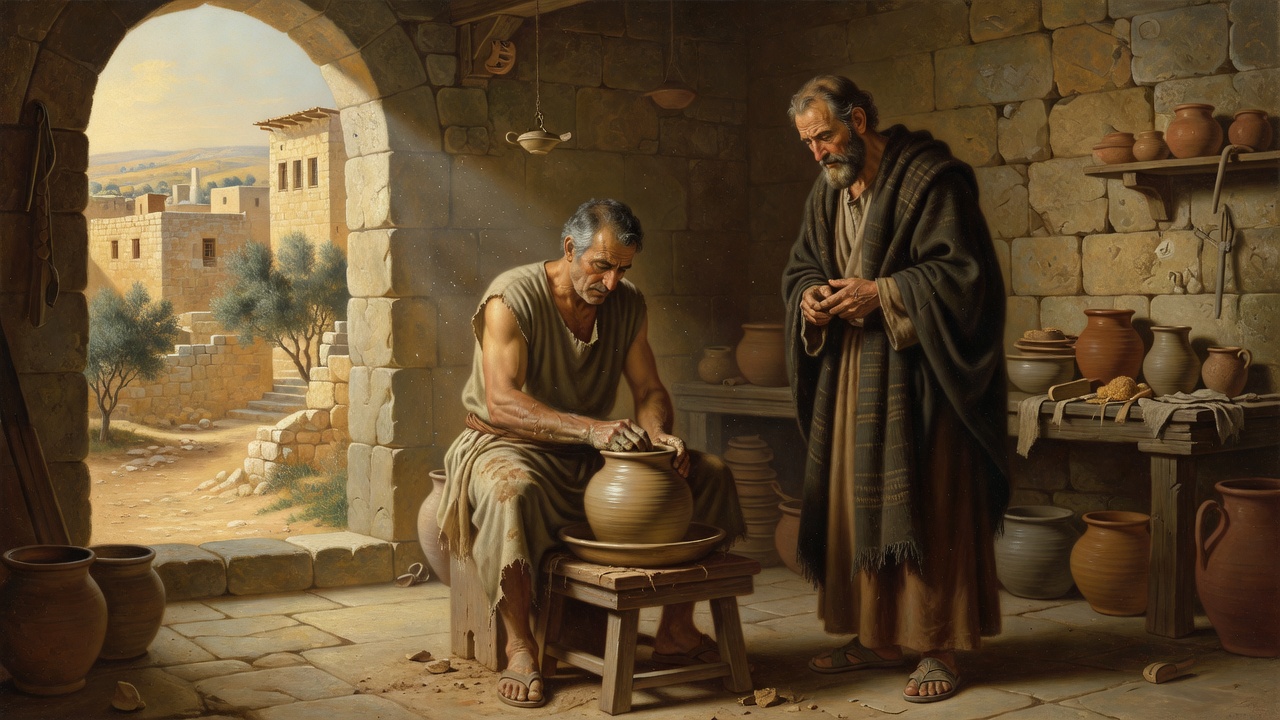
1The word that came from Jeremias to the Lord, saying: 2Arise, and go down to the potter’s house, and there thou shalt hear my words. 3And I went down into the potter’s house, and behold he was doing a work on the wheel. 4And the vessel was broken which he was making with clay with his hands: and turning he made another vessel, as it seemed good in his eyes to make it. 5Then the word of the Lord came to me, saying: 6Cannot I do with you as this potter, saith the Lord? behold as clay is in the hand of the potter, so are you in my hand, O house of Israel. 7I will suddenly speak against a nation, and against a kingdom, to root out, and to pull down, and to destroy it. 8If that nation against which I have spoken, shall repent of their evil, I also will repent of the evil that I have thought to do to them. 9And I will suddenly speak of a nation and of a kingdom, to build up and plant it. 10If it shall do evil in my sight, that it obey not my voice: I will repent of the good that I have spoken to do unto it. 11Now therefore tell the men of Juda, and the inhabitants of Jerusalem, saying: Thus saith the Lord: Behold I frame evil against you, and devise a device against you: let every man of you return from his evil way, and make ye your ways and your doings good. 12And they said: We have no hopes: for we will go after our own thoughts, and we will do every one according to the perverseness of his evil heart. 13Therefore thus saith the Lord: Ask among the nations: Who hath heard such horrible things, as the virgin of Israel hath done to excess? 14Shall now the snow of Libanus fail from the rock of the field? or can the cold waters that gush out and run down, be taken away? 15Because my people have forgotten me, sacrificing in vain, and stumbling in their ways, in ancient paths, to walk by them in a way not trodden: 16That their land might be given up to desolation, and to a perpetual hissing: every one that shall pass by it, shall be astonished, and wag his head. 17As a burning will I scatter them before the enemy: I will shew them the back, and not the face, in the day of their destruction.
Another Plot against Jeremiah
18And they said: Come, and let us invent devices against Jeremias: for the law shall not perish from the priest, nor counsel from the wise, nor the word from the prophet: come, and let us strike him with the tongue, and let us give no heed to all his words. 19Give heed to me, O Lord, and hear the voice of my adversaries. 20Shall evil be rendered for good, because they have digged a pit for my soul? Remember that I have stood in thy sight, so speak good for them, and turn away thy indignation from them. 21Therefore deliver up their children to famine, and bring them into the hands of the sword: let their wives be bereaved of children and widows: and let their husbands be slain by death: let their young men be stabbed with the sword in battle. 22Let a cry be heard out of their houses: for thou shalt bring the robber upon them suddenly: because they have digged a pit to take me, and have hid snares for my feet. 23But thou, O Lord, knowest all their counsel against me unto death: forgive not their iniquity, and let not their sin be blotted out from thy sight: let them be overthrown before thy eyes, in the time of thy wrath do thou destroy them.
Did you know?
The Potter and the Clay
- At the potter's house, Jeremiah observes an artisan reshaping a spoiled vessel on the wheel into another pot. The passage uses this craft to illustrate divine authority and conditional judgment: if a nation turns from evil after being warned, disaster is averted, but if a nation turns to evil, intended blessings are withheld.Sources: the Bible text itself
- The prophecy contrasts Israel's abandonment of God with the constancy of the natural world, asking if the snow of Lebanon ever departs from its rocky crags. The mountain range of Lebanon, whose name means white, was notable for its lofty peaks and enduring cold streams.Sources: Lebanon · the Bible text itself
- The conspiracy against Jeremiah was driven by opponents who assumed religious security, arguing that instruction would never be lost to the priest, counsel to the wise, or the divine word to the prophet. Jeremiah's message of impending ruin directly challenged this institutional confidence.Sources: Jeremiah · the Bible text itself
Notes written with AI assistance from open sources (Theographic Bible Metadata, CC BY-SA 4.0; Easton’s Bible Dictionary, public domain) and reviewed before publishing.
Places in this chapter
- Jerusalem · 31.777, 35.234 · verse 11
- Lebanon · 33.540, 35.584 · verse 14
- Mount Hermon · 33.400, 35.850 · verse 14
Only places identified with high confidence are shown (90% or more according to the scholarly sources compiled by OpenBible). Period map: DARE (Digital Atlas of the Roman Empire), CC BY 4.0; modern map: © OpenStreetMap contributors; places: OpenBible.info (CC BY 4.0).
Credits and license for this translation
Douay-Rheims 1899
The Holy Bible in English, Douay-Rheims American Edition of 1899, translated from the Latin Vulgate
Public Domain
Language: English
Dialect: archaic American
Translation by: English College, Douai
This Public Domain Bible text is brought to you courtesy of eBible.org.
Help support free Bible access at https://eBible.org/give.php .
2022-11-03
Section headings adapted from the Berean Standard Bible (public domain); they are not part of this translation’s text.
Source: http://ebible.org/engDRA/ · eBible.org